
Start selling dynamic packaging fast: build vs buy for travel agencies
Practitioner guide for travel agencies launching dynamic packaging: choose build or buy, use an integration checklist, and see partner outcomes.

Dynamic packaging travel means combining flights, hotels, transfers and activities into a single, real-time, opaque-priced package rather than selling pre-bundled inventory. For travel businesses, the practical benefit is straightforward: less capital tied up in prepaid stock, more flexibility to match client budgets, and a clear route to fatter margins than fixed commission models allow. The rest of this guide covers the technology, the build-versus-buy decision, and what to check before you commit.
TL;DR:
- Dynamic packaging reduces inventory prepayment by assembling trips only after customer commitment, enabling higher margins through opaque pricing strategies.
- The technology relies on real-time supplier integrations, a rules engine for pricing and allocation, and personalization driven by machine learning to target customer segments.
- Successful implementation requires thorough testing of supplier feeds, pricing logic, and fulfillment processes, along with compliance mapping for financial protection.
- Customer experience improves with instant confirmation and simplified, experience-focused packaging, but opacity risks causing trust issues if margins are pushed too aggressively.
- Using third-party platforms can accelerate market entry, especially for small agencies, by providing wholesale rates, automation, and branded storefronts without building from scratch.
Table of Contents
- What is dynamic packaging and how does it work?
- Technical components and architecture to evaluate
- Business benefits and commercial model
- Implementation: build versus buy, and what a rollout actually takes
- How dynamic packaging changes the customer experience
- Dynamic packaging across flights, hotels, car hire and activities
- Where dynamic packaging still runs into trouble
- What is next for dynamic packaging: AI, real-time data and beyond
- Publisher perspective: what partners found when they used our platform
- How Timeshunters gets you into dynamic packaging faster
- Sources
- FAQ
What is dynamic packaging and how does it work?
Dynamic packaging is not the same as dynamic bundling, and the distinction matters more than most operators admit. Bundling often just means a human agent manually stitching a flight and hotel together at the point of sale. True dynamic packaging combines components in real time and prices them as a single, opaque package, driven by automated recombination and conditional pricing rules rather than a person hunting through separate booking screens.
The mechanics follow a fairly consistent sequence, whichever platform sits underneath:
- Search — the system queries live supplier inventory (flights, hotel rooms, car hire, activities) against the customer’s dates, destination and budget.
- Match — the engine filters results against availability, supplier contracts and business rules (blackout dates, minimum stay, allocation limits).
- Price — a pricing layer applies markup, currency conversion and rounding logic to produce one package figure, deliberately obscuring the individual component costs.
- Present — the customer or agent sees a finished package, often with two or three tiers (standard, upgraded, premium).
- Confirm — on selection, the platform books each supplier component and issues confirmations, ideally within seconds rather than hours.
The component set is usually flights, hotels, airport transfers, activities and travel insurance, though the exact mix depends on the market. A ski specialist might add equipment hire; a cruise-focused agency might substitute shore excursions. What holds the whole thing together is the pricing engine, because without automated, rule-driven pricing you are simply looking at a fancier version of manual bundling.
Technical components and architecture to evaluate
Whether you are assessing a vendor or scoping an in-house build, the architecture tends to break into four layers. Get any one of them wrong and the package either fails to price competitively or fails to book at all.
- Supplier integrations — GDS connections, NDC feeds, bedbank APIs and direct hotel or activity feeds. Breadth (many suppliers, thin coverage each) suits mass-market leisure; depth (fewer suppliers, richer contract terms) suits specialists who need better allocation and net rates.
- Packaging and rule engine — the component that actually assembles the package, applies pricing logic, checks allocation limits, and triggers ticketing. Architecture descriptions from implementation specialists like IBS place this at the centre of the whole system, with business rules and personalisation sitting on top of it.
- Personalisation and machine learning — recommendation logic, customer segmentation and revenue management working together to surface offers matched to a traveller’s likely spend rather than the cheapest available combination.
- Operational features — instant confirmation, multi-currency checkout, and automated voucher or ticket issuing. Vendor platforms such as Travix Lab’s dynamic packaging engine list these as baseline capabilities rather than premium extras.
Pro Tip: When comparing platforms, ask specifically how the rule engine handles price allocation and rounding across currencies. A system that gets this wrong either erodes margin silently or produces prices that look wrong to the customer.
Personalisation is where the real commercial upside sits. ML-driven segmentation lets a system price the same package differently depending on signals like booking lead time, device, or past spend, which is a meaningfully different proposition to a flat markup applied across the board.
Business benefits and commercial model
The commercial case for dynamic packaging rests on one structural shift: you stop prepaying for inventory you might not sell. Traditional package holidays require operators to commit to room and seat allocations months ahead, carrying the financial exposure if demand falls short. Dynamic packaging assembles the trip only when a customer commits, which reduces the need to prepay inventory and can increase margins by letting operators sell at package-only rates that are not directly comparable to any single component’s advertised price.
That opacity is not a trick, it is the business model. Because the customer sees one figure rather than itemised costs, operators can apply markup strategies that would look unreasonable if disclosed line by line, while still landing on a total that beats booking each piece separately.
Where the margin usually lands: retail teams capture the customer-facing markup, wholesale or contracting teams capture better net rates through volume commitments, and revenue management captures the yield from dynamic pricing adjusted to demand and lead time. Ancillary add-ons, such as insurance, airport lounge access or excursion bolt-ons, sit on top of all three as near-pure margin.
Businesses that treat these as three separate levers, rather than one blended margin, tend to extract considerably more value from the same booking volume.
Implementation: build versus buy, and what a rollout actually takes
Building an in-house packaging engine gives full control over supplier relationships and pricing logic, but it is a genuine engineering commitment: expect ongoing investment in API maintenance as suppliers change their feeds, plus a dedicated team to manage rule changes. Buying or integrating a vendor platform gets you to market faster and shifts feed maintenance onto the vendor, at the cost of some flexibility over rule design and margin structure.
Most small and mid-sized agencies find buying makes more sense, simply because supplier integration work never stops. The moment a bedbank changes its API, someone has to fix it, and that someone is either your engineer or the vendor’s.
Before going live, work through this checklist:
- Supplier feed testing — confirm live availability and pricing return correctly across every connected supplier, not just the largest ones.
- Pricing and markup rules — verify rounding, currency conversion and allocation logic produce sensible, profitable prices at the edges of your ranges, not just the middle.
- Confirmation and fulfilment — test that a booking actually issues correct tickets or vouchers to each supplier, since a ticket-issuing approach that treats each package as a discrete transaction simplifies reconciliation later.
- Financial protection mapping — confirm how ATOL or equivalent protection applies to the finished package, not just its individual components.
- Reconciliation testing — run a full booking-to-payment-to-supplier-settlement cycle before opening to real customers.
| Deployment stage | Typical focus | Common pitfall |
|---|---|---|
| Feed integration | Connecting GDS, NDC and bedbank sources | Treating a supplier’s sandbox environment as production-ready without a final live test |
| Rule configuration | Setting markup, allocation and rounding logic | Applying one markup rule globally instead of tiering by route or season |
| Fulfilment testing | Ticket and voucher issuing per component | Assuming confirmation speed in testing matches peak-load reality |
| Financial protection | Mapping ATOL or equivalent cover to packages | Leaving protection scoped to flights only, missing the accommodation element |
Resourcing tends to need input from engineering (feed and rule work), commercial (pricing strategy) and operations (fulfilment and customer service), even when the platform itself is bought rather than built.
How dynamic packaging changes the customer experience
Customers rarely think in terms of “components”. They think in terms of one trip, one price, one confirmation email. Dynamic packaging matches that mental model far better than a build-your-own-itinerary tool that forces the customer to price flights, hotels and transfers separately and then add it all up themselves.

The satisfaction gain is largely about reduced decision fatigue. Presenting two or three finished packages, rather than dozens of raw component choices, narrows the decision to something manageable. That said, opacity cuts both ways: a customer who later discovers they could have booked the same flight cheaper alone may feel misled, even though the package price reflected genuine value across the whole trip.
Speed matters just as much as presentation. A package that confirms in seconds rather than requiring a follow-up email feels categorically different to the customer than one that leaves them waiting to find out if their booking actually went through. Personalisation adds a further layer: a returning customer who consistently books premium transfers or specific room types should see packages reflecting that pattern, not a generic starting point every time. When it works well, the customer barely notices the technology at all, which is precisely the point.
Dynamic packaging across flights, hotels, car hire and activities
Dynamic packaging behaves differently depending on which components dominate the trip, and the differences are worth understanding before you configure pricing rules.
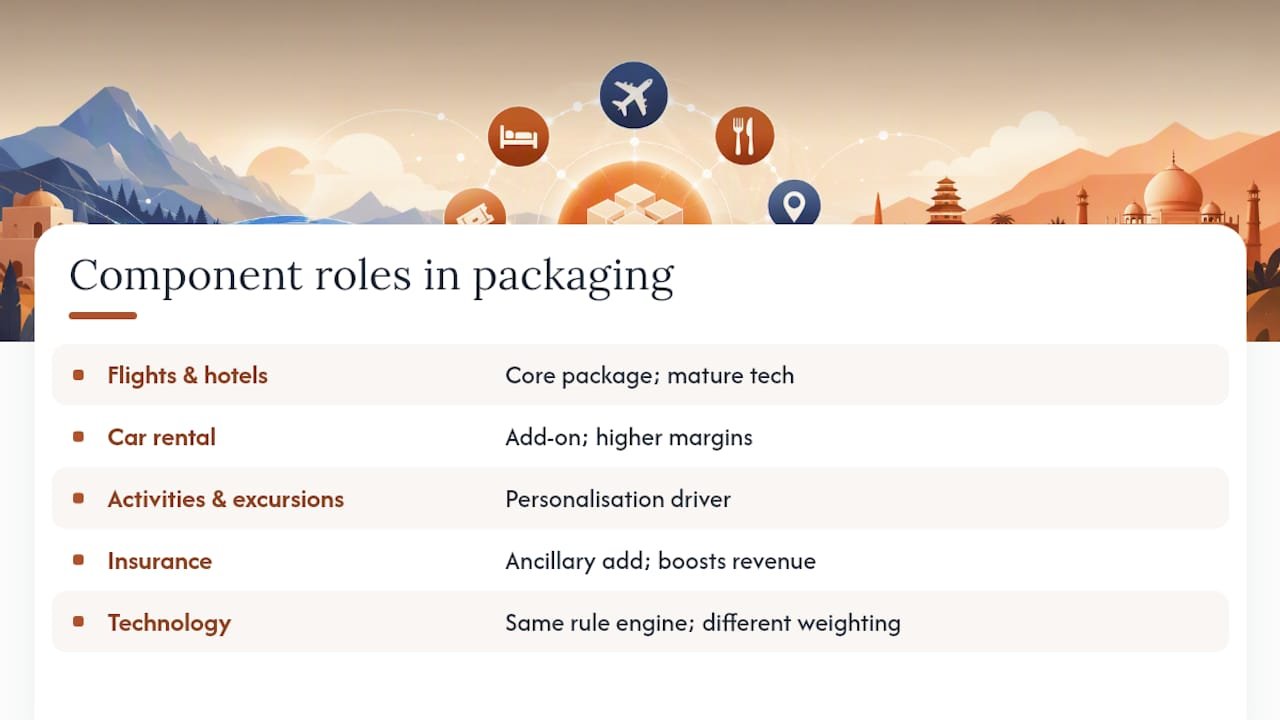
Flights and hotels form the classic core package, and it is where the technology is most mature. A flight-plus-hotel package can flex the hotel choice against seat availability in real time, something a static brochure package could never do.
Car rental tends to sit as an add-on rather than a core driver of the package price, but it is disproportionately useful for margin because rental margins are typically higher than flight margins and customers rarely price-check the rental component separately once it is bundled.
Activities and excursions are where personalisation shows its value most clearly. A family package and a couples package built from the same flight and hotel inventory can present entirely different activity bolt-ons, and this is increasingly where operators differentiate on experience rather than price.
Insurance rarely gets discussed as a “segment”, but it behaves the same way technically: an automatically included or easily added component that boosts ancillary revenue without complicating the core search.
The common thread is that every segment benefits from the same underlying rule engine, just with different weighting. A ski specialist tunes activity and equipment bolt-ons; a business-travel agency tunes flight flexibility and hotel loyalty tie-ins. The technology does not change, only the configuration.
Where dynamic packaging still runs into trouble
Supplier availability is the most persistent limitation. A packaging engine is only as good as the feeds it can query, and gaps in bedbank or NDC coverage mean some destinations or hotel categories simply will not price competitively, whatever the rule engine does.
Pricing complexity is the second recurring headache. Rounding logic, currency conversion and markup tiering sound simple in theory, but a rule engine handling dozens of supplier currencies and contract types can produce prices that are technically correct yet commercially odd, such as a package that costs more with a “discount” applied than without it, because a rounding rule triggered unexpectedly. Testing at the edges of pricing ranges, not just typical bookings, catches most of this before customers do.
Regulatory issues sit underneath both. Financial protection rules, particularly ATOL cover in the UK, were designed around identifiable package holidays, and mapping that protection correctly onto a dynamically assembled bundle takes deliberate configuration rather than an assumption that “the platform handles it”. Getting this wrong is not a minor technical bug, it is a compliance failure with direct consumer protection consequences.
There is also a subtler risk: over-reliance on opaque pricing can erode customer trust if margins are pushed too aggressively, particularly in markets where price comparison tools make component costs easy to check independently.
What is next for dynamic packaging: AI, real-time data and beyond
Machine learning is already reshaping how packages get priced and presented, and the direction of travel is towards finer segmentation rather than broader automation. Combining revenue management with ML-driven personalisation lets platforms target offers by likely willingness to pay rather than a single blended price for every customer searching the same route.
Real-time data use is deepening beyond simple availability checks. Expect pricing engines to increasingly factor in live demand signals, competitor pricing movements and even weather or event data for destination-specific packages, rather than relying purely on static allocation and markup tables.
Blockchain gets floated regularly as a solution to supplier reconciliation and fraud reduction, though adoption in mainstream dynamic packaging remains limited and largely experimental rather than proven at scale. Where it might eventually earn its place is in simplifying multi-supplier settlement, since a dynamically assembled package often involves reconciling payments across several unrelated suppliers, and that back-office friction is a genuine, unglamorous cost centre that better data infrastructure could meaningfully reduce.
The traveller-facing trend running through all of this is a shift from price-led shopping towards experience-led shopping, with dynamic packaging providing the flexibility to support it without operators needing to guess demand months in advance.
Publisher perspective: what partners found when they used our platform
Access to wholesale rates changes the packaging conversation for smaller operators. Partners running a white-label agency through Timeshunters get automated booking management sitting behind their own branded storefront, which removes most of the manual reconciliation work that sinks solo operators trying to run dynamic packaging by hand.
The clearest gains show up in commission structure. One partner reported average income per booking rising significantly, largely because automation freed up time to sell more packages rather than chase confirmations. That outcome favours partners who already have an audience or client base; those starting from zero clients see slower initial traction, since the technology accelerates selling, it does not manufacture demand from nothing.
— Sam
How Timeshunters gets you into dynamic packaging faster
Building a packaging engine and negotiating supplier contracts from scratch takes most agencies well over a year before they see a live booking. A specialized platform can give you access to wholesale hotel, cruise and tour inventory with financial protection already in place, automated booking management, and a branded storefront that lets you start selling dynamically packaged trips under your own name almost immediately.
That commission structure is what let one partner move their average booking value significantly, without adding engineering headcount or negotiating supplier contracts themselves.
If you already have an audience, clients, or industry contacts and want a faster route into dynamic packaging than a from-scratch build, request access to the Timeshunters partner platform and see what a live sandbox booking looks like under your own brand.
Sources
- Dynamic packaging — Wikipedia
- Dynamic Packaging: An implementation approach with machine learning and personalisation — IBS
- Dynamic Packaging Engine — Travix Lab
- What Is Dynamic Packaging and Why It Matters for Travel Companies? — Resabee
FAQ
Who uses dynamic packaging?
Tour operators, travel agencies, online travel agencies and white-label platforms like Timeshunters use dynamic packaging, mainly to avoid prepaying for inventory while still offering flexible, personalised trips.
What is the best booking software for travel agents?
There is no single best system, since the right choice depends on whether an agent needs broad supplier reach, deep contract control, or a ready-made platform with wholesale rates and automated booking management already built in.
Is it cheaper to use a travel agent or book online?
It depends on the trip: dynamically packaged deals through an agent can beat separate self-booked components because operators access wholesale rates and package-only pricing that individual travellers cannot get directly.
Who are the top travel agents in the UK?
Rankings vary by year and criteria, and no single authoritative list covers every UK agent, so it is more useful to compare agents on their access to wholesale rates, financial protection and commission transparency than on a generic ranking.
How do I start offering dynamic packaging as a small agency?
The fastest route for most small agencies is integrating an existing platform rather than building an engine from scratch, since supplier feed maintenance alone requires ongoing engineering resource that most small teams cannot justify.