
3 Travel Trust Account Checks UK Operators Must Do This Week
A concise legal and accounting checklist for UK travel operators: trust deed and trustee checks, ATOL two business day placement, TOMS timing, and three...

A travel trust account is a ring-fenced bank account, run by an independent trustee, that holds customer money separately from an operator’s own funds until the holiday is delivered. Under Regulation 23 of the Package Travel and Linked Travel Arrangements Regulations 2018, this is one of the recognised ways UK organisers protect customer payments. If you’re not certain your money is held this way, your first move this week is a call to your accountant or trustee provider to check exactly what protection model you’re running.
TL;DR:
- Only trust accounts managed by independent trustees based in the UK or EU meet legal requirements and provide genuine protection by restricting operator access until specified conditions are fulfilled.
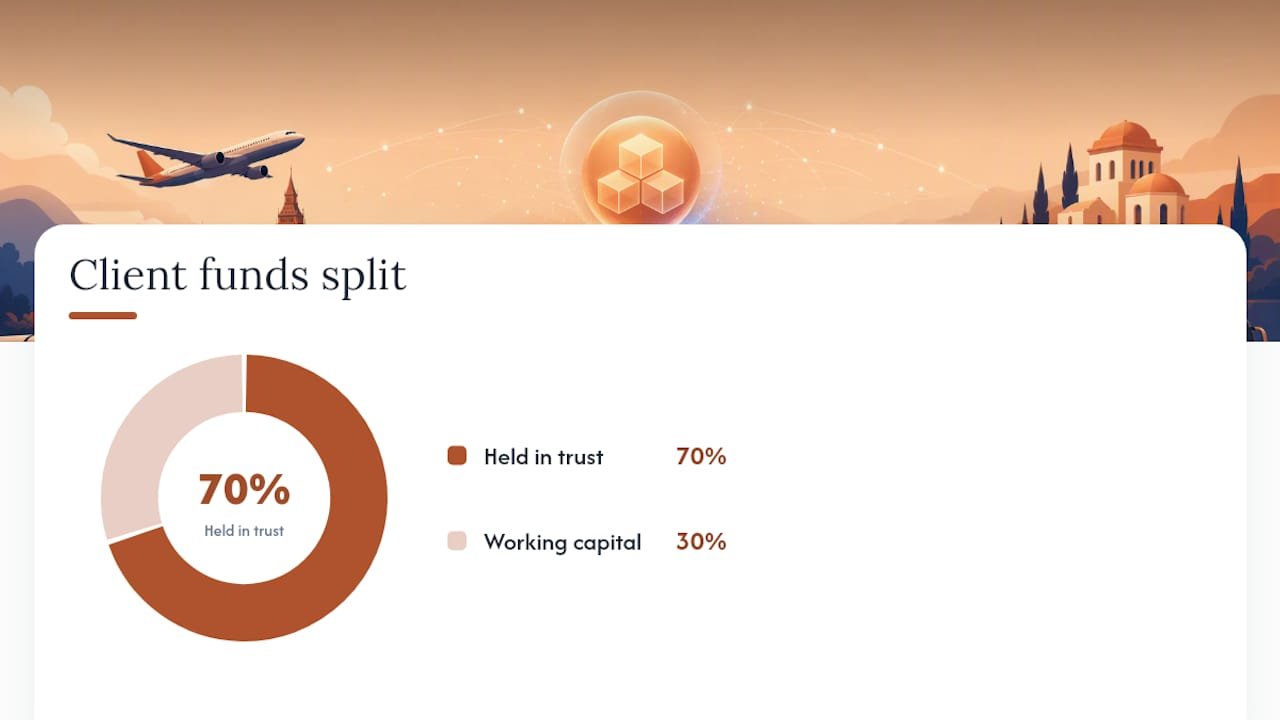
- Most trust arrangements retain around 70% of customer funds in escrow, with the remaining portion supporting working capital, which should be closely monitored through regular reconciliation.
- Trust funds are liabilities, not income, affecting VAT and TOMS calculations, requiring weekly reconciliation and precise timing of fund releases to avoid regulatory issues.
- Setting up a trust account takes weeks, involving careful selection of protection model, drafting a trust deed, appointing an experienced trustee, and establishing rigorous reconciliation routines before operational use.
- Alternatives like bonding or escrow can suit smaller operators with tight cash flow, but they generally offer less transparency and may involve higher costs compared to a formal trust account.
Table of Contents
- What is a travel trust account and how does it work?
- What UK law says about travel trusts and ATOL
- How trust accounts affect VAT, TOMS and cash flow
- How do you set up a travel trust account?
- Is a trust account the right protection model for you?
- Where a white-label travel platform fits alongside trust obligations
- What should you check about your travel trust account this week?
- Sources
- FAQ
What is a travel trust account and how does it work?
A trust account works because the operator gives up direct control of client money the moment it lands. An independent trustee, usually a solicitor, accountant, or specialist trust provider, holds the funds under a legal agreement called a trust deed. That deed sets out exactly when money can move: typically on departure, on final invoice, or against documented proof that suppliers have been paid.
The mechanics matter more than the label. A bank account named “client trust” means nothing if the organiser can still withdraw at will. A genuine trust restricts access until the release conditions in the deed are met.
A typical booking flow looks like this:
- Customer pays a deposit or balance into the trust account, not the operator’s trading account.
- The trustee logs the receipt against that specific booking reference.
- The organiser submits a payment request, usually backed by supplier invoices or proof of departure.
- The trustee releases funds once the conditions in the deed are satisfied, often a few days before or after travel.
- Commission or margin is released to the operator only once it has genuinely crystallised.
The organiser still carries real responsibilities: submitting accurate release requests, keeping supplier documentation current, and reporting outstanding client liabilities to the trustee on schedule.
Pro Tip: Ask your trustee for a monthly statement showing total funds held against total outstanding bookings. If those two figures don’t match, you’ve found a reconciliation problem before it becomes a regulatory one.
What UK law says about travel trusts and ATOL
Regulation 23 of the Package Travel and Linked Travel Arrangements Regulations 2018 is the legal foundation. It requires that where an organiser relies on a trust arrangement, customer money must be held by an independent trustee based in the UK or an EU member state. The organiser pays the administration costs of running the trust, and any interest earned belongs to the organiser rather than the trustee and is payable on demand.
For businesses selling flight-inclusive packages, the Civil Aviation Authority layers its own ATOL requirements on top of PTR 2018. ATOL trust rules generally require that money for licensable bookings be placed into a trustee-managed account within two business days of receipt. Many escrow arrangements hold around 70% of client funds in trust, according to guidance from the Air Travel Trust and CAA on trust and escrow structures, while the remainder can support working capital, subject to the trustee’s approval.
There’s also a lighter-touch option worth knowing about: the trigger escrow. Rather than holding funds continuously, a trigger escrow sits dormant until a financial covenant, such as a minimum cash balance or a cash-to-client-money ratio, is breached. Only then does money start flowing into the trustee account. This suits established operators with strong balance sheets who want protection to activate automatically if their financial position weakens, without tying up cash every day of the year.
Key regulatory facts to hold in your head:
- Regulation 23 mandates trustee independence and UK/EU domicile for the trust.
- The CAA’s two-business-day placement rule applies to licensable ATOL bookings.
- Escrow models commonly retain roughly 70% of client funds, per current ATOL guidance.
- On insolvency, trust funds tied to ATOL bookings become the property of the Air Travel Trust, which applies them directly to travellers’ claims.
Regulators tend to insist on a trust, or an equivalent form of financial protection like bonding or insurance, whenever an organiser takes payment for a package holiday before delivering it. Where a business sells non-flight packages or acts purely as an agent passing money straight to a principal, alternatives such as bonding may satisfy PTR 2018 without the full trust structure. The right call depends on your booking model, so this is genuinely a conversation for a travel-sector adviser rather than a guess.
How trust accounts affect VAT, TOMS and cash flow
Client money sitting in a trust account is a liability, not revenue, until the trustee releases it under the deed’s conditions. Treating a trust balance as available income is one of the most common and costly mistakes travel businesses make, and it distorts everything from management accounts to your VAT position.
That distortion gets sharper under the Tour Operators’ Margin Scheme. TOMS calculates VAT on the margin between what you charge the customer and what you pay suppliers, but that margin only crystallises at specific points, usually departure or final invoicing. If your trust releases don’t line up with when TOMS says a margin has actually been earned, you risk misstating VAT and drawing HMRC attention.
Three practical steps keep this under control:
- Reconcile weekly, not monthly. Match total funds held in trust against your liability ledger and the sum of every individual booking balance. A mismatch here is usually the first sign something has gone wrong.
- Only sweep commission once it crystallises. Don’t move margin into your operating account on the strength of a signed booking; wait until the supplier contract confirms it’s earned.
- Align trust release dates with your TOMS reporting cycle. If departures cluster around VAT quarter-ends, build that into your forecasting rather than discovering it during the return.
Trusts also create a genuine cash-flow constraint. Money you’d otherwise use to fund operations, pay staff, or invest in marketing is locked away until departure. Operators mitigate this with a short-term revolving credit facility, negotiated supplier payment terms that push settlement closer to the trust release date, or targeted supplier failure insurance rather than relying on client prepayments to keep the lights on.
Pro Tip: Build a rolling 13-week cash-flow forecast that treats trust-held funds as untouchable from day one. Businesses that model cash flow around what’s actually free tend to spot funding gaps months before they bite.
How do you set up a travel trust account?
Setting one up properly takes weeks, not days, and rushing the trustee selection is where most problems start later. Work through it in this order:
- Choose your protection model. Decide between a full trust, a partial escrow (commonly around 70%), or a trigger escrow, based on your booking mix, cash position, and appetite for administrative overhead.
- Consult a specialist before drafting anything. A travel-sector accountant or trust adviser will flag issues specific to your business model that generic legal templates miss.
- Draft and agree the trust deed. This document defines release conditions, trustee duties, reporting frequency, and what happens to interest and administration costs.
- Appoint an independent trustee. This can be a solicitor, a chartered accountant, or a specialist trustee firm with travel-industry experience.
- Open the dedicated trust bank account and agree the reporting format the trustee expects, usually a booking-level ledger updated at least weekly.
- Integrate your payment flows. Connect your booking system, merchant acquirer, and payment request process so client money routes into the trust account automatically rather than through manual transfers.
- Set your reconciliation and audit routine before you take your first booking, not after.
Once running, the ongoing discipline matters as much as the setup:
- Weekly (daily in peak season) three-way reconciliation between cash held, the liability ledger, and per-booking balances.
- A departures ledger tying each booking to its supplier settlement date, which is widely regarded as the single most effective control against supplier payment failures.
- Documented payment requests to the trustee, each backed by supplier invoices or departure confirmation.
- Regular reporting to the trustee at whatever cadence the deed specifies, often monthly.
A practical checklist approach to organising trip-related settlements can help structure these routines, even where the specific tools differ from the UK market.
Is a trust account the right protection model for you?
A trust account buys you three things bonding and insurance struggles to match: visible consumer confidence, a robust regulatory position, and often better terms from suppliers and merchant acquirers who see ring-fenced client money as lower risk. Customers researching a small operator can point to a named trustee as proof their deposit isn’t sitting in a general business account.
The cost is liquidity. Locking a large share of incoming cash away for weeks or months is a real constraint for smaller operators running tight margins, and running the trustee relationship, reconciliations, and reporting adds administrative overhead that a two-person agency can find genuinely heavy.
Alternatives exist, and each has trade-offs worth weighing against a trust:
- Bonding through a recognised scheme can satisfy PTR 2018 for some business models and doesn’t lock up working capital the same way, but it typically costs more as turnover grows and offers less transparency to customers.
- Financial failure insurance (SFI) protects against a specific insolvency event rather than holding funds continuously, which suits operators with strong cash management but thinner margins for trust administration.
- Escrow arrangements, including trigger escrows, split the difference: less cash locked away permanently, but more complex covenant monitoring.
Work through a short checklist before deciding: what’s your booking model (flight-inclusive, land-only, agency), how much of your revenue is locked in ticketing versus flexible packages, what’s your cash runway without access to client deposits, and how favourable are your supplier payment terms? Those four answers usually point clearly towards one model over the others.
Where a white-label travel platform fits alongside trust obligations
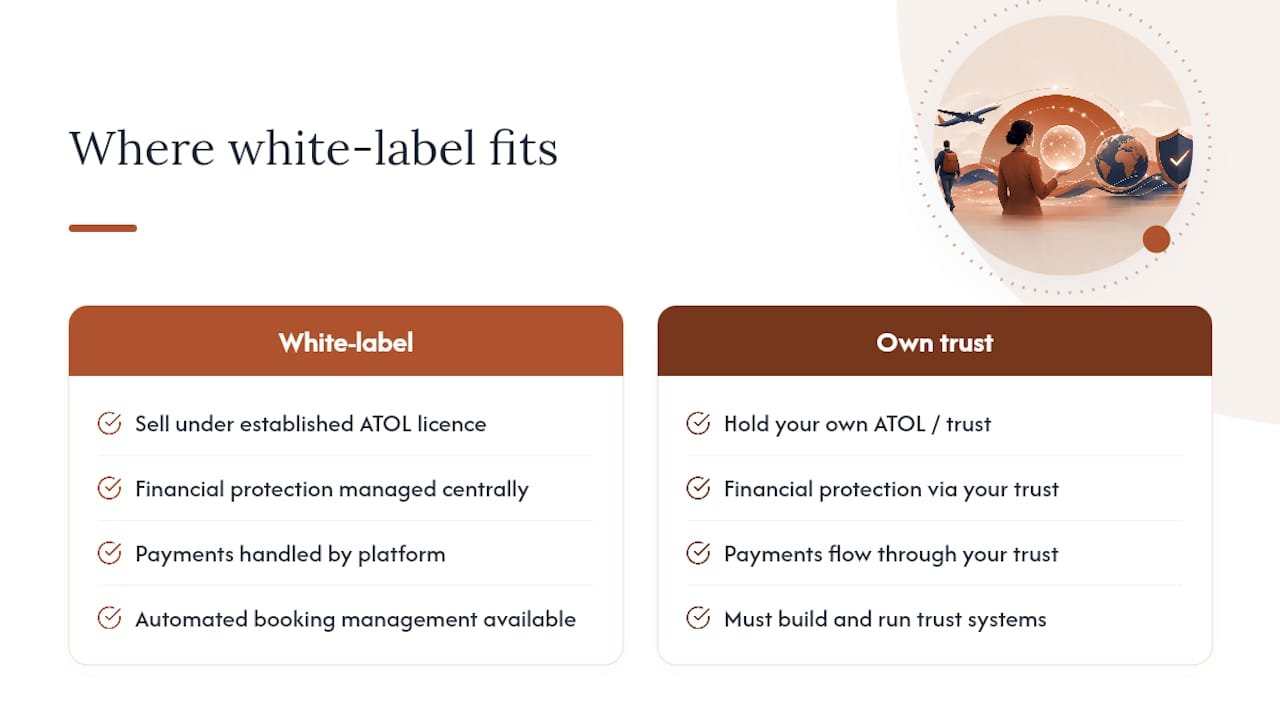
Some travel entrepreneurs sidestep the trust-setup burden entirely by trading under an established ATOL licence rather than holding one themselves. Some travel platforms work this way: partners sell packages under an established ATOL-protected licence, with payments and financial protection managed centrally rather than through a trust the partner has to build and run.
That structure changes the reconciliation question. Automated booking management and wholesale rate access reduce the manual documentation burden that usually falls on smaller operators managing their own trust reporting.
This is illustrative of how the partner model interacts with financial protection requirements, not a substitute for your own legal or accounting advice, and partners should verify current terms directly with their platform provider before relying on them.
What should you check about your travel trust account this week?
If you take one thing from this, it’s that “we have a trust account” and “we have genuine financial protection” are not automatically the same statement. Check three things immediately: are customer funds actually segregated in a trustee-controlled account, is that trustee genuinely independent of your business, and does your reconciliation show funds held matching your booking liabilities right now, today.
If any answer is unclear, call a trustee specialist or a travel-sector accountant this week, not next quarter. If you’re selling flight-inclusive packages, loop in an ATOL adviser too. Get sign-off from whoever owns financial decisions in your business before peak booking season arrives, and build a short-term cash plan that assumes trust funds stay locked until departure.
— Sam
Sources
- Package Travel and Linked Travel Arrangements Regulations 2018 (Regulation 23)
- LAS Accounting — Client trust account UK for travel businesses
- CAA — About the Air Travel Trust
FAQ
Can I open a trust account in the UK?
Yes. Any organiser can set one up by drafting a trust deed and appointing an independent trustee based in the UK or an EU member state, as required under Regulation 23 of the Package Travel and Linked Travel Arrangements Regulations 2018.
How much does PTS membership cost?
Membership and administration costs for trustee schemes vary by provider and business turnover, and no single published figure applies across the market, so get a quote directly from the trustee or specialist firm you’re considering.
What is a travel trust?
A travel trust is a ring-fenced account, controlled by an independent trustee rather than the operator, that holds customer payments separately until the holiday is delivered or the deed’s release conditions are met.
Which bank is best for trust accounts in the UK?
There’s no single “best” bank; the right choice depends on your trustee provider’s preferred banking partners and the reporting integration they offer, so ask your trustee firm which institutions they work with before setting up the account.