
Hoteliers: Bedbanks vs White Label, 70% Partner Commission Explained
Operator-focused primer on hotel bedbanks: contracts, APIs, pricing and safeguards, plus a white label alternative that offers 70% partner commission for...

A bedbank is a B2B wholesale distribution platform that contracts hotel inventory at net rates and resells it through a single connection to thousands of travel sellers. It suits hoteliers who want broad reach without chasing individual OTA and tour operator contracts, or who need a reliable outlet for rooms that would otherwise sit empty close to arrival. It is less useful if your priority is protecting rate integrity on your own branded channels.
TL;DR:
- Using a bedbank can expand a hotel’s reach to international tour operators and travel agencies without multiple contracts, but it may dilute rate integrity on direct channels.
- The typical contract involves net rate agreements with options for guaranteed allotments or on-request availability, with clear settlement terms crucial to avoid payment delays.
- Connectivity options include real-time API integration for automation and speed, but slow or unreliable responses increase overbooking and rate leakage risks.
- Testing a small bedbank allotment for 60 to 90 days helps assess impact on profit margins, cancellation rates, and inventory synchronization before scaling.
- Relying solely on bedbanks is risky; they are best used as part of a diversified distribution strategy to avoid margin erosion and overdependence on wholesale volume.
Table of Contents
- How hotel bedbanks work step by step
- What benefits and trade-offs should hoteliers expect?
- Which are the major hotel bedbanks?
- How do bedbank commercial models actually work?
- What technology do you need to connect with a bedbank?
- What are the main risks and contract safeguards?
- How do you decide whether to use a bedbank and how do you scale it?
- Is there an alternative to traditional bedbank contracting?
- What most hoteliers get wrong about bedbank strategy
- Want wholesale hotel access without the bedbank contract?
- Sources
How hotel bedbanks work step by step
A bedbank sits between the hotel and a huge network of resellers: online travel agents, tour operators, and travel management companies. The hotel signs one contract with the bedbank instead of dozens with individual sellers, and that single agreement becomes the gateway to a distribution network the property could never build alone.
The mechanics follow a fairly consistent pattern across the industry:
- Contracting. The hotel agrees terms with the bedbank, choosing between guaranteed allotments (a fixed block of rooms held regardless of demand), on-request availability (checked live each time), or dynamic net rates that flex with occupancy.
- Distribution. The bedbank pushes that inventory to its reseller network, who apply their own markup and sell under their own brand. The hotel rarely knows which retail site the guest actually booked through.
- Booking flow. A reseller checks availability, confirms the rate through a checkrate call, submits the booking, and receives confirmation, all typically within seconds when connections run through an API rather than a manual portal.
- Payment and settlement. Some bedbanks operate on a merchant model, collecting guest payment upfront and remitting the net rate to the hotel later. Others run on commission, where the hotel takes payment directly and pays a percentage back.
Bedbanks provide a single integration point that lets hoteliers connect once and reach thousands of B2B sellers, cutting the operational load of maintaining separate contracts and rate loads for every wholesale partner.
What benefits and trade-offs should hoteliers expect?
The clearest upside is reach. One connection to a bedbank can put a property in front of tour operators and agencies across markets it has no direct sales presence in, without hiring a single extra salesperson.
Booking behaviour through bedbanks also differs from direct bookings in ways worth planning around:
-
Lead times tend to run longer, particularly for packaged holiday inventory booked months ahead.
-
Length of stay often skews longer too, especially on leisure-heavy routes.
-
Cancellation patterns vary by contract type. On-request bookings usually carry less risk than guaranteed allotments, which can go unsold if demand doesn’t materialise.
-
Channel management gets simpler, since one bedbank relationship can replace dozens of smaller wholesale contracts.
Pro Tip: *Track your ADR delta between bedbank-sourced bookings and direct bookings monthly.
The trade-off is margin pressure. Net rates leave less room than direct sales, and unsold guaranteed allotments tie up rooms that could have gone to higher-yield channels. HBX Group’s own commentary makes the point that relying on bedbanks alone is not sufficient for sustainable, profitable distribution, and that bedbank volume works best as one piece of a wider channel mix rather than the whole strategy.
Which are the major hotel bedbanks?
The bedbank market has a handful of global heavyweights and a longer tail of regional specialists, each with different strengths worth checking before you sign anything.
- Hotelbeds operates as one of the largest global bedbanks, with extensive API documentation and connectivity built for high-volume automated distribution.
- WebBeds competes at similar global scale, distributing into a broad international reseller base.
- HBX Group operates as a wider distribution and technology group in this space, positioning bedbank inventory as one part of a connected travel technology ecosystem rather than a standalone product.
- HotelsPro focuses on wholesale hotel content with particular strength in specific regional markets.
- Travco runs as a regional wholesaler with strong positioning in the Middle East and parts of Europe.
- Restel serves as another regionally focused wholesale distributor within the European bedbank landscape.
- Yalago operates as a smaller wholesale distributor within the same net-rate model, distributing to a narrower reseller base.
Industry summaries consistently cite Hotelbeds and WebBeds among the largest global bedbanks, with regional players filling in specific geographic gaps. Before signing with any of them, confirm three things directly: what connectivity method they support (API versus portal), how and when they settle payment, and which reseller markets they actually distribute into. A “global” bedbank still concentrates its reseller strength unevenly by region, and that unevenness matters more to your occupancy forecast than the brand name on the contract.
How do bedbank commercial models actually work?
Net rate contracting underpins almost every bedbank relationship. The hotel sets a wholesale net price, and the reseller adds a retail markup on top when selling to the end traveller. That markup logic isn’t unique to hotel distribution either; the same margin mechanics appear across reseller pricing models more broadly, where the platform’s take and the seller’s markup both have to clear before anyone profits.
A few structural choices determine who carries the risk on any given booking:
- Merchant model: the bedbank or reseller collects payment upfront and typically absorbs cancellation risk, since the guest paid them directly.
- Commission model: the hotel collects payment at the property and pays commission afterwards, keeping more control but more admin.
- Allotments and release periods: unsold rooms in a guaranteed block usually revert to the hotel automatically at a set release date, often 24 to 72 hours before arrival.
- Net rates versus reseller markup, as described above, directly shapes how much margin actually reaches the property versus the distribution chain.
Insist on clear settlement timelines in writing, and never accept a contract that leaves release periods vague. An unclear release clause is the single most common source of unsold, unrecoverable inventory in bedbank deals.
What technology do you need to connect with a bedbank?
Two connection methods dominate. Real-time API integration lets availability, rates, and bookings sync automatically between your property management system and the bedbank, typically within seconds. Portal or channel-manager workflows are slower and more manual, better suited to smaller properties without dedicated distribution staff.
Four technical concepts matter most when you’re evaluating any bedbank’s connectivity:
- Availability checks confirm whether rooms exist for the requested dates before a booking attempt starts.
- CheckRate calls verify the current net rate is still valid at the moment of booking, since rates can shift between search and purchase.
- Booking confirmation locks the reservation and returns a confirmation reference, ideally within the same session.
- Inventory count messages update room availability across every connected channel to prevent overselling.
Developer documentation from providers such as Hotelbeds shows the standard API operations behind availability, checkrate and booking calls, and similar structures appear across the industry. Inventory feeds follow related standards too. Google’s own ARI inventory message specification shows how InvCount and CountType fields keep room counts accurate across channels, a detail worth showing your PMS vendor directly.
Pro Tip: Ask any bedbank candidate for their API uptime record and average checkrate response time before signing. A slow or unreliable checkrate call is what causes overbookings, not a bad allotment forecast.
What are the main risks and contract safeguards?
Rate leakage is the risk that comes up most often, and it happens when a closed net rate meant only for B2B resale ends up visible on a public consumer site. It usually traces back to a reseller redistributing inventory further down the chain than the original contract allowed.
A short list of protections is worth insisting on before signing anything:
- Explicit distribution limits naming exactly who the bedbank may resell to.
- Audit rights letting you check where your rates actually appear online.
- Clear cancellation and refund liability, spelled out per contract type, not left to “standard terms.”
- Credit and fraud protections, particularly on merchant-model deals where a third party holds guest payment.
- A defined release period with no ambiguity about timing.
| Risk | Typical cause | Contractual safeguard |
|---|---|---|
| Rate leakage | Reseller redistributes beyond agreed network | Distribution limit clause plus audit rights |
| Unsold allotments | Guaranteed blocks with no release trigger | Fixed release window (24 to 72 hours) |
| Payment delay | Unclear merchant settlement terms | Written settlement schedule with penalty clause |
| Overbooking | Slow or failed inventory sync | Real-time API connectivity with tested checkrate response |
Mews’s guidance on this is blunt: contract language restricting redistribution and granting audit rights is the most reliable legal control against public exposure of your net rates. Get it in writing before you sign, not after you’ve spotted your rate on a site you’ve never heard of.
How do you decide whether to use a bedbank and how do you scale it?
Start small. Test a limited allotment or a short release window with one bedbank before committing wider inventory, and watch three numbers closely: the ADR delta against direct bookings, the cancellation rate on that specific contract type, and how much of your total channel cost that bedbank now represents.
A practical rollout tends to follow this sequence:
- Assess fit based on your property mix, seasonality, and how much margin erosion you can genuinely tolerate before it hurts profitability.
- Run a small test allotment for 60 to 90 days rather than committing your full unsold inventory upfront.
- Track KPIs weekly, not monthly, during the test phase, since early cancellation spikes are easy to miss otherwise.
- Reconcile inventory and payments on a fixed schedule to catch sync errors before they become overbookings.
- Scale gradually, segmenting inventory by season so bedbank volume fills genuine gaps rather than cannibalising your strongest direct periods.
Property owners who treat bedbank connectivity as one part of a wider distribution stack rather than the whole strategy tend to protect margin better than those who lean on a single channel type. Testing before scaling, as Planet’s operator guidance suggests, catches ADR erosion and cancellation problems while the exposure is still small.
Is there an alternative to traditional bedbank contracting?
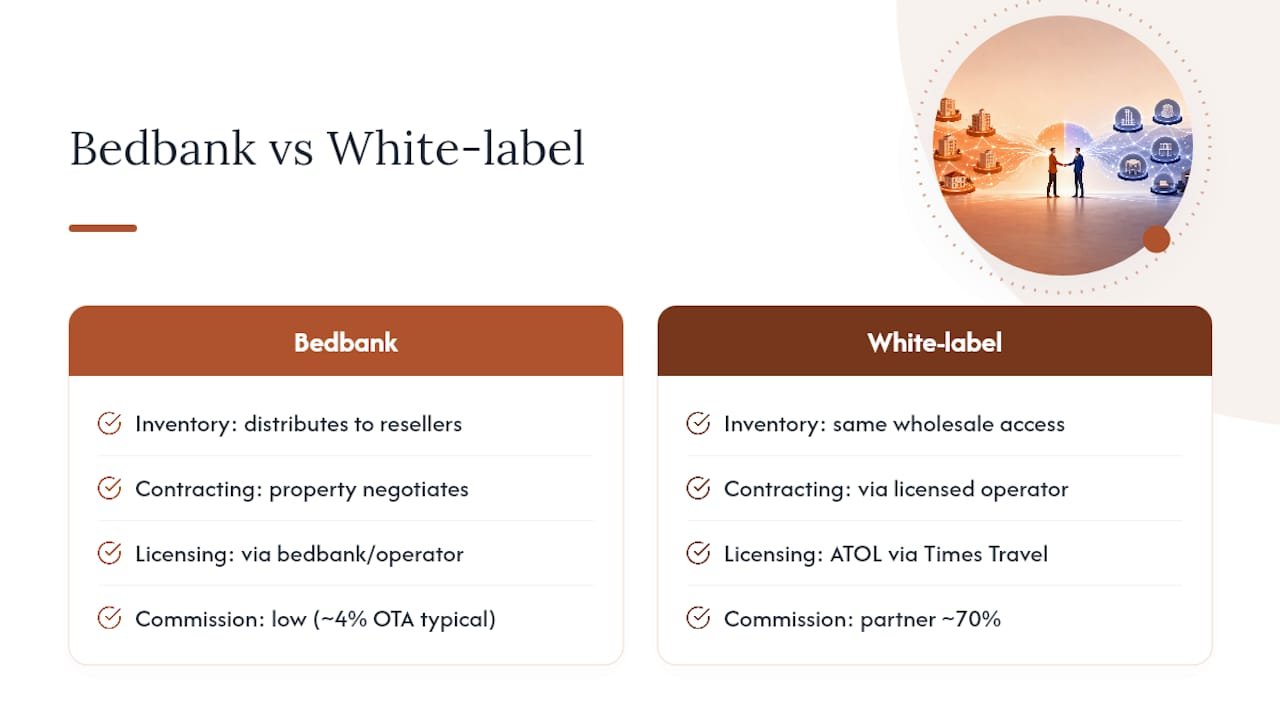
Bedbank relationships aren’t the only route into wholesale hotel inventory. White-label travel platforms give individuals and small agencies access to wholesale hotel, cruise, and tour rates without the property having to negotiate a bedbank contract at all, because the distribution already runs through an existing licensed operator.
Timeshunters works this way: partners launch a branded travel agency under Timeshunters’s white-label platform, trading under ATOL-protected licences from Times Travel group, with access to the same kind of wholesale inventory a bedbank would offer, but structured around a 70% partner commission rather than the 4% typical of standard online travel agency arrangements. Some partners have reported income increases per booking after switching models. The distinction matters for anyone comparing routes: a bedbank distributes hotel inventory to resellers, while a white-label reseller model gives an individual their own branded storefront on top of that same wholesale access.
What most hoteliers get wrong about bedbank strategy
The mistake I see most often is treating a bedbank contract as a one-time decision rather than a channel that needs the same ongoing management as any other. Hoteliers sign, load a generous allotment, and then stop watching the ADR delta until a finance review flags it six months later.
Bedbanks earn their place when you need geographic reach you can’t build directly, or when you’re carrying unsold inventory close to arrival that a direct channel simply won’t shift in time. Where I’d push back on the conventional pitch: bedbank volume should shrink, not grow, as your direct booking engine matures. The properties that get this right treat bedbank allotments as a pressure valve for distressed inventory, not a primary sales channel. Direct investment repays more once you have the guest data and repeat booking behaviour to justify it, and that payoff compounds in a way bedbank commission never will.
A balanced strategy usually means bedbanks handle the long tail, and everything with real margin sits closer to home.
— Sam
Want wholesale hotel access without the bedbank contract?
Timeshunters gives you wholesale-level hotel, cruise, and tour rates without the drawn-out contract negotiations a direct bedbank relationship usually demands.

You get a branded booking site, instant pricing proposals, automated client follow-up, and managed payments handled for you, so the operational load of running a wholesale distribution relationship sits with the platform rather than with you. If broad access to wholesale travel inventory without building your own bedbank contracts sounds like the gap in your current setup, visit the Timeshunters partner page to see how the commission structure and licensing actually work.
Sources
For deeper technical detail beyond this explainer, Hotelbeds’s developer documentation covers booking API operations directly, while Google’s ARI inventory message guide explains inventory count fields for engineering teams building or auditing channel connectivity.