
Keep Merchant of Record Upside Without the Build for Travel Sellers
Practical guide for travel sellers: merchant of record essentials, PCI scope, VCC payouts, cash and chargeback risk, and when a white label partner is...

A merchant of record in travel is the legal entity that takes the customer’s payment, issues the receipt, and carries responsibility for refunds, disputes, and tax on that transaction. The trade-off is stark: you gain pricing control, customer data, and a bigger slice of margin, but you also take on working capital demands, PCI compliance, and chargeback exposure. It suits established sellers with capital behind them, not early-stage agencies still finding their feet.
TL;DR:
- Using a merchant of record model requires high transaction volume, sufficient margin, and capital reserves to offset working capital and chargeback risks.
- The MoR handles all payment processing, refunds, and disputes, giving control over customer experience but increasing PCI compliance and liability.
- Cross-border transactions expose currency and FX rate risks that demand multi-currency routing tools, virtual credit cards, and fast settlement processes to reduce costs.
- MoRs enable quicker refunds, clearer support channels, and branding consistency, but they also create legal exposure and regulatory obligations beyond simple payment processing.
- Many travel businesses choose a hybrid approach or white-label solutions initially, balancing control, compliance, and costs before scaling to full MoR infrastructure.
Table of Contents
- What a merchant of record model looks like for travel businesses
- How the MoR model differs from the agency (pass-through) model
- Payment flows and tools used by travel MoRs
- Operational and financial risks for MoRs and practical mitigations
- Compliance, tax and contracting considerations for travel MoRs
- Should your travel business adopt MoR? A decision checklist
- Impact of merchant of record on international travel bookings and currency handling
- How MoR affects customer experience and support in travel transactions
- Case studies and examples of MoR implementation in travel companies
- Comparing merchant of record providers for the travel sector
- Legal implications and liability concerns unique to travel industry MoRs
- The publisher’s view on when MoR actually pays off
- A branded agency route without the payment infrastructure build
- Sources
What a merchant of record model looks like for travel businesses
Under a merchant of record setup, your business, not the airline, hotel, or tour operator, sits legally between the customer’s card and the supplier’s invoice. That means you take the payment, generate the receipt, and handle any refund or chargeback that follows. If a customer disputes a charge months after a cancelled flight, you’re the one answering the bank, not the supplier.
The card statement descriptor matters more than most operators realise. A vague or unfamiliar descriptor is one of the biggest drivers of “friendly fraud” chargebacks, where customers genuinely forget what they bought and dispute it by reflex. Clear, recognisable descriptors cut this risk noticeably.
Three variants exist in practice: fully in-house MoR (you build and own the entire stack), third-party MoR providers who absorb the compliance burden for a fee, and hybrid setups where a platform handles settlement while you retain the branding and customer relationship. Each shifts the balance of risk and control differently.
How the MoR model differs from the agency (pass-through) model
The agency, or pass-through, model works differently at every step. The supplier, not you, receives the customer’s pay-in directly, and you collect a commission after the fact. Under MoR, the money lands with you first, and you push a payout to the supplier afterwards. That single difference changes almost everything downstream.
- Cash flow timing: agencies get paid commission on settlement; MoRs hold customer funds and carry the float until supplier payout clears.
- Margin structure: MoR sellers can mark up net rates and capture the spread; agency sellers are capped at whatever commission the supplier sets.
- Customer data ownership: MoRs own the full transaction record; agencies often only see a booking reference, with the supplier holding payment details.
- Chargeback liability: falls on the MoR every time; under agency, it usually routes back to the supplier’s merchant account.
Businesses lean towards agency when they’re small, cash-constrained, or selling low-margin inventory where the compliance overhead of MoR simply isn’t worth it. They lean towards merchant status once volume, margin ambition, or the need for direct customer data outweighs the extra plumbing. Industry analysis consistently frames this as a scale decision more than a preference one.
Payment flows and tools used by travel MoRs
The mechanics run in a fairly predictable sequence: the customer pays in through a card or wallet, that payment is captured by an acquirer or payment service provider (PSP), funds settle into the MoR’s account, and only then does the supplier get paid out. Each handoff is a point where reconciliation can break down if the tooling is weak.
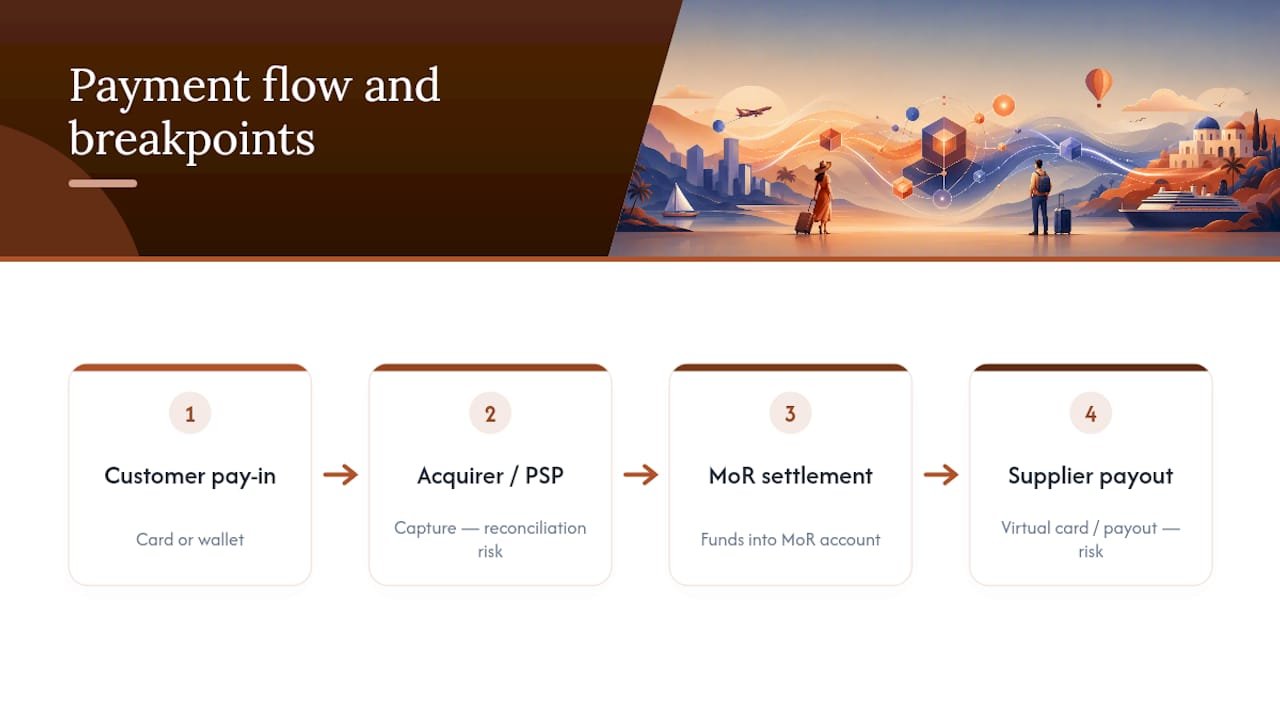
Virtual credit cards have become the standard tool for the supplier-payout leg. Instant card issuance lets a travel MoR generate a unique card number per booking, cap it to the exact supplier invoice amount, and close it once the transaction clears, which sharply improves supplier acceptance rates and makes matching payments to bookings far simpler than wire transfers ever were.
B2B wallets and travel-specialist PSPs add the multi-currency layer, routing pay-ins and payouts across different issuing networks and currencies to lift approval rates on international cards. When you’re vetting a payments partner, ask for three things specifically: booking-level data attached to every transaction (not just a lump settlement figure), same-day or next-day reconciliation reporting, and a clearly documented refund path that doesn’t require a support ticket every time.
Operational and financial risks for MoRs and practical mitigations
Working capital is the risk most new MoRs underestimate. Settlement delays while fraud checks and regulatory reviews complete can leave real cash tied up for days, and travel’s advance-booking model, where you’re paid now for a trip to six months, only widens that gap. Without a reserve or credit facility, a single slow settlement cycle can strain payroll or supplier payments.
Chargebacks compound the problem. Travel tickets are high-value, bookings are made well ahead of the service date, and disputes often surface long after the transaction, which is exactly the profile banks flag as high risk. That’s why travel businesses are routinely underwritten differently to standard retail, and why acquirers sometimes freeze accounts mid-season if chargeback ratios spike unexpectedly.
Pro Tip: Stage your billing wherever the supplier allows it: take a deposit at booking, capture the balance closer to departure. It shrinks the amount exposed to a chargeback at any single point in time, and it gives you a natural checkpoint to catch fraud before the bulk of the money moves.
Travel-underwritten merchant accounts, integrated chargeback monitoring, and dispute insurance are the standard mitigations acquirers and PSPs expect to see before they’ll extend favourable terms, as explained in Corporate Accounts — Airport Lift Nottingham.
Compliance, tax and contracting considerations for travel MoRs
PCI DSS scope expands considerably once you’re the merchant of record. Agencies that never touch card data directly can often stay out of most PCI requirements; MoRs storing or processing card details sit squarely inside them, which means annual assessments, network segmentation, and stricter vendor contracts.
Tax and invoicing responsibility also shifts. As the entity issuing the receipt, you’re generally the one accounting for VAT or local transaction tax on the sale, not the supplier, so your finance team needs processes built for that from day one.
For airline inventory specifically, IATA/BSP accreditation (or a local equivalent) often determines whether suppliers will trust you with direct ticketing at all, separate from your payment credentials. Before signing with an acquirer or PSP, ask directly about settlement timing, how multi-currency exposure is handled, and what regulatory coverage (safeguarding, e-money licensing) sits behind their service.
Should your travel business adopt MoR? A decision checklist
Run through this before committing to anything:
- Monthly transaction volume — is it high enough to justify the compliance overhead?
- Margin buffer — do you have enough spread to absorb processing fees and occasional chargeback losses?
- Capital availability — can you fund a working capital reserve or secure a credit line?
- Refund and chargeback profile — how disputed-prone is your typical booking (last-minute, high-value, package versus single-component)?
- Supplier acceptance needs — do your suppliers demand card guarantees that only VCCs solve cleanly?
- Reconciliation capability — can your finance team match bookings to settlements without manual spreadsheet work?
If most of those point in your favour, analysts generally agree MoR is worth piloting rather than adopting wholesale:
- Run a small pilot with a limited product line or region.
- Select a VCC or PSP partner built for travel, not generic retail.
- Arrange properly underwritten acquiring before scaling volume.
- Test settlement timing and reconciliation accuracy under real load.
Watch three metrics closely during that pilot: settlement lag, reconciliation match rate, and chargeback rate. Any of the three trending the wrong way is a signal to slow down before expanding.
Impact of merchant of record on international travel bookings and currency handling
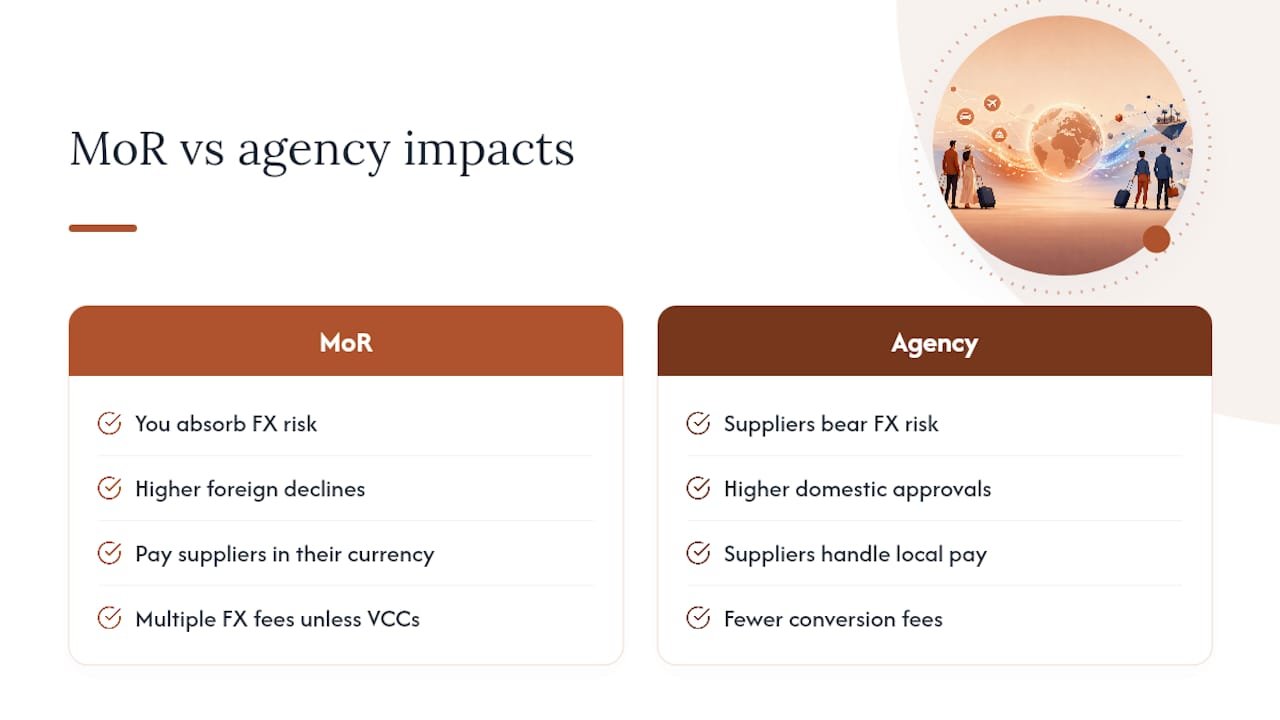
Cross-border bookings expose the sharpest edges of the MoR model. When a UK-based travel seller takes payment from a customer in euros for a hotel invoiced in US dollars, someone has to absorb the currency conversion, the FX spread, and the settlement timing risk between those two events. Under MoR, that someone is you.
This is where multi-currency routing through a B2B wallet or travel-specialist PSP earns its keep. Routing pay-ins through local acquiring in the customer’s own currency, rather than forcing every transaction through a single home-currency gateway, tends to lift card approval rates meaningfully, because issuing banks are more likely to approve a transaction that looks domestic to them than one flagged as foreign.
The supplier side carries its own currency complexity. A tour operator invoicing in Thai baht, a cruise line in US dollars, and a European hotel chain in euros all need paying in their own currency or close to it, ideally without triggering three separate wire transfer fees and three separate FX conversions. Virtual credit cards issued in the correct currency for each supplier sidestep a chunk of that friction, since the card network handles the conversion at a competitive rate rather than your bank doing it at a retail markup.
Timing adds a further layer. FX rates move between the moment a customer books and the moment a supplier gets paid, sometimes weeks or months later for advance travel bookings. An MoR holding that exposure for an extended period without hedging or fast settlement is effectively taking a currency bet on every international sale, whether it intends to or not. That’s a real cost line that agency-model sellers, who pass the currency risk straight to the supplier, simply don’t carry.
How MoR affects customer experience and support in travel transactions
Customers rarely think about payment architecture, but MoR status shapes their experience in ways they do notice. The name on their bank statement, the entity that answers when they call about a refund, and how quickly a dispute gets resolved all trace back to who holds merchant of record status on that booking.
Refund speed is the clearest example. Under agency arrangements, a refund request often has to be relayed to the supplier, approved there, and only then processed back to the customer, a chain that can stretch into weeks. As the merchant of record, you control that process directly, which means you can issue a refund the moment your own policy allows it, without waiting on a third party’s approval queue. For a customer who’s just had a flight cancelled, that speed difference is the entire experience.
Support clarity improves too, in theory. If your brand name matches the statement descriptor and the entity the customer booked with, there’s no confusing moment where they’re not sure who to call. That consistency is exactly why vague or mismatched descriptors do so much damage: customers who don’t recognise a charge don’t ring their travel agent first, they ring their bank and file a dispute.
The flip side is accountability. Every complaint, every “where’s my refund” call, every dispute now terminates at your support desk rather than getting deflected to the supplier. That’s more work, but it’s also more control over the tone and speed of resolution, which for a brand-conscious travel business is often worth the extra support load on its own.
Case studies and examples of MoR implementation in travel companies
Online travel agencies that have grown large enough to justify the switch typically follow a similar arc: start on the agency model while volumes are thin, then move specific product lines, package holidays or dynamic packaging in particular, onto a merchant of record structure once the margin from owning the transaction outweighs the compliance cost.
Package holidays are the clearest real-world case. When a seller bundles flights, hotels, and transfers into a single price, taking merchant of record status lets them set that combined price freely rather than simply passing through a supplier-set rate plus commission. That flexibility is precisely why so many packaged-holiday specialists operate as MoR while their single-component flight or hotel bookings often stay on an agency footing.
Tour operators offer a second pattern. Because tour pricing is already opaque to the end customer, there’s a natural business logic to owning the full transaction: the operator sets the retail price, takes the payment, and pays wholesale suppliers via the payout leg, using virtual card issuance to keep each supplier payment cleanly matched to a specific tour departure.
The common thread across cases that work well is booking-level reconciliation data. Sellers who wire lump payments to suppliers without a clean per-booking reference routinely end up in slow, manual dispute resolution when a supplier claims non-payment for a specific customer. Sellers who issue a VCC per booking, or route through a wallet that tags each payout to its originating transaction, avoid that entirely; when a supplier query comes in, the answer is a lookup, not an investigation.
Comparing merchant of record providers for the travel sector
Travel-specialist MoR and payment infrastructure providers tend to differentiate along a few practical lines rather than any single “best” metric: how deeply they understand travel’s advance-booking cash flow pattern, whether they issue virtual cards natively or bolt them on through a partner, how granular their reconciliation reporting is, and how they price for travel’s higher chargeback baseline compared with generic retail.
Card-issuing platforms built specifically around travel use cases, such as those offering instant virtual card issuance, tend to win on the supplier-payout side: fast card generation per booking, tight spend controls, and clean matching between card and invoice. Multi-currency B2B wallet providers, like Amadeus’s Outpayce offering, win on the acceptance side: better approval rates across issuing networks and currencies, which matters most for sellers with a genuinely international customer base. Travel-underwritten merchant account providers focus on a different problem entirely, keeping your acquiring relationship stable through seasonal volume swings without the freezes that generic retail underwriting often triggers.
No single provider category covers all three needs well. In practice, most travel MoRs of any size end up running a small stack: an acquirer or PSP underwritten for travel risk, a card-issuing tool for supplier payouts, and either a wallet or direct banking relationships for cross-currency settlement. Evaluating providers in isolation misses this. The real question isn’t which provider is best, it’s which combination closes the gap between your booking volume, your currency mix, and your appetite for building reconciliation processes in-house.
Legal implications and liability concerns unique to travel industry MoRs
Liability sits differently in travel than in most other MoR categories, largely because travel involves a future promise, not an immediate good. A customer paying for a cruise in March for a departure in November has eight months during which the supplier could fail, the itinerary could change, or a dispute could surface, and the MoR is holding that liability the entire time.
Financial protection schemes add a layer that most other MoR sectors don’t face. In the UK, package holidays typically require ATOL protection, and the entity responsible for that protection needs to be clearly established in the contract chain, because a customer whose trip collapses due to supplier insolvency will look to whoever took their payment first. Getting this wrong isn’t just a service failure, it’s a regulatory exposure.
Contract terms with suppliers need to spell out exactly who’s liable when things go wrong mid-chain: a cancelled excursion, a downgraded room, a delayed transfer. Agency-model sellers can often point straight to the supplier’s own terms. MoRs, having taken the payment and issued the receipt, find that customers, and sometimes regulators, expect them to resolve the problem first and sort out supplier recovery afterwards.
Cross-border bookings raise jurisdiction questions too. An MoR taking payment from customers in multiple countries for suppliers based in others needs contracts and terms of service that hold up under more than one legal system, something worth getting proper legal advice on before scaling internationally, rather than after a dispute forces the question.
The publisher’s view on when MoR actually pays off
Owning the transaction sounds like the obvious upgrade, more margin, more data, more control, but the capital and compliance burden is real, and plenty of agencies chase MoR status before they have the settlement reserves to survive a rough chargeback quarter. The pitfall isn’t the model, it’s timing: switching before volume and cash buffers can absorb the float. For sellers who want the commercial upside of owning more of the margin without building acquiring relationships and reconciliation systems from scratch, a white-label partner model is worth weighing seriously.
— Sam
A branded agency route without the payment infrastructure build
Building full MoR infrastructure, underwritten acquiring, VCC issuance, multi-currency reconciliation, is a serious undertaking, and it’s not the only route to better margins. A white-label platform can put your own brand on the booking site while running under an ATOL-protected licence, so you’re not carrying that regulatory weight alone.

Partners keep a substantially higher commission on bookings compared to the much lower typical commission of standard online travel agency arrangements, while a white-label service handles wholesale rate access, payment management, and automated booking administration behind the scenes. Some partners have reported an increase in income per booking after making the switch. You get the brand control and earning upside that draws people towards the MoR model, without needing to negotiate acquiring terms or build reconciliation reporting yourself.
If that fits where your travel business wants to go, visit Timeshunters to see how the partner model works and what’s involved in setting up your own branded agency.