How to Increase Travel Agent Commission in the UK
Raise your travel agent commission in the UK: typical rates, six levers that lift earnings, how to read a quoted rate, and why the split matters most.

The fastest way to increase travel agent commission is to change three things: the share of each booking you keep, the products you sell, and the terms behind the rate you are quoted. Selling more at the same low rate helps, but it is the slowest route. Most UK agents sit on a headline rate of roughly 5% to 15% of booking value, and the split with whoever licenses or hosts you often matters more than the supplier’s percentage.
This guide covers what normal looks like in the UK, six levers that lift your earnings, how to judge a “high” quoted rate, and where a 70% commission split fits in.
TL;DR
- Standard UK commission usually falls between 5% and 15% depending on the product, according to Travel Weekly UK.
- Your take-home depends on the supplier rate and on the split you keep after your host, consortium or licence holder.
- Compare quoted rates on the gross booking value they apply to, not on the headline percentage.
- Tiers, overrides, product mix and certifications can add a point or more across all your sales.
- With our model you keep 70% of commission and build your own brand and client list.
Table of Contents
- What a normal travel agent commission looks like in the UK
- Six ways to increase your travel agent commission
- How to judge a “high” commission offer
- Why the split decides your income
- How our 70% commission model works
- Start earning a larger share of every booking
- A 90-day plan to lift your commission
- FAQ
- Sources
What a normal travel agent commission looks like in the UK
A travel agent earns a percentage of the booking value from the supplier: a hotel, airline, cruise line or tour operator. Travel Weekly UK puts standard rates at 5% to 15%, depending on the type of booking.
The spread by channel is wide:
| Channel | Typical commission | Source |
|---|---|---|
| Travel agent (retail, gross rate) | 10% to 15% as a guide | National Park Experiences |
| Online travel agency | 10% to 30% | National Park Experiences |
| Wholesaler | 20% | National Park Experiences |
| Rail, public internet sales | 4.5% from 1 April 2025 | ATOC |
| Rail, telesales | 9.0% | ATOC |
| Rail, season tickets | 2.0% | ATOC |
The same rail table shows the first lesson. The same ticket pays more than twice as much by phone as online, so the way you sell is a commission decision. For a fuller breakdown by product, see our guide to typical travel agent commission rates.
Supplier rate versus what you actually keep
The supplier rate is only the first slice. If you work under a host agency or a consortium, a share of that commission goes to them, and some arrangements add fees or clawbacks when a booking is cancelled. Our breakdown of host agency commissions after fees and clawbacks shows how a 12% rate can shrink in practice.
Ask the same question of every arrangement: out of every £100 of commission the supplier pays, how many pounds reach my account, and when?
Six ways to increase your travel agent commission
1. Move to a higher split, not just a higher rate
A 10% supplier commission on a £3,000 holiday is £300. If you keep 40% of that, you earn £120. If you keep 70%, you earn £210 on the same sale with the same effort. Lifting your share is the single lever that applies to every booking you ever make.
This is why we built our model around a 70% partner commission, against the roughly 4% our business description cites for online travel agencies. We cover the mechanics further down.
2. Use tiers and overrides
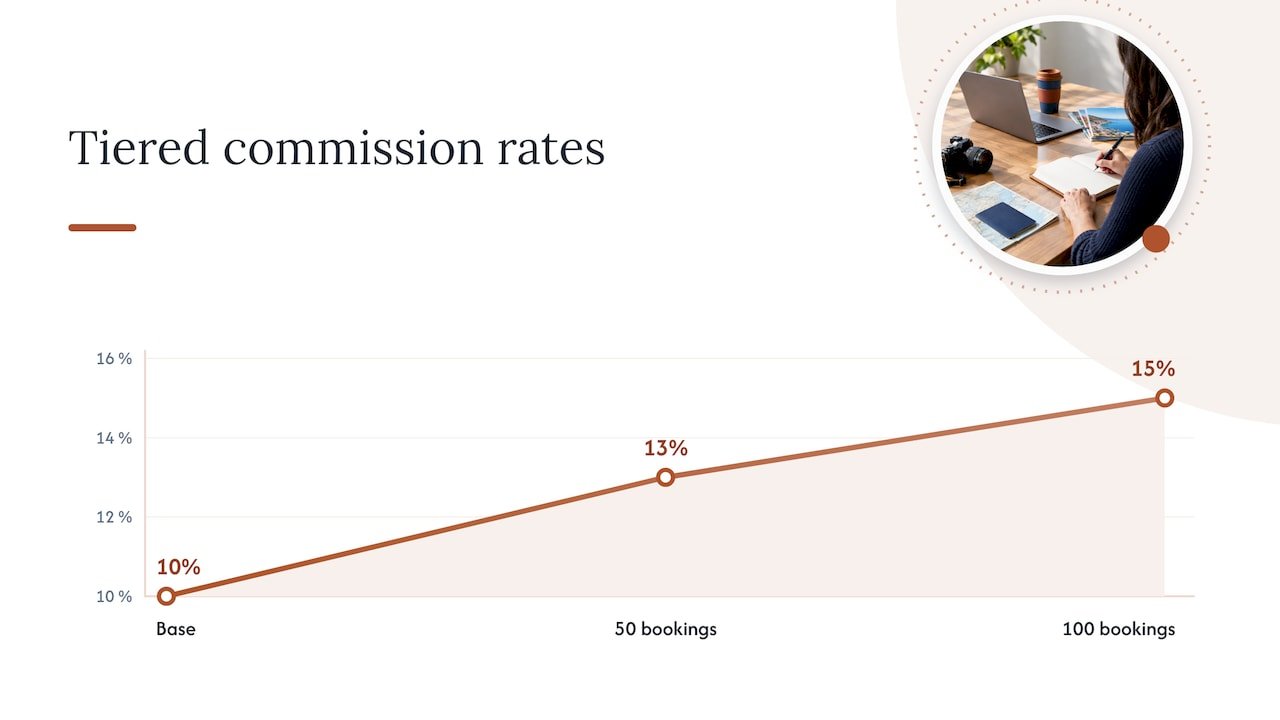
Travel Sales IQ describes six common structures: standard, tiered, override, product-specific, launch incentives and net pricing. A tiered example it gives is 10% as a base, 13% from 50 bookings and 15% from 100. An override rewards you for hitting annual targets.
In a separate piece, Travel Sales IQ puts override uplifts at +0.5% to +3% on all bookings once a volume or revenue threshold is reached. Funnelling more business through fewer suppliers is how most agents reach those thresholds.
3. Shift your product mix
Not all bookings pay the same. Travel Sales IQ calls a higher share of premium cabin bookings the highest-impact strategy for airline commission, and illustrates a move from 8% to 18% premium share producing £17,500 to £22,500 more commission per 1,000 bookings.
The same principle applies beyond flights. Cruises, villas, safari camps and tailor-made tours carry a higher booking value per client than a standalone hotel night, so the same conversation produces more commission. Our guides to cruise agent commissions and tour operator commissions per booking work through the figures.

4. Get certified with suppliers
Travel Sales IQ notes that airlines increasingly offer enhanced terms to agencies with certified agents: +0.5% to +1.5% commission, valued at £3,000 to £15,000 a year per certified agent, plus perks such as familiarisation trips. Supplier training is free or cheap and compounds across every booking afterwards.
5. Sell the extras
Transfers, car hire, excursions, insurance referrals and upgrades often carry their own margin. Agents who bundle them raise the value of each client without finding a new one. Travel Weekly UK recommends bundling services such as car rental or packages for this reason. Our UK playbook on upselling travel extras shows how to do it without losing margin on the way.
6. Build repeat clients under your own name
The cheapest booking is the second one from a client who already trusts you. When your clients know your brand rather than a host’s or a marketplace’s, referrals and repeat travel stay with you. A fit-first sales process helps here, and our seven stages for independent UK agents lay one out.
How to judge a “high” commission offer
A big headline number is not always a big payout. Three checks keep you honest.
What does the percentage apply to? Travel Weekly UK points out that some companies quote a higher headline rate that excludes taxes and fees, while leading platforms pay on the total gross booking value. TicketingHub explains the same point: the agreement defines which parts of the price qualify, so the commissionable amount can differ from the full retail total.
A worked example: 12% on a £2,000 booking where only £1,700 is commissionable pays £204. 10% on the full £2,000 pays £200. The “lower” rate nearly matches.
Is the rate commission or a net rate? Under a net rate you buy at a fixed price and add your own mark-up. Trade net rates are typically agreed well ahead, and ETAG notes they are static and confidential, which makes contract terms important. We list five contract checks for net rates to protect your cash flow.
What happens on cancellation and when do you get paid? Ask about clawbacks, payment dates and who holds client money. A rate that pays 15% three months after the client returns is worth less to a new business than 12% paid promptly.
Why the split decides your income
Most advice on raising commission assumes you stay inside someone else’s structure and negotiate for a point or two. That works at scale. For a new or independent agent, the structure itself is the bigger variable.
Compare the typical routes:
- Online travel agency or marketplace: high volume but low rates, and the client belongs to the platform.
- Host agency: support and protection, but you share commission and usually the client relationship.
- Your own licence: full control, but ATOL and bonding costs and admin are heavy before your first sale.
- White-label platform: your brand and clients, with the licence and back office provided.
The white-label route is the one we offer.
Our view
We started TimesHunters because we kept seeing the same pattern: capable people with loyal clients earning a sliver of each booking. Commission in this industry is rarely low because agents sell badly. It is low because the person who holds the licence and the client keeps most of the value.
Our answer is to split it differently. Partners sell under their own name, using Times Travel group’s ATOL-protected licences, and keep 70% of commission. The licence branding is invisible to your clients, so the relationship, the repeat business and the reputation are yours.
We would rather a partner earn well on 20 clients who trust them than a pittance on 2,000 anonymous ones. Better rates, wholesale access and automation are what make that possible.
Sam
How our 70% commission model works
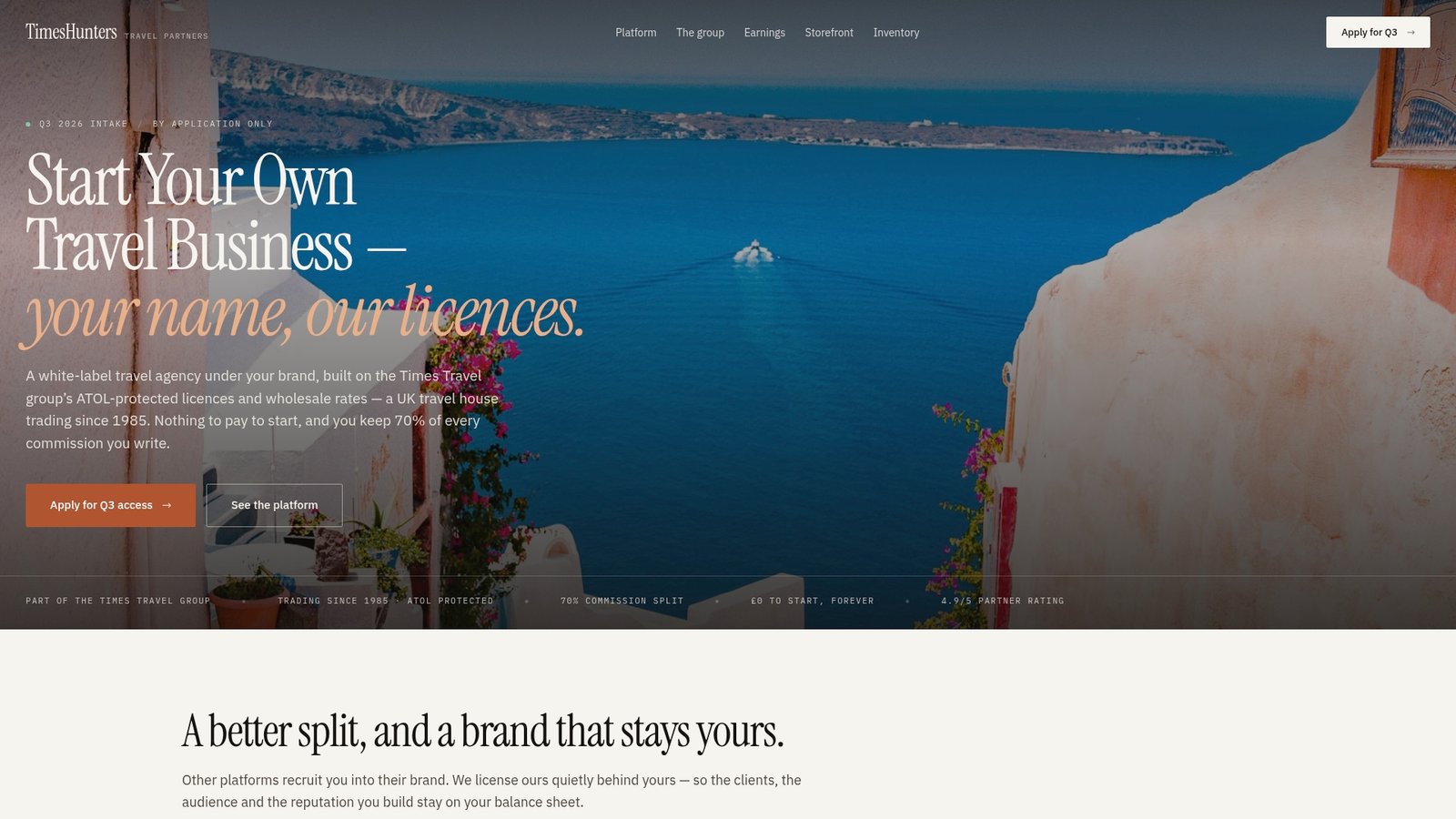
TimesHunters is a white-label travel agency platform. You launch a travel business under your own name, on Times Travel group’s ATOL-protected licences, with no cost to start. You keep 70% of commission on bookings and we keep the 30% split.
What the platform includes:
- A branded booking site under your name
- Access to wholesale hotel, cruise and tour inventory, plus villas, safari camps and rail
- Instant pricing proposals for clients
- Automated booking management and client follow-up
- Managed payments and financial protection
- Training and support
One partner reports their income per booking rising from £400 to £1,200 after moving to this model. That is a single partner’s result, not a guarantee, and your earnings depend on what you sell and to whom.
For how this compares with a host agency in practice, see our travel agency business model guide and our page on preferred supplier programmes with white label.
Start earning a larger share of every booking
If you already have an audience, a client list or a hospitality business, you have the hard part. We provide the licence, inventory and back office so you can sell under your own brand and keep 70% of commission. You can see how the model works on our white-label travel agency page, or read about the UK referral and partner programme.
If you want a structured start, our UK travel agent training covers launching a white-label ATOL agency, and travel agent support sets out the onboarding steps.
A 90-day plan to lift your commission
- Weeks 1 to 2: list every supplier you use and write down the real rate, the commissionable base and the payment date for each.
- Weeks 3 to 4: work out the split you keep after host, consortium or licence fees. This is your true rate.
- Weeks 5 to 8: concentrate bookings with the two or three suppliers where tiers or overrides are in reach, and complete their agent certifications.
- Weeks 9 to 12: add one extra to every proposal and shift your mix toward higher-value products such as cruises and tailor-made tours.
- Ongoing: record every commission by booking, so late or short payments are caught quickly.
Tracking matters more than it sounds. Operators have long listed costs they carry on top of commission, such as marketing support, incentives and educationals, as TravelMole reported. Expect suppliers to look hard at what they pay, and keep your own records equally hard.
FAQ
What is a normal commission for a UK travel agent?
Most UK travel agent commission falls between 5% and 15% of booking value, depending on the product, according to Travel Weekly UK. Rail is lower, at 4.5% for public internet sales since April 2025. What you keep also depends on any split with a host or licence holder.
Do travel agents get 70% off flights?
Usually not. The figure people quote is closer to a commission split, such as our model where partners keep 70% of commission. Separately, an old industry scheme known as AD75 allows up to 75% off published fares for qualifying agency staff, but those fares carry restrictions and have largely faded.
What are the highest travel agent commissions in the UK?
The highest percentages tend to sit with wholesalers and online platforms, at 20% and 10% to 30% respectively, per National Park Experiences. A better measure is what you keep per booking. A 70% share of commission on wholesale-priced products is how our partners aim to earn more.
Can I increase commission without more clients?
Yes. Raise the average booking value through product mix and extras, reach tier or override thresholds with fewer suppliers, and earn supplier certifications. Each lifts income from the clients you already have.
Sources
- Travel Weekly UK: why travel agents should rethink their partnerships
- National Park Experiences: Becoming Travel Trade Ready
- ATOC rail industry commission rates from 1 April 2025
- Travel Sales IQ: Travel Trade Partnerships Explained
- Travel Sales IQ: Maximise Airline Commission Knowledge
- TicketingHub: Commissionable Rate explained
- ETAG: Rates and Pricing in more detail
- TravelMole: Operators paying too much to agents
- Do travel agents get discounts on flights?