
Linked Travel Arrangements in the UK: What They Are and What Changes in 2027
What a linked travel arrangement is under UK law, how it differs from a package, and what changes on 6 April 2027 for travellers and travel sellers.

A linked travel arrangement (LTA) is a set of separately contracted travel services for one trip, such as a flight and a hotel, that a trader helps you buy together but that does not count as a package. Under the 2018 Regulations, you get some financial protection but not the full rights of a package holiday. That is changing: from 6 April 2027, the category is largely being abolished. If you sell travel, or plan to, the boundary between an LTA and a package decides your legal duties and your financial protection. This guide explains both.
TL;DR
- An LTA is at least two different types of travel service for the same trip, bought under separate contracts, where a trader helps you select and pay for them in a linked way.
- Protection is narrower than for a package: insolvency security applies, but the seller is not responsible for how the whole trip is delivered.
- The Amendment Regulations 2026 take effect on 6 April 2027: former Type A LTAs become packages and Type B LTAs are removed.
- The changes do not apply to contracts made before that date, so keep records showing when each booking was concluded.
- If you run or plan a travel business, work out now which of your sales will count as packages and how you will protect client money.
Table of Contents
- What counts as a linked travel arrangement
- How an LTA differs from a package holiday
- What protection a traveller gets
- What changes on 6 April 2027
- What it means for travel sellers
- Our perspective
- Working with the new rules while you build your agency
- Common mistakes to avoid
- FAQ
- Sources
What counts as a linked travel arrangement
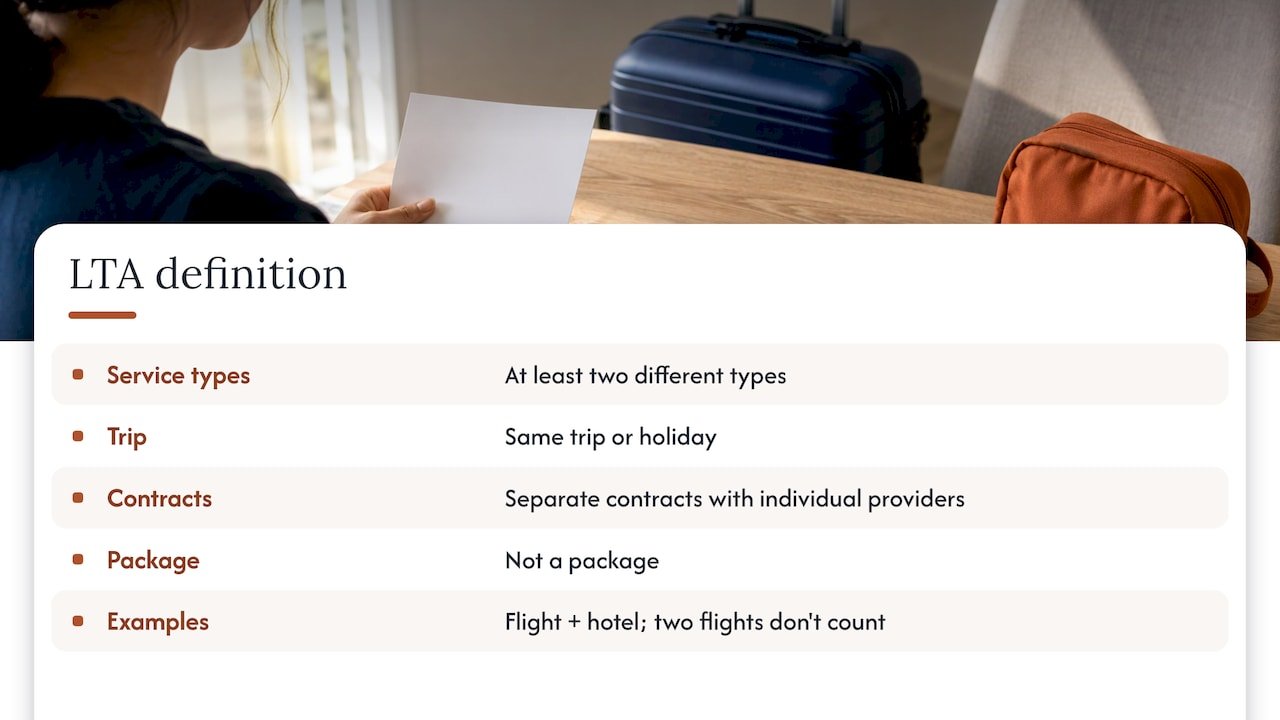
The definition sits in the Package Travel and Linked Travel Arrangements Regulations 2018. An LTA is at least two different types of travel service bought for the same trip or holiday. It is not a package, and the services are bought under separate contracts with the individual providers.
The travel services that count are transport, accommodation, vehicle rental and, if they are significant enough or an essential feature of the trip, other tourist services. The legislation sets out the tests in detail. Two flights are not two different types of service. A flight plus a hotel is.
The second ingredient is how the trader links the purchases. The Regulations describe two routes, which practitioners call Type A and Type B.
Type A: one point of sale
A trader, such as a high street agent or a website, helps you select and pay for each service separately during a single visit or contact with its point of sale. You choose a flight, pay for it, then choose a hotel and pay for that, all in one sitting. Because you pay each provider separately rather than one price for a combination, it is not a package.
Type B: the targeted follow-on booking
The trader invites you, in a targeted way, to book an additional service from another trader. You then conclude that second contract no later than 24 hours after the first booking is confirmed. A confirmation email for a flight that carries a tailored hotel offer is the classic pattern.
If neither route applies, there is no LTA. Someone who books a flight on one website on Monday and a hotel on another site on Friday has simply made two ordinary bookings.
How an LTA differs from a package holiday
A package combines at least two different types of travel service for the same trip under the conditions listed in the Regulations, for example sold at an inclusive price, or advertised as a package. An LTA is a non-package arrangement with separate contracts. Government business guidance describes LTAs as having looser commercial connections than packages, and says they receive some protection but not the same rights.
The practical difference is who answers when something goes wrong. ABTA explains that with a package, the travel company is responsible for the performance of the holiday and you have both financial and legal protection. With an LTA, each provider is responsible for its own service and you have financial protection only, at a lower level. Complaints generally go to the relevant provider.
| Package | Linked travel arrangement (until 6 April 2027) | |
|---|---|---|
| Contracts | Usually one contract with the organiser | Separate contracts with each provider |
| Who is responsible for delivery | The organiser | Each provider for its own service |
| Insolvency protection | Required, covering refunds and repatriation | Required for money the facilitator receives, plus repatriation where it is responsible for carriage |
| Legal protection across the whole trip | Yes | No |
| Information the traveller must be given | Standard pre-contract information | Clear notice that package rights do not apply |
What protection a traveller gets
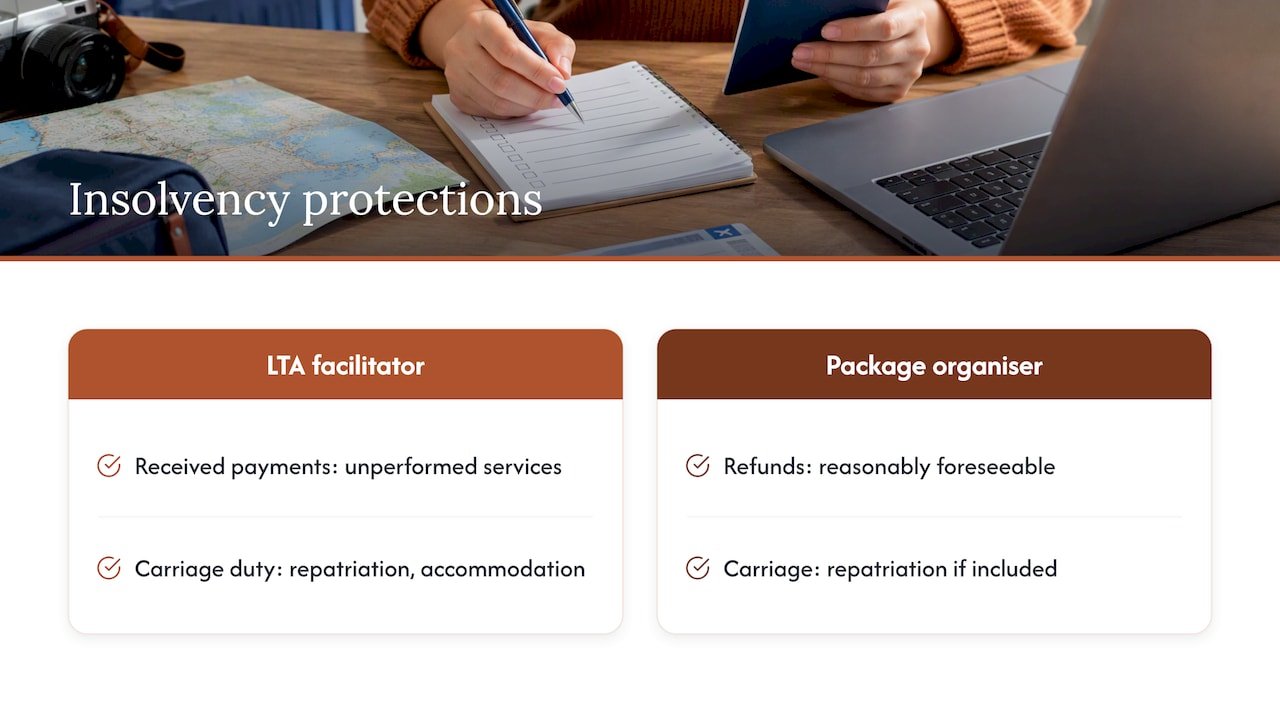
The duties fall on the trader that creates the link, called the facilitator. Under regulation 26, the facilitator must arrange effective insolvency security for payments it receives for services that are not performed because of insolvency. Where it is responsible for passenger carriage, that security also covers repatriation and any necessary accommodation.
The traveller must also be told, clearly and prominently before contracting, that package rights do not apply and that each provider is responsible for its own service. The facilitator must state that insolvency protection exists, provide a copy of the Regulations, and use the prescribed form and wording where required.
Package organisers established in the UK have to provide effective insolvency security covering reasonably foreseeable refunds and, where the package includes passenger carriage, repatriation. The 2018 rules also extend equivalent insolvency-security requirements to LTAs sold in the UK by a trader established neither in the UK nor in another EU member state.
What this means if you are the traveller
Before paying, check three things:
- Who you are paying. If you pay the airline and the hotel separately, you hold two contracts and two sets of terms.
- What the notice says. An LTA seller must tell you package rights do not apply. If you see that wording, you are in LTA territory.
- How you pay. Card payments can add a layer of recourse. Our guide to UK travel chargebacks explains the time windows and value limits.
The same logic applies when you build a trip around a single type of stay. Reading up on what adults-only hotel checks involve before booking is worthwhile precisely because a hotel-only booking, or one stitched to a separate flight, gives you the provider’s own terms and not package cover.
What changes on 6 April 2027
The government made the Amendment Regulations 2026 on 22 April 2026. They come into force across the UK on 6 April 2027 and are not retrospective. In summary:
- Former Type A LTAs become packages.
- Type B LTAs are removed as a category.
- Regulation 26 and its forms, which govern LTA insolvency protection and notices, are repealed.
- Regulation 29 is replaced with provisions on third-party refunds and redress.
The reasoning is set out in the government’s December 2025 consultation response. Type B was removed because the model was easily circumvented, and the government considered removal supportive of domestic-sector growth. Treating single-point-of-sale transactions as packages simplifies the boundary.
The amended government guidance, published in October 2026, confirms the changes do not affect package contracts or LTAs entered into before 6 April 2027. It advises businesses to identify and retain evidence of the relevant contract or arrangement date. Under that guidance, package organisers are liable for performance of the travel services even when third parties deliver them, subject to the organiser’s statutory rights of refund and redress against suppliers.
For a deeper look at the timetable and the actions for each side of the market, see our page on the UK Package Travel Regulations from April 2027.
What it means for travel sellers
ABTA’s industry guidance of 20 August 2026 says agents who facilitate what are now Type A sales will need to meet package obligations from April 2027, including financial protection and liability for the services. It advises agents to consider which sales fall within the new package definition and to make sure package financial protection and information requirements are met for them.
A practical way to prepare is to audit your sales flow.
Step 1: map where you sell two or more service types
List every journey in which a client buys, say, flights and a hotel, or a hotel and a car, through you. Note whether they are selected and paid for separately in one session, or sent as a follow-on offer.
Step 2: decide how each will be sold after the change
A former Type A sale will be a package. That means deciding whether you will structure it as one properly protected package, or split the offer so that you sell a single type of service. The first is usually the commercially stronger route because the client gets a joined-up trip and you control the experience.
Step 3: check your financial protection
Packages need insolvency protection. For UK sellers that often means either a bonding arrangement, a trust account, or operating under a licence holder’s protection. Our explainers cover tour operator bonding, the trust account checks operators should run, and trust accounts versus insurance.
Step 4: update your paperwork and cover
Check your booking conditions and cancellation wording so they match what you will be selling. Our guide to a travel agency cancellation policy lists what to include. Then review the covers you hold, as liability for delivery is a different risk from selling a single service: see the three core covers UK agents hold.
Step 5: keep dated evidence
Because the old rules continue for contracts made before 6 April 2027, keep records showing when each booking was concluded and under which regime it falls.
Our perspective
We built TimesHunters because we think the rule change makes the case for operating under proper protection stronger, not weaker. When a former LTA sale becomes a package, the person selling it carries the obligations of an organiser. For a freelancer or a small hospitality business selling two services together, building that protection from scratch is the hard part.
That is why our model starts from ATOL-protected licences held by Times Travel group. Our partners sell under their own name and keep their own client relationships, while the licence sits behind the scenes and its branding is invisible to end clients. Managed payments and financial protection are part of the platform, and so are automated booking management and client follow-up, which matter when you must evidence exactly when and how each booking was concluded.
We also think the economics should reward the person who holds the client relationship. Partners receive 70% commission on bookings, and we keep a 30% split. Combining hotels, tours, cruises and other inventory into properly protected trips is exactly where a branded agent adds value, and the April 2027 change moves the market toward that kind of trip.
Sam
Working with the new rules while you build your agency
If you are starting out, you do not need to solve package compliance alone. TimesHunters gives you a branded booking site, access to wholesale hotel, cruise and tour inventory, instant pricing proposals and automated booking management, all under ATOL-protected licences, with no cost to start. You can read how the model works on our white-label travel agency page, or see what support looks like from onboarding to launch.
If you want to see whether it fits your audience or client list, start at timeshunters.com. If you are still weighing up the route, our guide to becoming an independent travel agent in the UK compares the options, and the page on client money protection for white label partners covers the checks to make.
Common mistakes to avoid
- Assuming the rules change immediately. They apply to contracts concluded on or after 6 April 2027. Existing arrangements stay under the 2018 regime.
- Treating separate payments as proof of an LTA. Separate payment at one point of sale is exactly what makes a Type A arrangement, and that is the case becoming a package.
- Thinking an LTA notice is a free pass. The notice that package rights do not apply is a disclosure duty, and it comes with a duty to hold insolvency security.
- Forgetting overseas sellers. The 2018 rules extend insolvency-security requirements to LTAs sold in the UK by traders established outside the UK and the EU.
- Not keeping evidence. The government’s guidance specifically asks businesses to retain evidence of the contract date.
FAQ
What is a linked travel arrangement?
It is at least two different types of travel service for the same trip, bought under separate contracts, where a trader helps you pick and pay for them in a linked way. It is not a package. You get insolvency protection, but each provider is responsible for its own service.
Is a linked travel arrangement the same as a package holiday?
No. A package carries both financial and legal protection, and the organiser is responsible for delivery. An LTA has financial protection only, at a lower level, and complaints usually go to the individual provider, as ABTA sets out.
Are linked travel arrangements being banned?
In effect, the category is being removed. From 6 April 2027, former Type A arrangements become packages and Type B arrangements are removed. Sellers will need to meet package obligations for the former Type A sales, and contracts made before that date are unaffected.
What should a travel business do before April 2027?
Review which sales combine two or more types of service, decide whether to sell them as protected packages, and confirm your financial protection. Keep dated records for bookings made under the old rules. The ABTA guidance and the government’s amended guidance are the places to check the detail.
Sources
- The Package Travel and Linked Travel Arrangements Regulations 2018
- Regulation 26, 2018 Regulations
- 2018 Regulations, full text PDF
- Package Travel and Linked Travel Arrangements (Amendment) Regulations 2026
- Government business guidance on the 2018 Regulations
- Amended government guidance, October 2026
- Government response to the package travel consultation, 2 December 2025
- ABTA: package holiday or linked travel arrangement
- ABTA: upcoming changes to the Package Travel Regulations
- Adults-only hotels: what to check before booking