Sell Travel Without ABTA: What UK Law Requires
You can legally sell travel in the UK without ABTA membership. Here is what the law requires instead, and how ATOL-protected white label gets you started.

Yes, you can sell travel in the UK without being an ABTA member. ABTA is a trade association you choose to join. The legal requirement is financial protection for what you sell: an ATOL if the booking includes a flight, and a bond, insurance or trust arrangement if it does not. The quickest way to meet that requirement as a new seller is to trade under an established ATOL-protected licence. That is what our white-label platform provides: you build your own brand and client list, and the protection sits behind every booking.
TL;DR
- ABTA membership is voluntary. ATOL and package-travel insolvency protection are the legal requirements, depending on what you sell.
- If you sell flight-inclusive packages or flight-only travel to UK consumers, you must be an airline, hold an ATOL, or be exempt. Applying for your own is slow and capital-heavy.
- Non-flight packages need protection through a bond, insurance or a trust, and you must give customers clear pre-booking information.
- The Package Travel rules change on 6 April 2027, so build your business on the new definitions now.
- With TimesHunters you sell under Times Travel group’s ATOL-protected licences, keep 70% commission, and pay nothing to start.
Table of Contents
- ABTA and ATOL: what each one actually is
- What the law requires, depending on what you sell
- Why selling without ABTA is not the hard part
- Your three ways to sell protected travel
- How to start selling in practice
- What you must tell customers
- When your sale becomes a package
- What changes on 6 April 2027
- Is going without ABTA a disadvantage?
- Start selling under your own name
- Our view
- FAQ
- Sources
ABTA and ATOL: what each one actually is
The two names get used as if they were interchangeable. They are not.
ATOL (Air Travel Organisers’ Licensing) is a licence. The Civil Aviation Authority (CAA), the UK aviation regulator, runs it, and it covers holidays that include flights. It is a legal requirement, not an option. The CAA states that a business selling a flight-inclusive package or flight-only travel to UK consumers must be an airline, an ATOL holder or an exempt person. The same page says the rules also reach businesses established outside the UK that advertise and sell to UK consumers.
ABTA is a trade association. Members sign up to a code of conduct, and consumers see the ABTA logo as a sign of reassurance. Joining is a commercial decision. No UK law says you must be a member to sell holidays.
So the honest answer to the keyword is simple: the logo is optional and the protection is not. What customers actually need, and what regulators check, is that their money is covered if the business fails.
| ATOL | ABTA | |
|---|---|---|
| What it is | A legal licence run by the CAA | A voluntary trade association |
| Required by law? | Yes, for flight-inclusive packages and flight-only sales unless an exemption applies | No |
| Applies to | Bookings that include flights | Members, whatever they sell |
| What a customer gets | Insolvency protection on covered bookings | A code of conduct and the member’s protection arrangements |
What the law requires, depending on what you sell
Your obligations depend on the product, not on any logo.
Packages that include flights
The government’s 2026 guidance on the Package Travel Regulations says that flight packages in Package Categories 1 to 6 must have insolvency protection through ATOL. The Chartered Trading Standards Institute’s February 2026 guidance makes the same point for overseas sellers: businesses selling into the UK must comply with UK insolvency protection, so all organisers of flight-inclusive packages sold in the UK need an ATOL.
Packages without flights
Think of a hotel plus a rail journey plus tours, or a villa plus transfers and excursions. The same government guidance says these must use one of three permitted options:
- Bonding through an approved body. Bonds can run for up to 18 months and are sized at 25% of expected 12-month payments or the maximum held at one time, whichever is smaller.
- Insurance with an insurer authorised in the UK, the Channel Islands or the Isle of Man.
- A trust arrangement.
Whichever you use, the protection must cover refunds for services not performed and repatriation, and it must be free to the traveller. If you want the detail on how those options compare, we cover them in our guides to tour operator bonding and trust accounts versus insurance.
Where you are only an agent
Many new sellers act as an agent for a licensed organiser rather than organising packages in their own name. That distinction decides who holds the licence and who carries the financial protection. Our guide to what counts as a package holiday under UK law explains where the line sits.
Why selling without ABTA is not the hard part
Most people who search this phrase assume ABTA is the gate. In practice the gate is the licence. A new seller who wants to hold an ATOL personally meets a demanding process.
The CAA’s page on types of ATOL shows what a first-time applicant faces for the Small Business ATOL:
- a limit of 500 passengers and £1,000,000 of licensable revenue a year, for a minimum of three years;
- a minimum £50,000 bond;
- a personal fitness and competence test;
- a £1,538 application fee and a £1,250 payment on account;
- at least £30,000 of paid-up share capital for a limited company.
That is real money and real time before your first client books. Our own write-up of the 12-week ATOL wait and how white label avoids it goes through the process.
Your three ways to sell protected travel
There are really three ways to end up legally selling holidays without ABTA. We put ours first because it is the one built to get a new seller trading without the capital outlay.
1. White label under ATOL-protected licences (our route)
You trade under your own name, on a branded booking site, using Times Travel group’s ATOL-protected licences. The licence’s branding is invisible to your clients, so they see your business. There is no cost to start, and you keep 70% commission on bookings while we keep 30%.
The platform covers the parts that normally take months to assemble: wholesale hotel, cruise and tour inventory, instant pricing proposals, automated booking management, managed payments and financial protection, and automated client follow-up. Training and support come with it. Our white-label travel agency page shows the categories you can sell, including hotels, cruises, tours, villas, safari camps and rail.
2. A franchise ATOL
The CAA lists a Franchise ATOL granted on the basis of membership of an approved franchise consumer protection scheme. It needs no ATOL bond or financial criteria test, but it still requires a personal fitness and competence test, and the application fee is £981 for under 1,001 passengers. You also take on the franchise’s own network terms and fees.
3. Your own ATOL
This keeps every pound of commission but puts the whole regulatory burden on you, as the figures above show. It suits an established business with capital and a track record, not someone testing an idea with an existing audience.
How to start selling in practice
If you are an ex-agent, a hospitality owner or a creator with an audience, the sequence below gets you from idea to first booking.
Step 1: Decide what you will sell
Pick a niche that matches your audience: cruises, safaris, villas, tailor-made city breaks. A narrow focus makes your brand easier to remember and your proposals faster to build. If you plan to sell bespoke trips, read how to sell tailor-made holidays legally in the UK.
Step 2: Put the protection in place first
This is the step where independent starters stall. Under our model it is done on day one: your bookings sit under Times Travel group’s ATOL-protected licences and our managed payments and financial protection, so you do not build a bond, a trust or an application of your own. For a fuller picture of how client money is handled, see our guide to protecting client money when you sell travel.
Step 3: Build your brand and booking site
Your site carries your name, your colours and your voice. Clients book with you, and their details stay as your client list. That list is the asset: it is what you keep if you change niche or grow.
Step 4: Learn the sales process
Training matters more than most starters expect, because pricing and suppliers are where margin is made or lost. Our UK travel agent training is built around launching a white-label ATOL agency in four weeks.
Step 5: Quote, book and follow up
Instant pricing proposals let you answer an enquiry while it is still warm. Automated booking management and client follow-up handle confirmations and reminders, so your time goes on conversations rather than admin.
What you must tell customers
Selling without ABTA does not mean selling with less transparency. VisitBritain’s guidance on the Package Travel Regulations says that before booking, customers must receive the package’s main characteristics, the total price, the organiser’s details and the cancellation policy. Standard information forms must explain the key protections, including whether the booking is covered by the regulations.
At booking, they must also receive contact details for problems during the contract, the complaints process and the ability to transfer the booking.
The practical lesson is to be specific about what a price includes. Even a detail such as whether hotel breakfast is included belongs in the main characteristics you describe, because a vague proposal causes disputes later. Tell each client plainly which protection their booking sits under. Keep that record per booking so it is easy to show later.
When your sale becomes a package
A package forms when you combine different travel services for the same trip, such as accommodation with tours or transfers, in a way the regulations define. That triggers organiser responsibilities, including insolvency protection. Beginners most often hit this when they add excursions to a hotel booking and price the whole as one trip.
The government guidance adds that where ATOL-protected packages or flight-only sales already exist, added services forming a Category 7 package must be protected through separate non-flight arrangements. Upselling extras is where much of your margin comes from, so understand this early. Our guide to upselling travel extras shows how to do it while staying inside the rules.
What changes on 6 April 2027
The Package Travel and Linked Travel Arrangements (Amendment) Regulations 2026 commence on 6 April 2027 and do not apply to contracts entered into before that date. They:
- absorb the first type of linked travel arrangement (Type A) into the definition of a package;
- remove the second type (Type B) entirely;
- set a 14-day period for refunding cancelled services;
- clarify a right to redress from third parties.
The government’s response to its 2025 consultation confirms that the ATOL scheme itself sits outside this instrument. For a seller, the effect is that more of what used to be a loose referral will count as a package, with full protection duties. Our page on the Package Travel Regulations from April 2027 sets out what sellers need to do.
Is going without ABTA a disadvantage?
Customers care about one thing: whether their money is safe. You can say so truthfully and show it. Under our model, bookings are protected through ATOL-protected licences, and we describe protection plainly in your proposals. If a customer asks about ABTA, you can explain that ABTA is a voluntary trade body, and that the legal protection for their holiday is the ATOL or other insolvency arrangement in place.
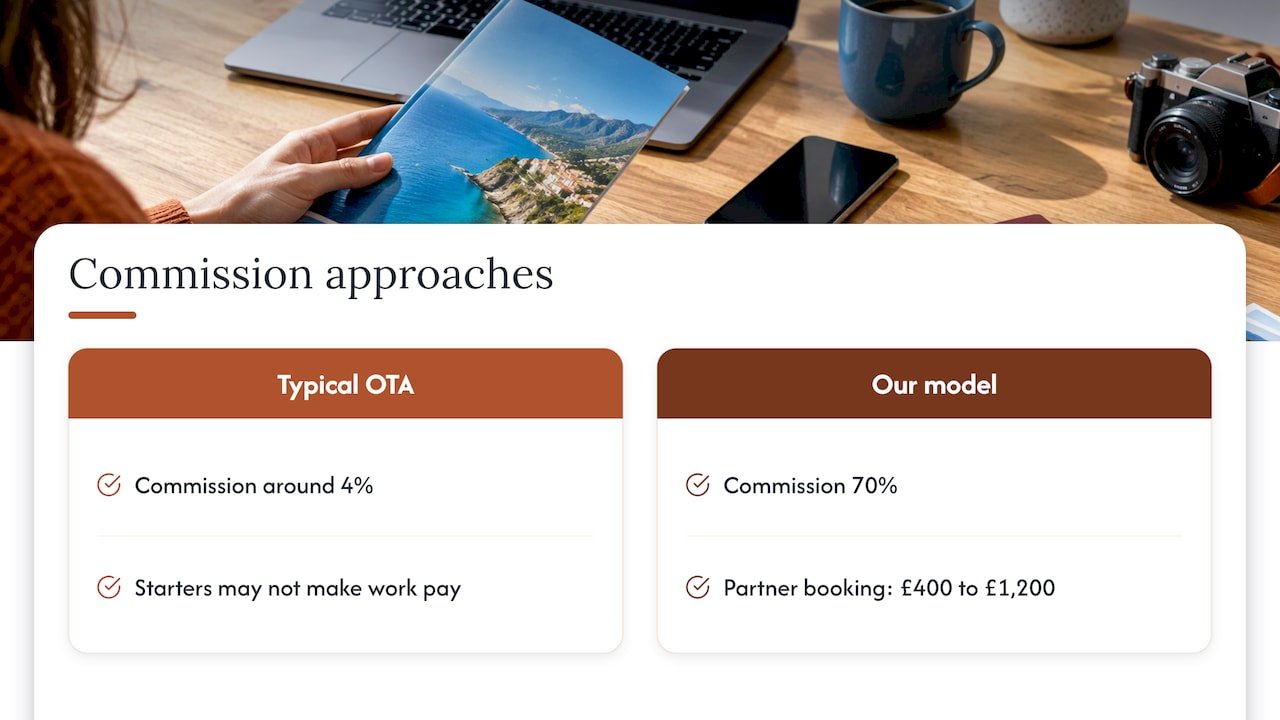
For a creator, hospitality owner or freelancer, the bigger question is margin. A typical online travel agency pays a commission around 4%, which is why many starters never make the work pay. With 70% commission, a single well-built booking changes the sums. One partner reported moving from £400 to £1,200 per booking. Use our tour operator commission calculator guide to work out your own net per booking.
Start selling under your own name
If you have an audience, a client list or a hospitality business, you can launch a travel brand without applying for a licence, raising a bond or paying to start. You get the branded booking site, wholesale inventory, automated booking management and the training, and you keep 70% of the commission.
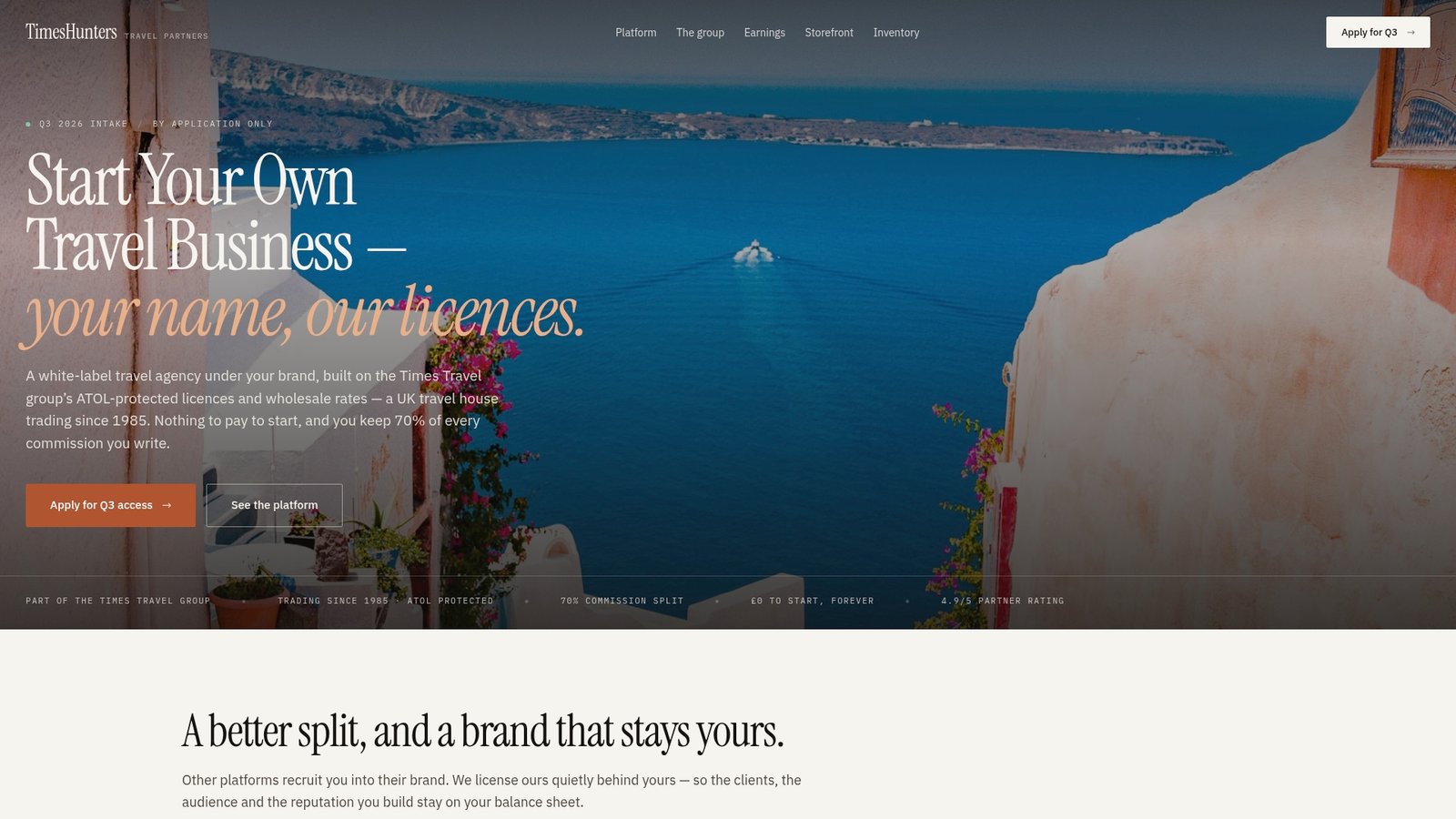
See how it works on the TimesHunters home page, or read how influencers sell travel through a white-label agency.
Our view
Most people who ask us about selling without ABTA are really asking whether they can start without the barriers that used to keep newcomers out. They can.
We built TimesHunters because the usual deal is poor: a high-street or online agency keeps most of the money, and a new seller who wants independence faces a licence process and a bond before earning anything. Our answer is to let you trade under your own name using Times Travel group’s ATOL-protected licences, keep 70% commission, and start at no cost.
The point is not the logo on the door. It is that your client’s money is protected, your brand is yours, and the relationship stays with you. That is what a sustainable travel business needs, and it is what we designed the platform around.
Sam
FAQ
Is it legal to sell holidays without ABTA membership?
Yes. ABTA membership is a voluntary trade association choice, not a legal requirement. What the law requires is insolvency protection: an ATOL for flight-inclusive packages and flight-only sales, and a bond, insurance or trust for non-flight packages.
What is the difference between ATOL and ABTA?
ATOL is a legal licence run by the CAA that covers bookings including flights. ABTA is a voluntary trade body with a code of conduct for its members. A seller can hold one, both or, if exempt or working under a licensed organiser, neither in their own name.
Do I need my own ATOL to sell flight packages?
Only if you are the organiser acting in your own right and are not exempt. Under the CAA’s rules you must be an airline, an ATOL holder or exempt. With TimesHunters you sell under Times Travel group’s ATOL-protected licences instead of applying yourself.
What must I tell customers about protection?
Before booking, you must give the main characteristics, total price, organiser details, cancellation policy and a standard information form showing whether the booking is covered. At booking they need complaints and problem-contact details, as set out by VisitBritain.
Will the 2027 changes affect new sellers?
Yes, for contracts made on or after 6 April 2027. More arrangements will count as packages and the refund period for cancelled services becomes 14 days. Starting on a platform that already handles protection makes the transition simpler.
Sources
- Do I need an ATOL | UK Civil Aviation Authority
- Types of ATOL | UK Civil Aviation Authority
- Guidance on the Package Travel and Linked Travel Arrangements Regulations 2018 (amended 2026)
- Practical holiday law, February 2026
- UK Package Travel Regulations Guidance | VisitBritain
- The Package Travel and Linked Travel Arrangements (Amendment) Regulations 2026
- Government response to ‘Package travel: updating the framework 2025’ consultation