
Travel Advisor Bio Examples You Can Adapt for Your Own Brand
Copy-and-adapt travel advisor bio examples for your website, About page and Instagram, with a simple formula, UK wording tips and a checklist.

A good travel advisor bio answers three things in its first two sentences: who you help, what kind of trips you plan, and how to get in touch. Below you will find a formula, ready-to-adapt examples for an About page, Instagram, LinkedIn and email, and the mistakes that make a bio sound like every other one. Swap the square brackets for your own details and you have a draft in ten minutes.
TL;DR
- Lead with your specialism and your client, not your life story. Proof and a clear next step come second and third.
- Use the SPEC formula: Specialisation, Proof, Expertise, Call to Action. It keeps a bio specific rather than generic.
- Keep Instagram bios within the 150-character limit, and give your website bio room for a short story, a named contact and a real photo.
- Never invent credentials. Only mention licences, memberships and protections you can show.
- Write one long version and cut it down for each platform, so your message stays consistent.
Table of Contents
- Travel advisor or travel agent: which word goes in your bio?
- What every travel advisor bio needs
- The SPEC formula, step by step
- Travel advisor bio examples for a website or About page
- How long should the bio be?
- Short travel agent bio examples for social media
- Wording that makes a bio sound generic
- Be careful with credentials and protection
- Our perspective on bios and brand
- Turn your bio into a business
- A five-step process to write your own bio
- Where to use your bio
- FAQ
- Sources
Travel advisor or travel agent: which word goes in your bio?
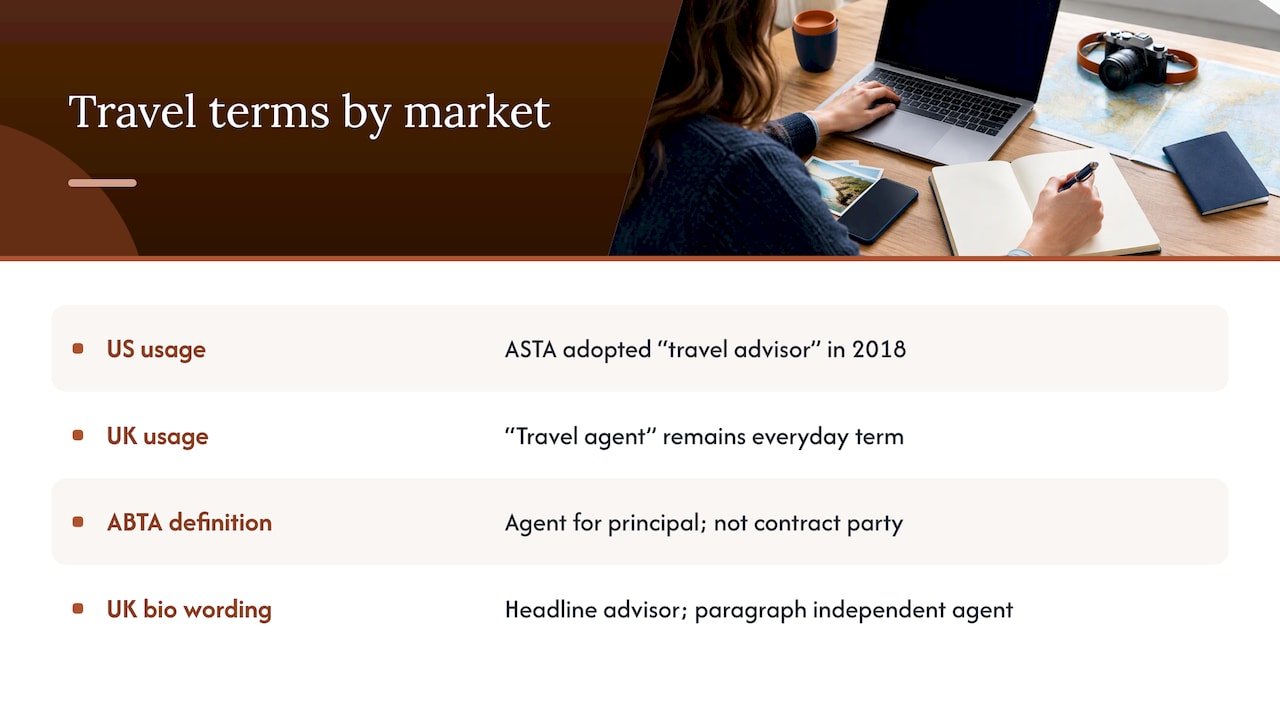
Both words describe the same job to most readers, so use the one your clients search for and recognise. In the United States the main trade body, ASTA, adopted the name “travel advisor” in 2018 to signal a move from simply booking trips to advising. In the UK, “travel agent” is still the everyday term, and it has a specific meaning: ABTA describes a travel agent as a business acting as an agent for a principal, helping bring about a contract between the customer and the principal without being a party to that contract itself.
For a British audience, a practical approach is to use both. Your headline can say “Travel advisor” and your first paragraph can say “independent travel agent”. That way you match what people type into search and still sound like the consultative professional you want to be. If you are still deciding how to set up, our guide on how to become an independent travel agent in the UK covers the route in more detail.
What every travel advisor bio needs
Whatever the platform, the same building blocks apply. Marketers who write on this topic recommend that a bio should cover who you help, your specialism, proof and a call to action. Here is how to treat each one.
Who you help
“I plan holidays” is not a client. “I plan multigenerational family trips for parents who are tired of juggling six tabs” is. Name the person, the situation or the occasion. Honeymooners, over-60s walking groups, families with teenagers, groups of friends marking a 40th: each reads as a distinct service.
Your specialism
Pick one memorable thing and put it first. It can be a place (Southern Africa, the Greek islands), a type of trip (cruises, safari camps, villas, rail journeys) or a type of traveller. You can sell other things as well. The bio only has to make someone think of you for one of them.
Proof
Proof is what turns a claim into something believable. Good proof is checkable:
- Years in the travel industry, or years planning trips for friends before going professional
- Number of trips arranged or clients helped, if you can state it honestly
- A review, with the client’s permission, or a rating from a platform you can link to
- Memberships, training or product certifications you hold
- Financial protection for client money, stated accurately
If you are new, your proof can be the specifics of your own travel: the three times you have stayed at that lodge, the route you have driven twice. It does not need to be a big number. It needs to be true.
Expertise and personality
One sentence of the human side belongs here: what you love, a trip that changed how you plan, the thing clients say about you. Keep it to one or two lines. The point of the bio is the client, not you.
A call to action
Tell the reader exactly what to do next: message you dates, request a quote, book a 20-minute call. A bio that ends with a warm sign-off but no instruction wastes the visitor’s best moment of interest.
The SPEC formula, step by step
One framework worth borrowing is SPEC, which stands for Specialisation, Proof, Expertise and Call to Action. Adam Parkar, a marketing expert, points out that it keeps bios anchored in specifics rather than vague marketing claims. Here it is applied to a single invented example.
| Letter | What it does | Example line |
|---|---|---|
| S | Names the niche | I plan safari and beach combinations for couples in the UK. |
| P | Gives a proof point | Eight trips to Southern Africa and counting. |
| E | Shows how you work | I build each itinerary around the camp, not the other way round. |
| C | Says what to do next | Send me your dates and I will reply with a proposal. |
Put together, those four lines are already a usable short bio. Everything below is a variation on that skeleton.
Travel advisor bio examples for a website or About page
The examples below are templates, written for illustration. They are not real people. Replace every square bracket with your own facts, and delete any line you cannot back up.
Example 1: the specialist
Hi, I’m [Name], an independent travel advisor based in [town]. I plan [type of trip] for [type of client], from the first idea to the day you get home.
I have spent [number] years in travel, and I have personally stayed in [number] of the camps and hotels I recommend. That means when I suggest a room or a route, I can tell you what it is actually like.
Tell me your dates, your budget and who is travelling, and I will send a clear proposal within [timeframe]. Message me on [platform] or use the form below.
Why it works: it opens with a person and a place, states a niche, gives a checkable proof point and ends with a concrete next step and a promised response time.
Example 2: the career changer
After [number] years in [previous career], I turned the thing friends always asked me about, planning their trips, into my work. I’m [Name], and I now arrange [specialism] for [client type].
My old job taught me to keep a close eye on detail and to answer messages quickly. Both turn out to matter a great deal when someone is trusting you with their annual holiday.
If you have a trip in mind for [season or year], send me a note and tell me what a perfect week would look like.
Why it works: it turns a non-travel background into a strength instead of apologising for it, which is useful if you are starting out and have no years of agency experience to quote.
Example 3: the community voice
I’m [Name], and I share [destination or travel style] tips with [number] people on [platform]. Many of you have asked me to plan the trips as well, so now I do.
Every itinerary is built around the way you like to travel: [two or three details]. I handle the booking and the paperwork, and I stay on hand while you are away.
Message me with where you want to go and I will put together options.
Why it works: for creators, the audience is the proof. If this is your route, our page on how to sell travel as a creator explains how a branded agency can sit behind your existing following, and the guide to monetising a travel audience covers the compliance side.
Example 4: the hospitality owner
I run [property name] in [location], and for [number] years our guests have asked me where to go next. So I now plan the rest of the trip too: [destinations], [trip types], arranged by someone who knows what a good stay feels like from the inside.
Get in touch through [contact] and tell me what you are planning.
Why it works: it uses real hospitality experience as the reason to trust your recommendations, and it extends an existing client relationship into a new service.
How long should the bio be?
There is no official limit for a website bio, but shorter usually wins. One industry guide suggests keeping a travel agency profile description to roughly 120 to 200 words and putting verifiable credentials near the top. Treat that as a sensible guide rather than a rule. Your About page can run longer if you have a story worth telling, but the first paragraph should work on its own, because many visitors will not scroll past it.
The same guide notes that a named contact and a genuine photograph tend to bring more enquiries than a faceless team description. For a solo advisor that is good news: the thing that feels slightly uncomfortable, putting your face and name on the page, is also the thing that builds trust.

Short travel agent bio examples for social media
Instagram gives you 150 characters, so every word has to earn its place. The pattern that works is specialism, a proof point, then a call to action and link. A short-profile formula from another practitioner is similar: who you are and where you are, the trips you plan, why clients can rely on you and how to request a quote.
Here are templates, with characters in mind. Check your own counts before you paste.
- Family specialist: Family holidays, planned properly | [Town] | Real hotel reviews | Message me your dates ↓
- Cruise specialist: Cruise planner for first-timers | [Number] sailings and counting | Ask me for a quote ↓
- Safari and long-haul: Safari and beach trips for couples | I’ve stayed in what I recommend | Get a proposal ↓
- Creator-led: Your [destination] trip, planned by me | Join [number] travellers | DM “PLAN” ↓
- Rail and city breaks: Train-led trips across Europe | Simple itineraries, no stress | Quote link below ↓
LinkedIn gives you more space and a more professional tone. Open with the client you serve, not your job title:
I help [client type] plan [trip type], handling the research, booking and support so they can enjoy the trip. Previously [relevant background]. Based in [location], working with clients across the UK. Message me to talk through your next trip.
Email signature
Keep it to one line plus contact details: “[Name] | Independent travel advisor | [Specialism] | [Phone] | [Website]”. If your regulator or protection scheme requires you to show certain details, include them as required rather than leaving them to a link.
Wording that makes a bio sound generic
Certain words appear in so many bios that readers stop seeing them. Guidance for travel company profiles suggests avoiding overused adjectives such as passionate or bespoke and focusing on specifics such as scale and regions. Try these swaps:
| Instead of | Write |
|---|---|
| I’m passionate about travel | I have been to [number] countries and plan [type] trips |
| Bespoke holidays | Itineraries built around [specific need] |
| Dream holiday | A week in [place] with [two specific features] |
| Tailor-made service | I reply within [timeframe] and stay in touch while you are away |
| Years of experience | [Number] years, [number] trips arranged |
Two other habits are worth dropping. First, resist the temptation to list every destination in the world. Second, avoid superlatives you cannot support, such as “the best prices”. If a claim cannot be checked, leave it out.
Be careful with credentials and protection
A bio is a place where honest detail builds trust, and where loose wording can cause trouble. Only mention a licence, membership or financial protection if it applies to your business, and describe it accurately. If you trade under a licence held by another company, say so in plain terms where you are required to, and check the current rules for your set-up before publishing. Our pages on client money protection and the compliance steps for a UK white-label launch explain what to put in place before you start promoting yourself.
Our perspective on bios and brand
Most advisors treat the bio as a form to fill in. We see it as the first sales conversation, and the only one a prospect has with you before deciding whether to trust you.
The strongest bios we see come from partners who have a brand of their own: a name, a niche and a client list that belongs to them. That is the idea behind our model. Partners keep their own brand and their own client relationships, and the licence behind them stays invisible to the people they serve. Because the brand is yours, the bio can be properly yours too, with your story, your specialism and your voice, rather than a corporate paragraph that could belong to anyone.
A clear bio also pays off in the numbers. When clients know exactly what you do and for whom, they ask for the trips you want to sell. Our partners keep 70% of commission on bookings, so a specific, confident bio that brings in the right enquiries has a direct effect on what you earn. Our guide to travel agency branding goes deeper on selling the feeling of a trip rather than the flight.
Sam
Turn your bio into a business
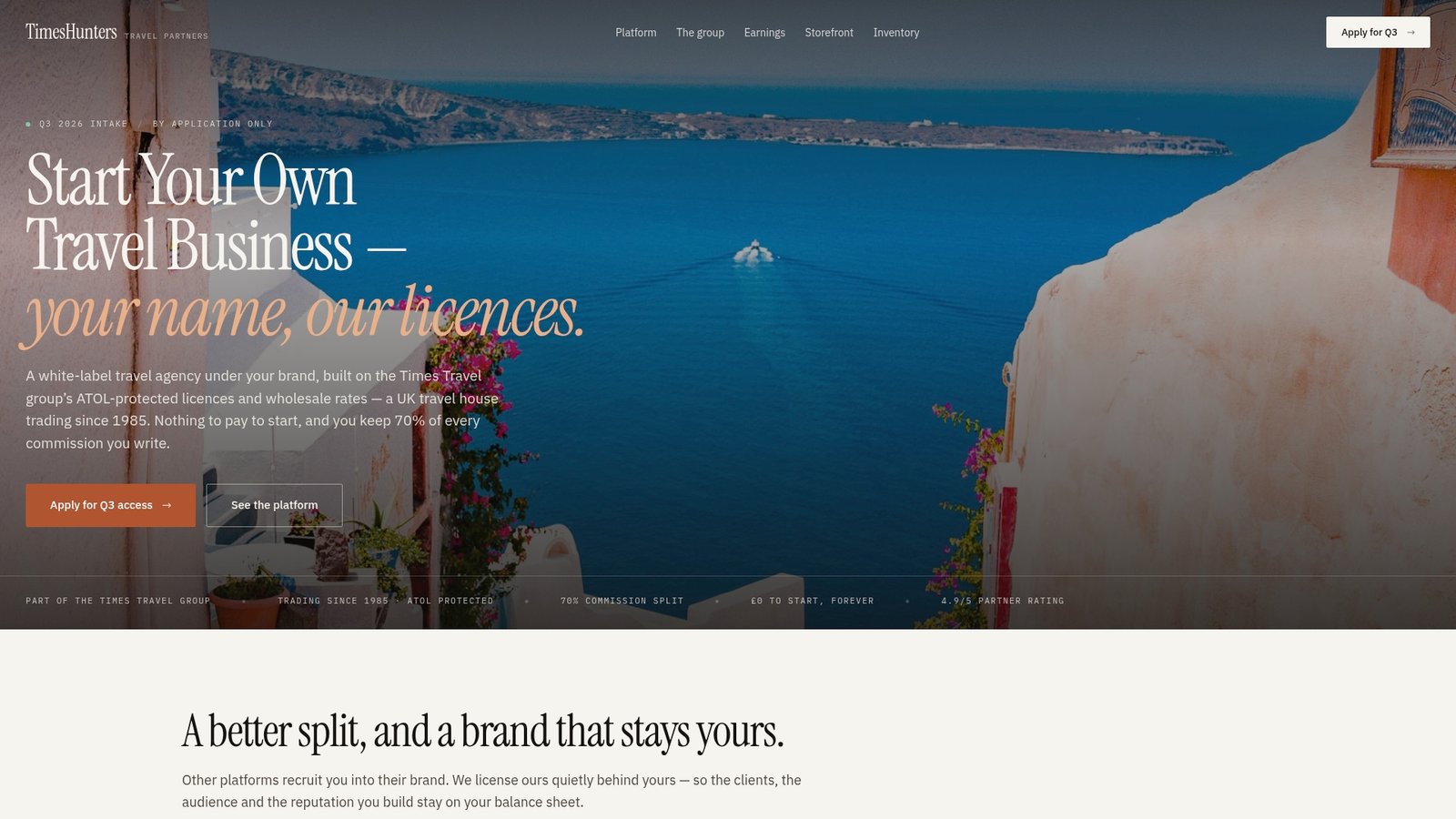
A sharp bio helps only if you have something behind it: a way to take bookings, get paid and protect your clients. That is where we come in. TimesHunters is a white-label travel agency platform that lets you start a travel business under your own name, using Times Travel group’s ATOL-protected licences. You get a branded booking site, access to wholesale hotel, cruise and tour inventory, instant pricing proposals, managed payments and automated client follow-up, plus training and support. The commission split is 70% to you, and the licence’s branding is invisible to your clients.
If you want to see how it would work for your niche, start with our white-label travel agency overview, or look at the 70% commission white-label OTA page to see how the model works. You can also read about the first stages of selling travel to clients before you write a word of your bio.
A five-step process to write your own bio
- Decide the one client you most want. Write a single sentence: “I help [who] to [do what].” If you cannot finish it, you are not ready to write the bio.
- List your proof. Write down every true, checkable fact: years, trips, destinations you have visited, training, reviews. Pick the two strongest.
- Write the long version. Around 150 words for your website, using Example 1 or 2 as a skeleton. Add one human detail.
- Cut it down. Make a 150-character Instagram version, a three-line LinkedIn version and a one-line email signature. Keep the specialism in all of them.
- Test it on a stranger. Ask someone outside the industry to tell you, after ten seconds, what you do and who you do it for. If they cannot, rewrite the first line.
Revisit the bio every few months. Add new reviews, update trip counts and swap in the specialism you are actually selling most. A bio that sat untouched for two years usually shows.
Where to use your bio
The same core message should appear everywhere, adjusted for length and tone:
- Website About page and homepage intro
- Instagram, TikTok and Facebook profiles
- LinkedIn headline and summary
- Email signature and booking confirmations
- Guest posts, podcast guest listings and local business directories
- Quote and proposal documents, as a short “about your advisor” panel
Consistency matters more than cleverness. If a client finds you on Instagram and then visits your website, they should recognise the same person, the same niche and the same promise.
FAQ
What should I put in a travel advisor bio if I am just starting out?
Lead with your niche and the specific reason you know it: trips you have taken, a previous career that taught you useful skills, or an audience you already serve. Be honest about being new, but focus on what you offer now, such as fast replies and careful planning. Add a clear call to action so visitors know how to start.
How long should a travel agent bio be?
Aim for around 120 to 200 words on a website, a single line to three lines on LinkedIn and within 150 characters on Instagram. Put the most important details in the first two sentences, since many people stop reading early. Longer versions are fine if the extra words are specific and useful.
Should I write my bio in the first or third person?
First person usually suits a solo advisor, because it sounds warm and makes the “named person” effect work in your favour. Third person can work on a formal page or a press listing. Whichever you pick, use it consistently across your website and profiles.
Can I mention ATOL protection in my bio?
Only if it accurately describes how you trade, and only in wording you can support. If you operate through a partner’s licence, check how you are required to describe that arrangement before you publish. Our guide to ATOL and trust accounts explains the options for UK agents.
Is a travel advisor the same as a travel agent?
In everyday use, yes. “Travel advisor” emphasises the advice you give, while “travel agent” remains the common term in the UK and has a defined legal meaning in the trade, as ABTA explains. Using both in your bio helps people find you and understand what you do.
Sources
- ASTA press kit: the travel advisor name
- ABTA: how your business trades
- How to write a travel agency bio that converts
- How to write a travel company profile description
- Travel agent Instagram bios to copy and adapt