Travel Agent Support: 30/60/90 Onboarding to Launch in 4–8 Weeks
Practical travel agent support for new entrepreneurs: platform checklist, 30/60/90 onboarding, and the cost and timeline to trade in 4–8 weeks.

Travel agent support means the platform, licensing help, and day-to-day operational backing that lets someone launch a branded travel agency without building everything from scratch. For most first-time owners, the fastest and lowest-risk route is partnering with a host agency or white-label platform that already holds ATOL protection, provides a booking engine, and handles the back-office admin. Building an independent agency from zero is possible, but it costs more upfront and takes considerably longer to get trading.
TL;DR:
- Partnering with a host or white-label platform provides essential onboarding, supplier access, and payment processing, while building independent agency takes longer and costs more.
- Confirm whether your chosen platform offers live wholesale inventory, a branded booking interface, and transparent commission reconciliation, as these directly impact profitability and risk.
- Applying for your own ATOL license involves higher upfront costs and longer timelines but grants maximum control, while using a platform simplifies compliance requirements.
- Expect setup costs between a few hundred to several thousand dollars and a go-to-market timeline of four to eight weeks, with insurance coverage being critical from the start.
- Conduct thorough due diligence including testing transactions, reviewing agency agreements, and requesting references before committing to any platform partnership.
Table of Contents
- What does travel agent support actually cover?
- How does ATOL licensing affect a new travel agency?
- Which platform features actually matter for a white-label agency?
- Which business model suits your situation?
- What will it cost, and how long until your first booking?
- How do you evaluate and onboard with a platform?
- Why the platform route makes more sense than most new owners assume
- Start your branded agency with Timeshunters
- Sources
What does travel agent support actually cover?
The phrase gets thrown around loosely, so it helps to break it into what actually happens behind a booking. Support isn’t one service. It’s a stack of separate functions that all need to work together before a client’s payment turns into a confirmed holiday.
Here’s what falls under that stack:
- Onboarding and accreditation – getting you set up under an existing ATOL or guiding you through your own application
- Supplier and wholesale access – negotiated rates with hotels, cruise lines, and tour operators you couldn’t get alone
- Booking engine and branded storefront – the customer-facing site where quotes and bookings happen under your name
- Payments and reconciliation – collecting client money, paying suppliers, and tracking what’s owed where
- Client follow-up automation – reminders, itinerary updates, and rebooking prompts that don’t rely on you remembering
- CRM and reporting – a record of who booked what, when, and how much commission it generated
- Training and helpdesk access – someone to call when a booking goes wrong at 6pm on a Friday
Onboarding, supplier access, and payments are mission-critical. A platform without wholesale rates or working payment processing isn’t offering support, it’s offering a logo. Training and CRM extras are valuable but secondary. One thing worth flagging early: none of this concerns handling calls from confused travellers about their holiday complaints. That’s a different job entirely, run by tour operators’ own contact centres, not by the platform backing your agency.
How does ATOL licensing affect a new travel agency?
Anyone in the UK making flight accommodation available to the public generally needs an ATOL, unless an exemption applies. That single rule shapes almost every decision a new agency owner makes, because it determines whether you can sell package holidays that include a flight at all.
The Air Travel Organisers’ Licensing (Amendment) Regulations 2012 set this out directly: Regulation 9 requires the licence, and Regulation 22 instructs the Civil Aviation Authority to publish a schedule of agency agreement terms. That schedule matters enormously if you’re not applying for your own ATOL. It defines what an ATOL holder must include in any agreement with an agent selling under its licence, which protects both the customer’s money and your legal standing as the seller.
Statistic callout: ATOL applications assessed by the CAA typically require financial documentation, a review meeting, and completion of the Accountable Persons online course before a licence is granted.
Before signing with any host or platform, confirm:
- Which ATOL number covers your bookings, and whether you can verify it independently
- What the agency agreement says about liability if a supplier fails
- Whether client money sits in a protected trust account or similar arrangement
- How refunds are handled if a flight-inclusive package falls through
If you eventually want your own ATOL rather than trading under someone else’s, the CAA publishes the fees, forms, and assessment steps directly.
Which platform features actually matter for a white-label agency?
Not every white-label portal is built the same, and the differences show up fast once you’re trying to close a booking under pressure. The features that genuinely affect your earnings and risk exposure split into two groups.
Core essentials:
- Live inventory access across hotels, cruises, and package tours at wholesale rates
- A branded booking interface that hides the underlying platform from your customers
- Working payment processing that settles in a currency and timeframe you can plan around
- A back-office dashboard showing bookings, statuses, and commission owed
Operational extras that separate a good platform from an adequate one:
- Automated quote and proposal generation, so you’re not manually pricing every enquiry
- Follow-up sequences that chase abandoned quotes without you lifting a finger
- Clear workflows for changes, cancellations, and refunds
- Transparent commission reconciliation you can check against your own records
Pro Tip: Ask any platform to show you a real commission statement before you sign anything. If the numbers don’t reconcile cleanly against the bookings listed, that’s a warning sign worth taking seriously.
The tradeoff is straightforward. Bundled platforms like Timeshunters compress launch time and shift compliance work onto the provider, but you’re paying for that through subscription or commission-split costs rather than owning the infrastructure outright. White-label portals typically let you launch a rebrandable booking site in weeks rather than months, with itemised ongoing costs for hosting, payments, and platform access built in from day one.
Which business model suits your situation?
Four routes exist for launching a branded agency, and each one handles accreditation and supplier access differently.
- Host agency affiliation. You trade under the host’s ATOL and supplier agreements, usually in exchange for a commission split. Fastest to start, lowest control over branding depth.
- White-label platform. You get a branded storefront, wholesale access, and ATOL cover through the platform’s licence, while operating under your own business name and building your own client list. Speed and branding sit closer together here than with a basic host arrangement.
- Independent agency. You apply for your own ATOL, negotiate your own supplier contracts, and carry full compliance responsibility. Maximum control, maximum cost, and the longest runway before your first booking.
- Franchise. You buy into an established brand’s systems and reputation, often with territory restrictions and ongoing franchise fees on top of commission splits.
Guides on starting a travel business consistently point to the host or white-label route as the fastest and lowest-risk way to reach market, precisely because it avoids the accreditation overhead independent operators face.
If you’re testing the idea part-time alongside another job, a white-label platform lets you build a client base without carrying full regulatory weight. Niche specialists (cruise experts, luxury honeymoon planners) often do best under a white-label setup because it lets them keep a distinct brand identity while still accessing wholesale rates. If you’re aiming to scale into a multi-agent operation eventually, starting under a platform and later transitioning toward independent accreditation is a common, sensible progression rather than an either-or choice.
What will it cost, and how long until your first booking?
Costs vary sharply depending on the route. Independent accreditation means covering ATOL application fees, legal costs for supplier contracts, and building booking technology from scratch, which stretches both budget and timeline. Host and white-label routes compress most of that into a single setup fee plus ongoing subscription or commission-split costs.
Statistic callout: Industry breakdowns of white-label travel portals put typical branding and launch timelines at four to eight weeks, with mid-range setup fees and predictable monthly platform costs built into that period.
Budget for these before you commit. Consider professional assistance for setup by exploring digital marketing and website build services that could help new travel agencies with launch marketing, site setup and early traffic acquisition.
- Setup or onboarding fee (one-off)
- Monthly platform or subscription cost
- Payment processing fees on each transaction
- A marketing runway to generate your first bookings, separate from platform costs
Insurance gets overlooked constantly, and it shouldn’t. Confirm you’re covered by professional indemnity (sometimes framed as errors and omissions) and public liability, either through your host’s policy or your own. Practitioners commonly recommend keeping several months of operating cash in reserve while bookings ramp up, since commission income tends to lag behind the marketing spend that generates it.
How do you evaluate and onboard with a platform?
Run through this before signing anything:
- Confirm ATOL cover and read the actual agency agreement, not just a summary
- Ask for a sample commission statement and check it reconciles
- Test the payment flow with a small transaction if the platform allows it
- Check what training and helpdesk support is included, and how it’s delivered
- Clarify who owns your client data if you ever leave the platform
- Request references or partner testimonials you can actually contact
Once you’re in, a simple 30/60/90 plan keeps momentum:
- Days 1 to 30: branding, storefront setup, and a mock booking through to settlement
- Days 31 to 60: live test bookings, staff training, refining your quote templates
- Days 61 to 90: first marketing push, then a review of commission accuracy and client feedback
Pro Tip: Run one full mock booking through to settlement before taking real client money. It’s the single fastest way to expose gaps in reconciliation, VAT handling, or refund logic while the stakes are still zero.
Why the platform route makes more sense than most new owners assume
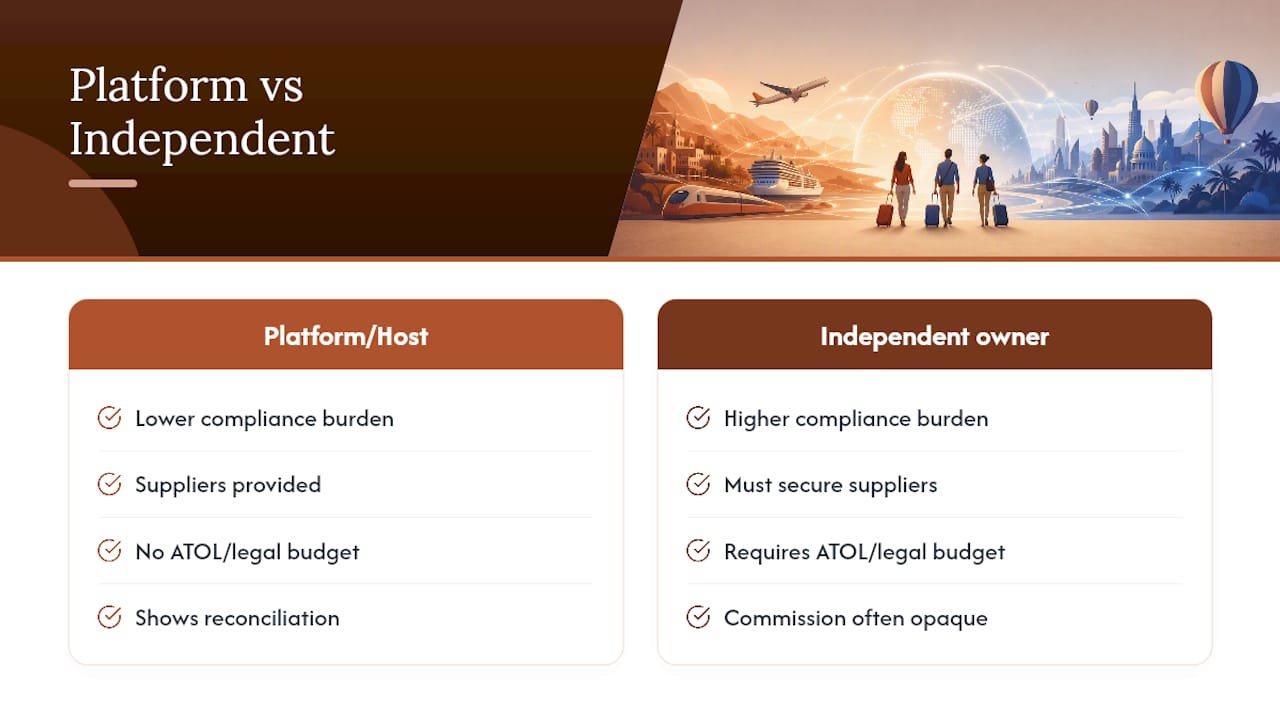
Most people overestimate how much independence matters in year one and underestimate how much compliance work drains their time. I’d argue the platform or host route isn’t a compromise, it’s the sensible default for anyone without existing supplier relationships or legal budget to burn on an independent ATOL application.
That gap illustrates why commission transparency matters more than brand independence when you’re starting out. Run the checklist above before you commit to anyone. The platforms worth trusting won’t flinch at showing you a real reconciliation statement.
— Sam
Start your branded agency with Timeshunters
A white-label platform can get you trading under your own brand in weeks, not months, because the ATOL cover, wholesale rates, and booking technology are already built and waiting for you to plug into.
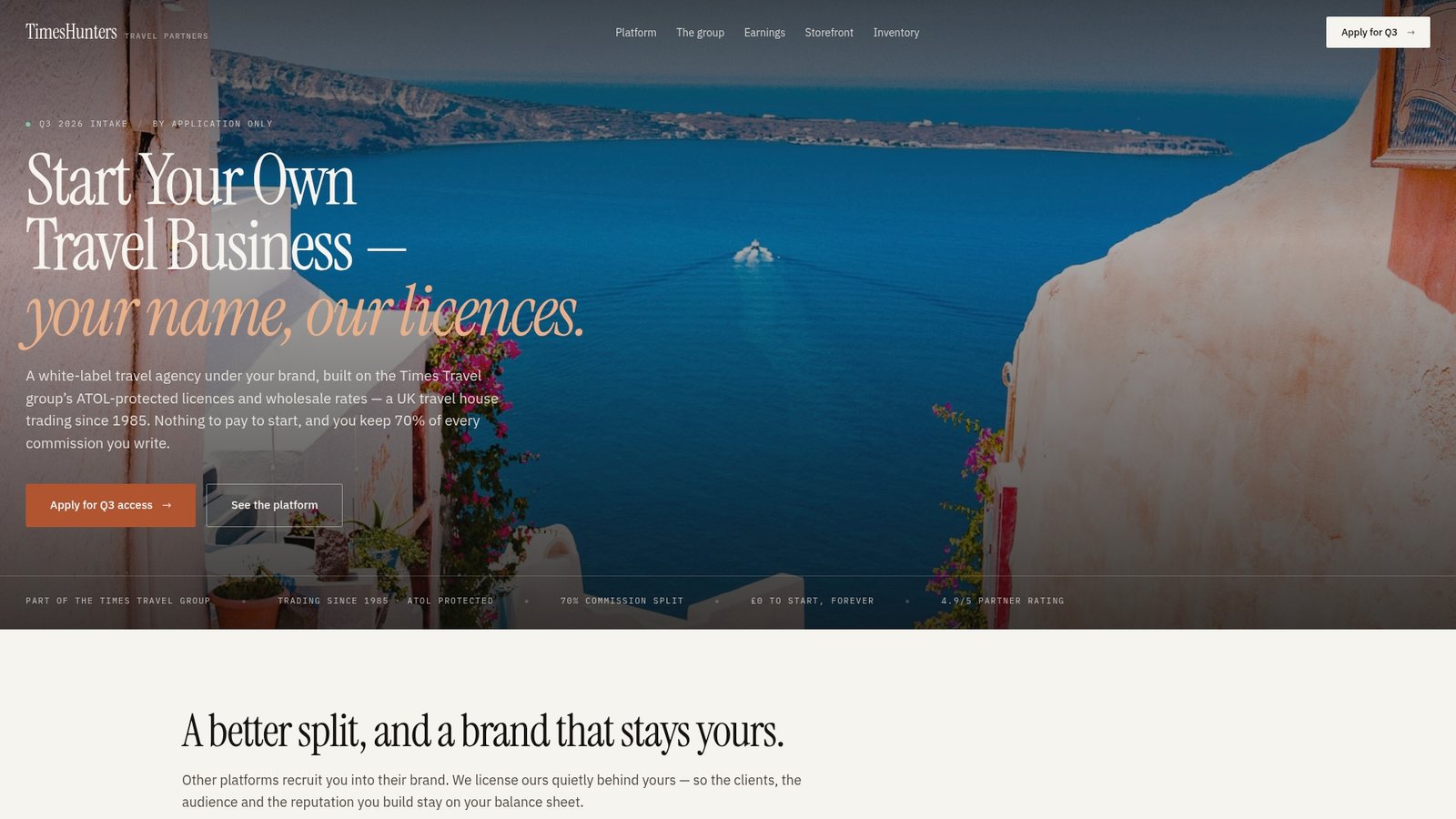
Such platforms can provide access to ATOL-protected licences, wholesale hotel, cruise, and tour inventory, and a branded booking site with automated client follow-up baked in. This model suits anyone with an existing audience who wants to turn that trust into a commission-earning business without the compliance burden of an independent ATOL. If the checklist above has you thinking a bundled route beats building from scratch, visit the Timeshunters partner programme to see what onboarding actually involves before you decide.