
£112 from a £2,000 Cruise: Wholesale Rates via White Label for Agents
Learn where trade sellers get net fares, why nominal commission shrinks, a worked £2,000 example, and how white-label platforms let agents start selling...
Wholesale cruise rates are the net, trade-only fares and cabin inventory that cruise lines and consolidators release to registered travel sellers, not the “discount” prices you see splashed across consumer sites. The fastest way into that inventory is a host agency or white-label platform that hands you an agency code, supplier logins and booking software on day one. TimesHunters is one direct route worth investigating if you want that access without building a licence structure from scratch.
TL;DR:
- Most cruise suppliers pay commissions only on the commissionable fare after non-commissionable fees are deducted, which can significantly lower actual earnings.
- Accessing the best wholesale rates typically requires joining a host agency or white-label platform, with consortia and direct contracts reserved for experienced agencies with volume and cash flow.
- Building margins involves adding visible value to clients and calculating markup on the commissionable fare, not the total booking amount, to ensure sustainable profitability.
- Completing supplier training early and buying group space in advance helps agents unlock better perks, lower costs, and qualify for unpublished offers or quiet inventory.
- Trends indicate a shift towards more fully commissionable pricing and specialization, which improve margins and conversion rates for niche cruise markets.
Table of Contents
- What do wholesale cruise rates actually mean for trade sellers?
- How much of that commission actually reaches you?
- How do you get set up to sell wholesale cruise inventory?
- How do you protect your margin once you’re pricing?
- What trends should you actually watch this year?
- Start selling wholesale cruise inventory under your own brand
- Sources
What do wholesale cruise rates actually mean for trade sellers?
Forget the retail meaning of “wholesale.” In the trade, wholesale cruise rates refer to net fares released to accredited sellers, commissionable inventory blocks, and unpublished offers that never reach a consumer’s browser. Access depends on how you plug into the supply chain, and three routes dominate.
- Host agencies and white-label platforms give you net fares, an agency code, financial protection where it applies, and a booking system connected to major suppliers, usually within days of signing up.
- Consortia and preferred-seller status reward volume. Large buying groups negotiate overrides, cabin perks and unpublished fares that a lone agent booking a handful of cabins a year will rarely see on their own.
- Direct supplier contracts and group blocks suit agencies with real cash and forecasting confidence. You commit to buying cabin space ahead of demand, which only pays off if you can fill it.
- Quiet, unpublished offers exist because cruise lines want to move soft inventory without damaging brand pricing. They go to sellers who can prove sales velocity or consortia membership, not to whoever asks first.
For most people starting out, host or white-label access is the only realistic entry point. Consortia perks and direct contracts come later, once you have booking history to show.
How much of that commission actually reaches you?
Here’s the part most newcomers get wrong: the headline commission rate on a cruise fare is not what lands in your account. Commission is calculated on the commissionable fare, not the total invoice, and that gap has been widening for years.
Non-commissionable fees (NCFs) can strip out a meaningful chunk of the fare before commission is even calculated, and ASTA’s own analysis shows these fees have quietly eroded effective commission rates across the industry, turning a nominal 10% commission into something closer to half that in real terms once port charges, taxes and certain surcharges are stripped out.
Timing matters too. Most cruise lines pay commission shortly after the client’s final payment date, not after the ship sails, but the exact window varies by supplier, and building your cashflow around the wrong assumption will bite you.
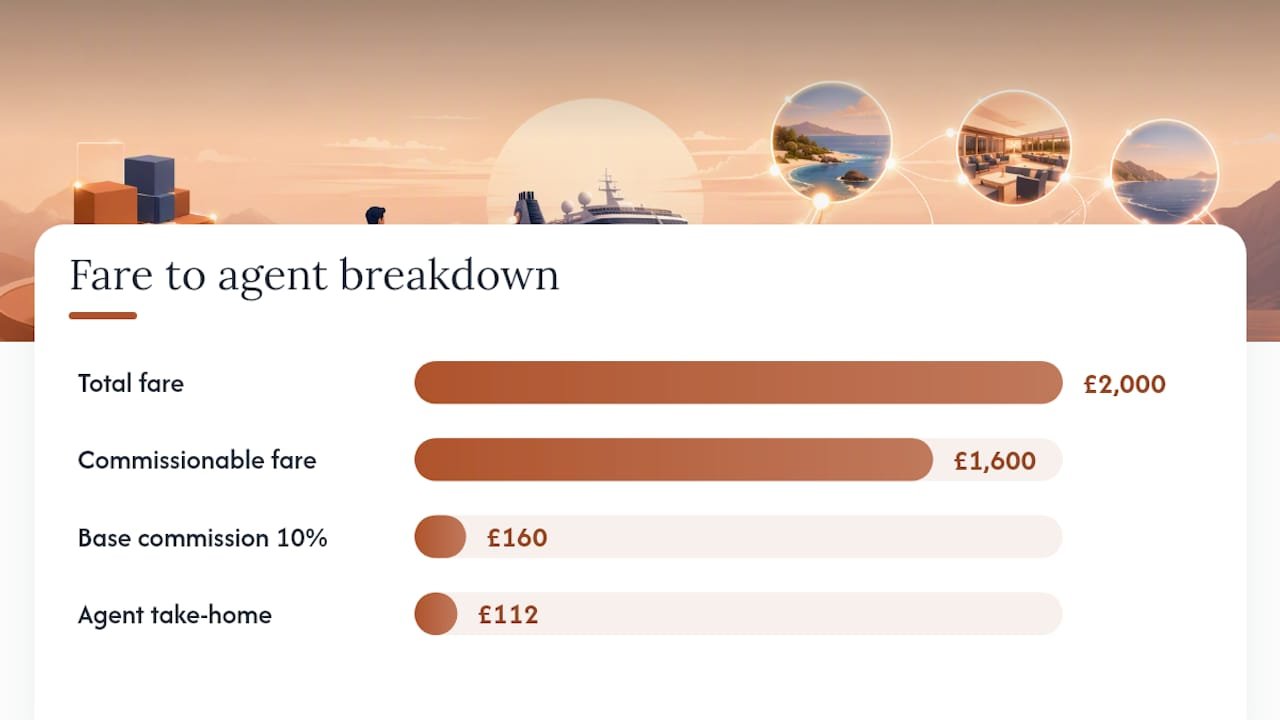
A worked example makes this concrete. Say a client books a £2,000 cruise, of which £1,600 is commissionable fare after NCFs are stripped out.
- Base supplier commission at 10% on £1,600 = £160.
- Under a white-label split where the partner keeps 70%, the agent takes home £112.
- The host retains £48 to cover licensing, ATOL protection, systems and support.
That £112 is your real number, not the £200 you’d calculate naively against the full booking value. Getting this maths right before you quote is what separates agents who survive their first year from those who misjudge margin and quietly go under.
How do you get set up to sell wholesale cruise inventory?
Getting from “interested” to “taking bookings” is mostly paperwork and platform setup, not a long apprenticeship.
- Gather your documentation. Most host agencies or white-label platforms want identity verification, a business registration (even as a sole trader), and sometimes a short application describing your target clients. ATOL protection is usually handled through the host’s licence rather than requiring you to hold your own.
- Pick your access route deliberately. Host or white-label suits solo starters wanting speed. Consortia membership suits agencies with existing volume. Direct contracting suits those with capital to hold group space.
- Build your operational stack. You need a booking platform connected to supplier systems, a way to take payments securely, clear client terms and conditions, and basic reporting so you can track commission against what actually gets paid.
- Complete supplier training. Cruise lines gate their better rates and perks behind training modules and sales thresholds. Celebrity Cruises’ expanded training programme for UK and Ireland agents is a good example of suppliers rewarding agents who invest the time.
- Understand group-space lead times. Agents who buy group blocks early lock in lower per-cabin costs, but that space has to be released or filled well before sailing, so factor lead times into your first-year planning.
Pro Tip: Book your first supplier training module in your opening week, even before your first client enquiry. Preferred-seller status and quiet offers are earned through proof of activity, and training completion counts toward that record from day one.
How do you protect your margin once you’re pricing?
Rebating, quietly handing part of your commission back to the client as a discount, breaches most supplier agreements and can get your agency code suspended. The safer play is adding value the client can see: onboard credit, a bespoke shore excursion bundle, or a curated pre-cruise hotel stay that a generic booking site won’t offer.
- Calculate your markup against the commissionable fare, not the gross price, so you know your real margin before you quote.
- Consider a flat planning fee for complex, multi-port or multi-generational bookings where your time input is high and the commission alone doesn’t cover it.
- Upsell travel insurance, private transfers and pre- or post-cruise hotel nights. Many of these carry their own commission, stacking on top of the cruise fare itself.
- When a client compares your price to an online agency’s headline figure, walk them through what’s included rather than matching the number. Value beats price on a repeat-booking relationship.
Pro Tip: Script your value conversation before you need it. “This includes priority boarding, a dedicated cabin upgrade watch, and 24-hour support if anything changes” lands better in the moment than improvising when a client pushes back on price.
What trends should you actually watch this year?
NCF pressure isn’t going away, but some suppliers are experimenting with more fully commissionable pricing structures in response to agent pushback. Favour the ones doing this over those quietly widening the non-commissionable slice of every fare.
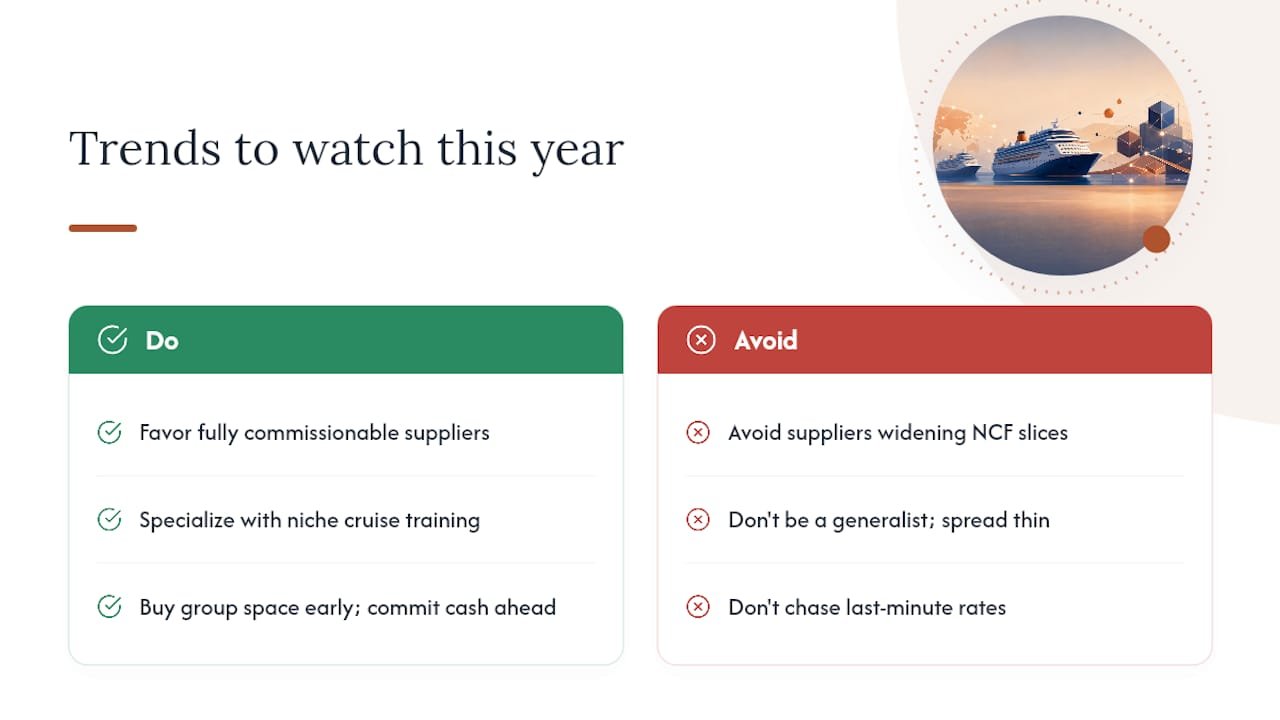
Specialisation pays. Agents who complete niche training in river, expedition or luxury cruising convert more consistently and hold better margins than generalists spreading thin across every cruise line. A partner like UnCruise’s Hawaii expedition product shows what specialist product knowledge looks like in practice.
Group space, bought early, still beats chasing last-minute rates for agents willing to commit cash ahead of demand.
— Sam
Start selling wholesale cruise inventory under your own brand
A white-label platform can provide immediate trade access without the licensing headache, offering direct access to wholesale cruise, hotel, and tour inventory, along with automated booking management to streamline sales.
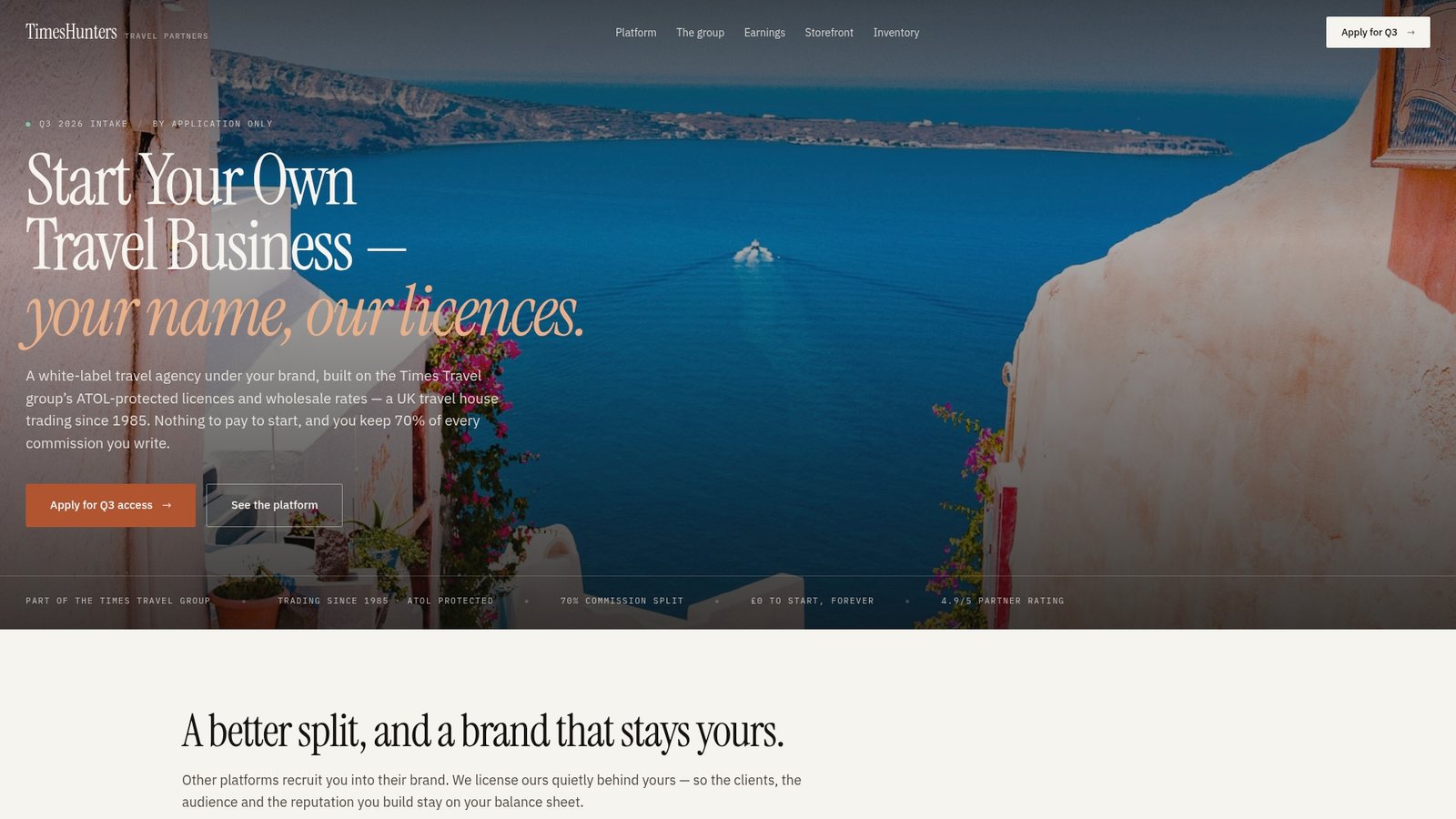
Some partners report an increase in income per booking after switching to such a platform. Onboarding often includes a branded booking site, instant pricing proposals, and training, enabling quoting of real net fares within days rather than weeks. Visit TimesHunters to see how the application process works and start building your own branded cruise business.