
Keep 70% Commission When You Launch a White Label OTA in the UK
UK entrepreneurs' guide to launching a white label OTA with ATOL cover. Vendor checklist, timeline, compliance steps and 70% commission.

A white label OTA is the fastest way for an entrepreneur to own a branded travel business without building booking technology from scratch, provided you choose a partner with ATOL protection in place. Before you sign anything, work through a vendor checklist covering inventory, commission and compliance, and understand the legal essentials that apply to anyone selling flight-inclusive holidays. Turnkey platforms exist that already bundle ATOL arrangements, wholesale rates and booking technology, so the research phase is usually shorter than people expect.
TL;DR:
- Using a turnkey white label OTA platform with ATOL protection can enable a fast launch within weeks, compared to months for building from scratch.
- White label partnerships keep your brand on all customer-facing pages and ownership of customer data, unlike affiliate models that direct traffic away from your brand.
- Margins come mainly from higher commission splits, bundling flights and hotels, ancillary sales, and repeat business due to owning the customer relationship.
- Key platform features include a mobile-friendly booking engine, live inventory feeds, comprehensive analytics, automation tools, and clear attribution tracking.
- Select platforms carefully by verifying inventory access, commission structures, ATOL arrangements, support levels, and customization options before committing.
Table of Contents
- What a white label OTA is and how it differs from affiliate or marketplace models
- The OTA software stack: the components you must source or verify
- What the white label model delivers commercially and where margins come from
- How to choose a white label OTA platform: an actionable evaluation checklist
- Launch checklist and realistic timeline: from sign-up to first live bookings
- Legal and financial protection essentials for UK operators
- Common mistakes and operational pitfalls to avoid
- Why TimesHunters is a practical route to launch
- Post-launch marketing strategies specific to white label OTAs
- Customer acquisition and retention techniques tailored for white label OTAs
- Integration with third-party suppliers and content management systems
- Scalability and customisation options of white label OTA platforms
- When to commit to white label and when to test first
- Get started with a white label launch
- FAQ
- Sources
What a white label OTA is and how it differs from affiliate or marketplace models
A white label OTA lets you put your own brand name, logo and domain on a travel booking platform that someone else builds and operates behind the scenes. The customer journey, from browsing to paying to receiving a confirmation, stays on your site under your name. That is the key difference from an affiliate or marketplace model, where you send visitors to a third-party site to complete their booking, and you never really own the relationship.
The commercial gap between the two models is wide. Affiliate deals for hotel bookings commonly pay around 5% of the confirmed booking value, largely because the affiliate takes on none of the operational risk and has no ongoing contact with the customer. White label arrangements split commission far more generously because the partner is doing more: building a client list, giving advice, and often handling the sale conversation directly.
A few practical distinctions worth weighing before you decide which route fits:
- Branding: white label keeps your name on every page and every email; affiliate links send traffic away from your brand entirely.
- Data ownership: white label partners typically keep the customer record; affiliates rarely see more than a click report.
- Commission structure: white label splits are usually a meaningful percentage of booking value; affiliate payouts tend to sit in the low single digits.
- Operational involvement: white label expects you to manage client relationships and sometimes payments; affiliate requires almost no ongoing effort.
An affiliate test can be the right starting point if you are unsure whether your audience books travel at all. Once you have proof that people will buy through you, a white label setup turns that same audience into a far more valuable asset.
The OTA software stack: the components you must source or verify
Every white label OTA sits on the same handful of technical building blocks, whether the vendor built them from scratch or licensed them from elsewhere. Knowing what each piece does lets you ask sharper questions on a demo call.
- Booking engine and storefront: the customer-facing site where people search, compare and pay; look for mobile-first design and a short checkout, since conversion rates hinge on both.
- Inventory and connectivity: links into wholesale suppliers, GDS feeds and hotel aggregators that pull live availability and pricing into your storefront.
- Payments and reconciliation: a merchant account or managed payment service that handles customer charges, supplier payouts and refunds without you reconciling spreadsheets by hand.
- Attribution and analytics: tracking that tells you which bookings came from which marketing channel, including how long the cookie or attribution window stays open.
- Back-office operations: the tools for managing live bookings, chasing supplier confirmations and answering customer queries after the sale.
Mobile behaviour matters more than many new operators expect: a growing share of travel bookings now happen on mobile devices, which is one reason storefront quality and checkout speed carry real weight in conversion performance. A clunky mobile checkout loses bookings that a smoother one would have closed.
Attribution deserves particular care. Some platforms close the attribution window quickly, crediting only short-planning-cycle bookings to the partner who generated the lead, which can quietly erode revenue on longer-planned holidays where the customer researches for weeks before booking. Ask any vendor exactly how long their attribution window runs and what happens when a customer returns after it closes.
On the operational side, businesses that already run a physical or service-based operation, such as accommodation providers like Executive Accommodation in Marbella, offer a useful comparison point: the back-office discipline needed to reconcile bookings, manage refunds and keep supplier records straight is similar whether you are renting apartments or selling package holidays.
Pro Tip: Ask to see the back-office dashboard before you sign anything: a platform that looks polished on the customer side but clunky on the admin side will cost you hours every week.
What the white label model delivers commercially and where margins come from
The commercial logic of white label is straightforward once you see it laid out. Instead of a flat, low affiliate percentage, you receive a commission split on every booking you generate, and that split is usually far larger because you are doing more of the selling and relationship work yourself.
Margin in this model comes from several levers working together:
- Commission splits: the core income stream, paid as a percentage of each confirmed booking rather than a flat referral fee.
- Mark-ups and dynamic packaging: bundling flights, hotels and extras often produces a better margin than selling each component separately.
- Ancillary sales: add-ons such as travel insurance, airport transfers or excursions that stack additional revenue onto a single booking.
- Repeat business: because you own the client relationship, a satisfied customer books again without any new marketing spend.
Owning the customer record is the quiet advantage here. Industry analysts covering the OTA sector note that owning the customer relationship is becoming one of the clearest differentiators for new entrants, as platforms shift from pure booking engines toward broader loyalty-driven relationships. When you hold the client list, every repeat booking and referral costs you nothing in new marketing spend, which affiliate models never let you capture.
The one caveat worth building into your financial model is attribution risk. If a platform’s tracking window closes before a customer who researched for weeks finally books, you may lose credit, and therefore commission, on exactly the sales that took the most work to generate.
How to choose a white label OTA platform: an actionable evaluation checklist
Choosing the wrong platform is expensive to undo once you have built a client base on it, so treat the selection process as seriously as you would any other business partnership.
Work through these categories with every vendor you consider:
- Inventory access: which wholesale suppliers, hotel aggregators and GDS feeds does the platform connect to, and how current is the pricing?
- Commercial terms: what is the exact commission split, and are there hidden deductions for payment processing or platform fees?
- Attribution: how long does the cookie or tracking window stay open, and what happens to bookings made after it closes?
- Payments: does the platform manage merchant accounts and refunds for you, or is that your responsibility?
- Customisation: can you change branding, domain and site layout, or are you limited to a template?
- Reporting: what does the partner dashboard show, and can you export booking and commission data?
- Support and service levels: what response times apply when a booking goes wrong or a supplier fails to confirm?
- Legal and ATOL arrangements: is flight-inclusive travel sold under the platform’s ATOL, and what paperwork does that require from you?
Sample questions worth sending in writing before a demo call, so you have a record of the answers:
- “What percentage commission split do partners receive, and is that fixed or tiered by volume?”
- “Which ATOL holder protects flight-inclusive bookings made through your platform, and what does that mean for my branding?”
- “How long is your attribution window, and how are bookings credited if a customer returns after that window closes?”
- “Can I see a live partner dashboard before I commit?”
Pro Tip: Ask for the names of two or three existing partners you can speak to directly. A platform confident in its service will arrange this without hesitation.
Three red flags that justify walking away immediately: a vendor that will not name which ATOL holder protects your bookings, a commission structure that changes without written notice, and a refusal to let you see the back-office dashboard before signing a contract. Any one of these suggests the partnership will cost you more than it earns.
Launch checklist and realistic timeline: from sign-up to first live bookings
A turnkey white label platform typically gets you from sign-up to your first live booking within a matter of weeks, since the booking engine, inventory connections and ATOL arrangements already exist. Building a custom OTA from scratch, by contrast, routinely stretches into many months once you account for development, supplier negotiations and compliance work.
The practical launch sequence looks roughly like this:
- Sign the agency agreement: confirm commission terms, ATOL arrangements and branding rights in writing before doing anything else.
- Set up merchant and payment processing: get your payment flows tested with real card transactions before you advertise.
- Customise your storefront: upload your branding, write your site content and configure your domain.
- Test the full booking flow: run complete dummy bookings through to confirmation and ATOL certificate issuance to catch errors early.
- Train on back-office tools: learn how bookings, refunds and supplier confirmations appear in your dashboard.
- Go live and start marketing: launch your site publicly and begin directing your existing audience toward it.
Costs tend to cluster into three buckets: a one-off set-up cost (if the platform charges one), the variable commission split taken on every booking, and payment processing fees that apply per transaction. Separating these in your financial model early avoids confusion later when reconciling monthly statements.
Legal and financial protection essentials for UK operators
Anyone selling flight-inclusive holidays needs to understand ATOL before launching, because the rules determine who is financially responsible if a supplier fails. The UK Civil Aviation Authority requires an ATOL for anyone making available flight accommodation, unless a specific exemption applies, and ATOL applications carry fixed fees plus per-passenger charges.
The distinction between acting as an agent and acting as an organiser matters more than most new entrants realise. An agent sells on behalf of an ATOL holder and relies on that holder’s licence; an organiser puts packages together under their own ATOL and faces capital and administration checks as a result. A white label arrangement typically lets you operate as an agent under the platform’s existing ATOL, which is precisely why the model removes a significant regulatory burden for a new entrant.
Practical compliance points to get right from day one:
- Display ATOL protection clearly: publicity material and your website must state the ATOL number and make clear which bookings are protected.
- Issue ATOL certificates correctly: every flight-inclusive booking needs a certificate generated and sent to the customer without fail.
- Put a written agency agreement in place: ABTA guidance stresses that members should have agency agreements in place and that websites and booking procedures meet ABTA’s standards where agents sell travel arrangements.
- Know when to seek legal counsel: if your agreement is unclear on who holds liability for a cancelled supplier, get it reviewed before you launch, not after a complaint.
Testing these mechanics in full, including the ATOL certificate step, during your pre-launch QA phase is one of the most reliable ways to catch a compliance gap before a real customer ever sees it.
Common mistakes and operational pitfalls to avoid
New OTA operators tend to trip over the same handful of problems, most of which are avoidable with a bit of upfront diligence.
- Misjudging regulatory exposure: assuming you are automatically protected as an “agent” without confirming which ATOL holder actually covers your bookings.
- Accepting opaque attribution: signing up to a platform that will not explain how its tracking window works, then discovering later that long-researched bookings were not credited to you.
- Skipping booking flow tests: launching without running a complete dummy booking through to ATOL certificate issuance, which is exactly where errors tend to hide.
- Leaving refund procedures vague: not knowing in advance who handles a refund or rebooking when a supplier cancels, which leaves you improvising during a stressful customer call.
Why TimesHunters is a practical route to launch
For entrepreneurs who want the checklist above satisfied without building any of it themselves, we built TimesHunters around exactly this gap.
- We give partners a white label travel agency platform with ATOL-protected licences already in place, so you never have to apply for your own.
- Our commission split pays partners a significant percentage on bookings, well above the roughly 5% that affiliate models typically pay out.
- We provide a branded booking site, wholesale rate access and automated booking management, so the back-office burden described earlier in this guide is handled for you.
- One partner reported increased income per booking after moving to this model, which illustrates the gap between affiliate-level payouts and a genuine commission split.
If you want to see how the platform fits your own plans, our white label travel agency page walks through the commercial model and inventory access in more detail.
Post-launch marketing strategies specific to white label OTAs
Marketing a white label OTA differs from marketing a generic travel blog or comparison site, because your advantage is the relationship, not the volume of traffic you can attract. Lean into content that positions you as a travel adviser rather than a search engine: destination guides, curated package suggestions and direct outreach to your existing audience tend to convert better than broad paid advertising in the early months.
Email remains one of the most reliable channels for a new branded agency, since you already own the list and the relationship. Segmenting past enquirers by destination interest and sending timed offers around booking windows (school holidays, shoulder-season deals) tends to outperform generic newsletters.
Social proof matters too. Encouraging early customers to share their trip photos and tagging your brand builds the kind of organic reach that a brand-new OTA cannot buy quickly. Because the booking journey stays on your own site under white label, every piece of content you publish reinforces your brand rather than sending credit to someone else’s.
Paid search and social advertising still have a place, particularly once you have enough booking data to know which destinations and traveller types convert best for you. Start narrow, focused on the routes and packages your supplier feeds price most competitively, and expand once you can see which campaigns actually produce bookings rather than clicks.
Customer acquisition and retention techniques tailored for white label OTAs
Acquisition for a white label OTA usually starts with an audience you already have, whether that is a social media following, a local client base or a professional network, rather than cold traffic. That existing trust is the single biggest advantage over a generic affiliate site, so the first marketing task is simply making that audience aware you now sell travel directly.
Referral incentives work particularly well in this model because you keep the full client record and can track exactly who referred whom. A modest discount or loyalty credit for a successful referral costs you far less than paid acquisition and tends to bring in higher-intent customers.
Retention depends on the quality of service after the booking is made, not just before. Automated client follow-up, sending trip reminders, post-trip check-ins and relevant offers for the next holiday, keeps your brand in front of customers without manual effort on your part. Because white label platforms typically retain the full booking history, you can personalise these follow-ups around where a customer has already travelled rather than guessing.
The compounding effect is the real prize: a customer who books once through your brand and has a smooth experience is far more likely to book again directly with you, skipping any new marketing spend entirely.
Integration with third-party suppliers and content management systems
The quality of your supplier integrations determines how competitive your pricing looks and how reliable your availability data is, so it is worth understanding how this works before you commit to a platform. Wholesale suppliers, hotel aggregators and GDS feeds each push live pricing and availability into your booking engine, and the strength of those connections is largely invisible to your customers until something goes wrong, a room shows as available when it is not, for instance.
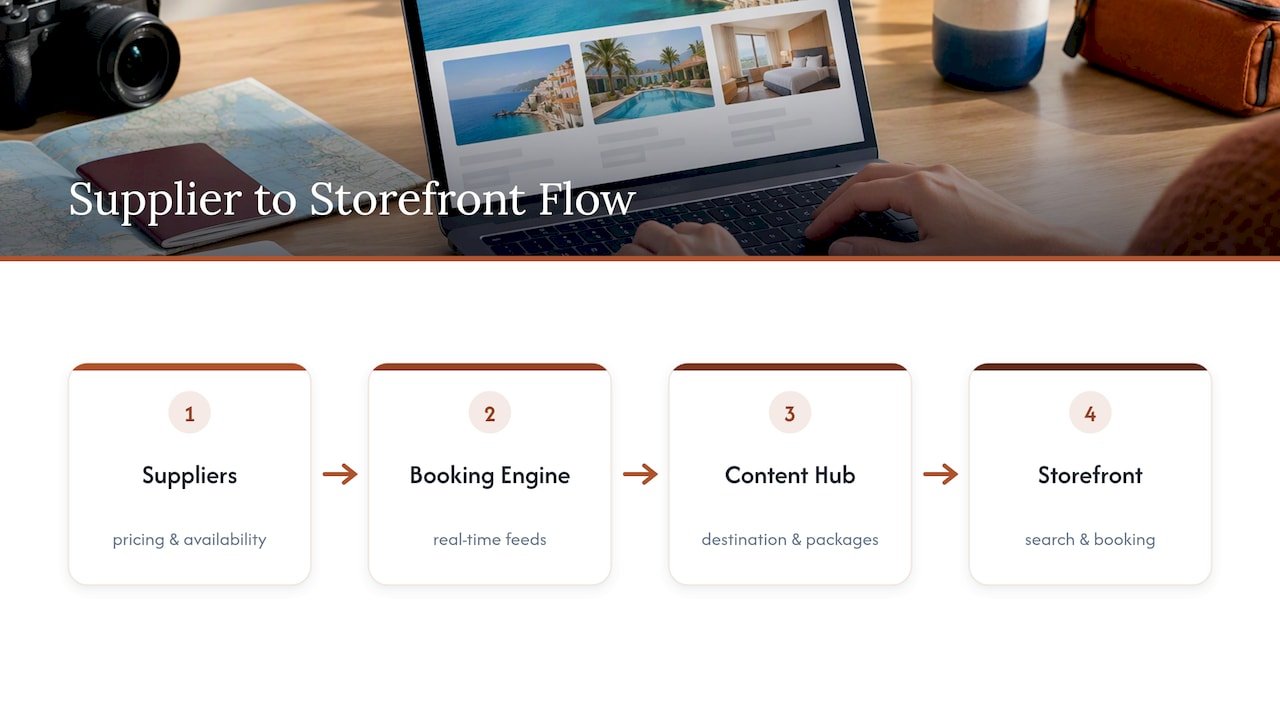
Content management matters almost as much as the booking technology itself. Your storefront needs destination descriptions, imagery and package content that feels current and trustworthy, and most white label platforms handle this centrally so you are not writing and maintaining content for thousands of hotels and tours yourself.
Generative and AI-driven tools are increasingly part of this layer. Industry coverage of the OTA sector notes that AI-assisted personalisation is moving from experimentation to a standard feature for improving search relevance and conversion on OTA storefronts, which is worth asking about if you expect your platform to keep pace with competitors over the coming years.
Scalability and customisation options of white label OTA platforms
A platform that works well for ten bookings a month needs to keep working when you are handling two hundred, so scalability is worth testing for before volume becomes a problem rather than after. Ask how the platform handles growth in supplier connections, payment volume and customer support load, since some back-office tools that feel fine at low volume become a bottleneck once bookings increase.
Customisation ranges widely between providers. Some let you fully rebrand the domain, layout and email templates; others restrict you to a template with your logo dropped in. The former gives you a genuinely independent-feeling brand; the latter can look obviously templated to a sceptical customer comparing you with a direct airline or hotel site.
The most useful platforms let you scale into new product categories, cruises, villas, safari camps, rail, without renegotiating your entire commercial arrangement each time. That flexibility matters most once your client base starts asking for holiday types beyond your original focus, and switching platforms at that point is far more disruptive than confirming category breadth upfront.
When to commit to white label and when to test first
Commit when you already have an audience, a marketing plan and the time to manage client relationships properly. If you are unsure whether people will book through you at all, run a short affiliate test first. Either way, the fastest sustainable route remains a white label launch under proper ATOL cover.
— Sam
Get started with a white label launch
We built TimesHunters to put every item on the checklist above in place before you ever take a booking.
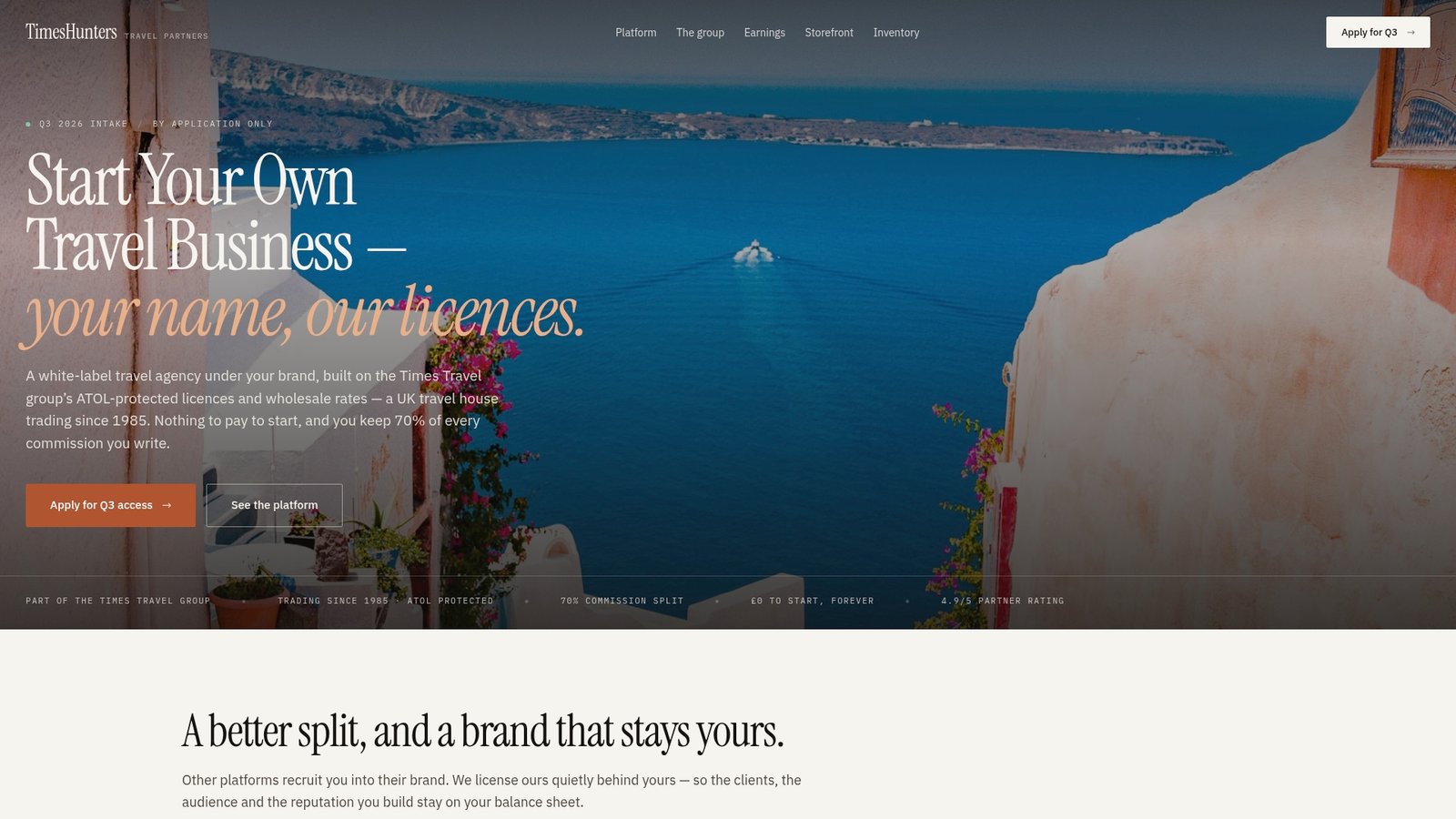
- Our partners operate under ATOL-protected licences already held by Times Travel group, so you skip the application process entirely.
- We pay a 70% commission split, with the full split structure detailed on our platform page.
- Branding, wholesale rates and automated booking management are set up for you, so you spend your time on clients rather than infrastructure.
If the checklist in this guide matches what you are looking for, visit our white label travel agency page to see how quickly you can get a branded site live.
FAQ
What does OTA mean in hotel booking?
OTA stands for online travel agency, a company that sells hotel rooms, flights or packages through a website rather than a physical shop. In a white label OTA, that booking technology and supplier access are licensed to a partner who sells under their own brand name.
Do travel agents get paid for booking hotels?
Yes, travel agents typically earn a commission on each confirmed booking, with the percentage depending on the commercial model. Affiliate arrangements commonly pay around 5% of booking value, while white label commission splits are usually structured to pay the partner a far larger share, such as the 70% split offered through TimesHunters.
What is an OTA online travel agency?
An OTA is simply a business that sells travel, flights, hotels, packages or tours, through an online booking platform rather than a traditional high street agency. A white label OTA is a variant where an entrepreneur runs their own branded version of that platform under a licence from an established provider.
Who is the biggest online travel agency?
Market size rankings among global OTAs shift depending on the metric used (bookings, revenue or market capitalisation) and the source consulted, so no single definitive answer applies across every market. Entrepreneurs evaluating a white label OTA are generally better served comparing commission structures and ATOL arrangements than tracking which global OTA currently leads by size.