
Sell Travel: 7 Stages for UK Independent Agents Who Put Fit First
UK travel agents can attract qualified enquiries, use a seven stage funnel, and turn discovery calls into better fit bookings with practical scripts.

Sell more travel to clients by combining targeted awareness with an intentional multi-touch sales funnel and a friction-free booking path. In the next week, run one targeted content or ad test aimed at a narrow audience, and open three discovery-call slots to capture the enquiries it generates. The rest of this guide gives you the scripts, the cadence and a higher-commission route worth knowing about.
TL;DR:
- Judge each marketing channel after four weeks using cost per qualified enquiry; qualify prospects by budget range, rough dates, and reason for travel.
- Qualify leads before calls, then use a focused discovery conversation and close with a dated commitment; follow up on Days 2, 5, 10, and 21.
- Show the full trip price, fees, deposit, and extras before payment, explain refund terms, and send confirmations within minutes with applicable ATOL certificates.
- Present personalized Good, Better, Best proposals that reflect the client’s stated priorities, show complete pricing, and end with one clear action and deadline.
Table of Contents
- Attracting the right clients: niche positioning and channels that deliver qualified enquiries
- Build an effective travel sales funnel: stages, qualification and proposal formats
- Reduce friction at booking: pricing, payments, and consumer protections agents should explain
- Scripts and email templates that convert: discovery call and follow-up sequence
- Techniques for building and nurturing an email list of travel prospects
- Leveraging social media content strategies to engage and convert clients
- Effective ways to create personalized travel proposals that close sales
- Referral programs and incentives to encourage client recommendations
- How to use testimonials and social proof to increase trust and bookings
- Author perspective: sell with care, choose fit over volume
- Explore TimesHunters: a route to higher commission and a turnkey agency model
- FAQ
- Sources
Attracting the right clients: niche positioning and channels that deliver qualified enquiries
Generic “we book holidays” marketing attracts browsers, not buyers. Choosing a narrow focus such as family river-cruise planning, bespoke safari itineraries or corporate offsite organising lets you speak directly to a buyer’s specific worry, which is what turns a casual visitor into an enquiry.
Once the niche is set, the channel choice gets easier. SEO content built around buying-intent search terms (not just destination inspiration) brings in people who are close to booking. A newsletter keeps warm leads thinking about you between trips. Referral partnerships with hotels, venues or complementary businesses bring pre-qualified introductions. Targeted social ads work best when they point to a specific package rather than a brand awareness message, and local events or talks build trust faster than any ad can.
Content that actually converts tends to share three traits:
- Destination-first hubs that answer a specific planning question rather than listing generic highlights.
- Packaged offers with transparent, all-in pricing shown up front rather than “prices from” teasers.
- Lead magnets, such as a short itinerary quiz or planning checklist, that filter for real intent rather than just collecting e-mail addresses.
Track cost per qualified enquiry, not just clicks or likes. A qualified enquiry is someone who has shared a budget range, rough dates and a reason for travelling. Run each new channel for four weeks before judging it: week one to set up tracking, weeks two and three to gather enquiries, week four to compare cost per qualified enquiry against your existing channels.
Pro Tip: Build one travel agency website page per niche package rather than one generic “contact us” page: specific pages convert better because they match what the searcher typed.
Build an effective travel sales funnel: stages, qualification and proposal formats
Selling travel works best as a sequence, not a single pitch. The stages are awareness, interest, qualification, consultation, proposal, booking and aftercare, and your role shifts at each one: informing early, questioning in the middle, and confirming at the end.
Qualification should happen fast, ideally before you ever book a call. Four questions do most of the work:
- What’s the budget range for this trip, and is it fixed or flexible?
- What are the travel dates, and how firm are they?
- Who else is involved in the decision, and are they on this call?
- What’s the one thing that would make this trip a disappointment if it went wrong?
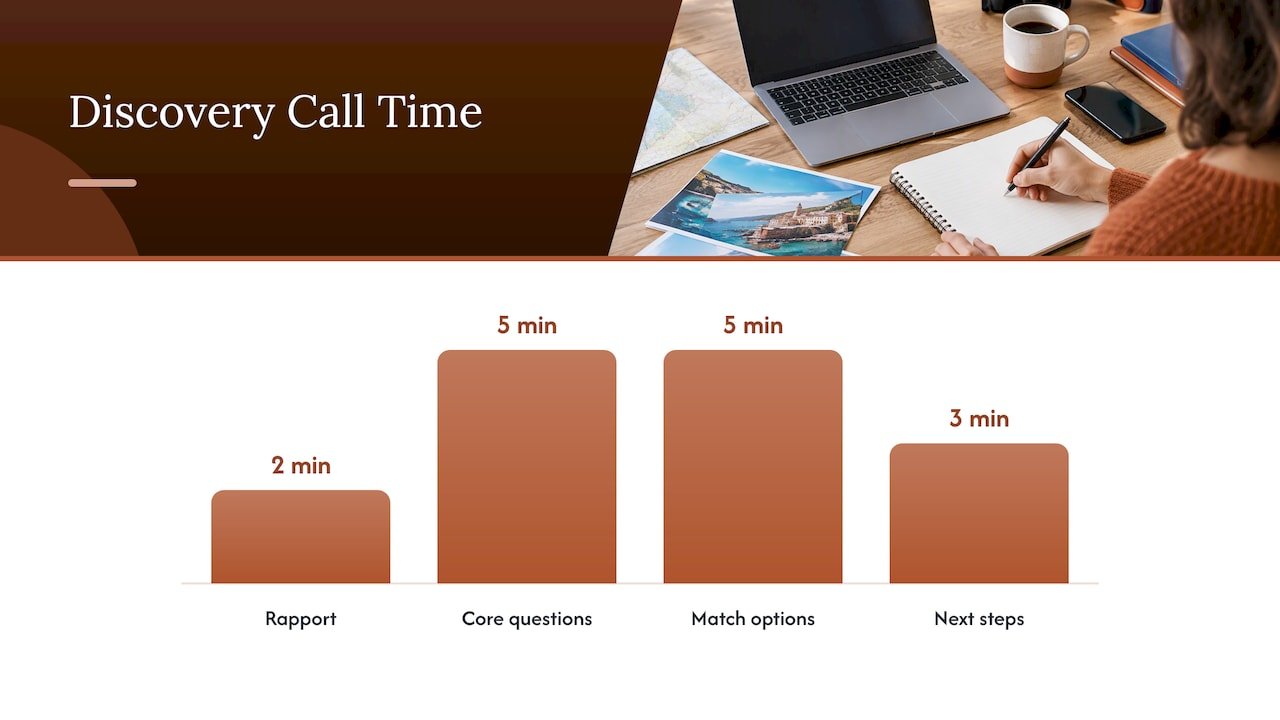
A 15-minute discovery call framework keeps the conversation focused: two minutes on rapport, five on the questions above, five on matching options to what you’ve heard, and three on next steps. Close every call with a specific commitment, such as “I’ll send you two options by Thursday morning, and I’ll call you Friday afternoon to talk through them.” A clear next step, rather than a vague “I’ll be in touch,” is one of the habits travel-sales trainers point to as improving conversion.
Proposals work best in a Good, Better, Best format:
- Good: the core trip at the agreed budget, no frills, clearly dated.
- Better: the same trip with one or two upgrades (room category, an excursion, flexible dates).
- Best: a premium version showing what’s possible if budget opens up, used to anchor value rather than to upsell aggressively.
Follow up on a fixed rhythm rather than randomly: a reaction check on Day 2, extra detail or a relevant answer on Day 5, a choice-based nudge on Day 10, and a close-the-loop message on Day 21. This cadence, recommended by travel-advisor trainers, reads as attentive service rather than pressure. Track reply rate and proposal-to-booking ratio at each stage so you know where enquiries are stalling.
Pro Tip: Send the proposal as a short, scannable PDF or web page, not a long email. Clients forward and compare proposals, and a cluttered email rarely survives that journey.
Reduce friction at booking: pricing, payments, and consumer protections agents should explain
The booking moment is where good proposals fall apart if the numbers feel unclear. Show the total trip cost upfront, broken into the base price, mandatory fees, the deposit amount and any optional extras, so nothing surprises the client at payment.
Offer more than one way to pay. A deposit followed by scheduled instalments suits clients booking well ahead, while card payments and open banking options suit last-minute bookings. Market practice has been shifting towards transparent, packaged pricing with mobile-first payment scheduling, and instalment options in particular tend to reduce abandonment at the payment step. Be explicit about refund terms and any card surcharges before the client reaches the payment page, not after.
Two consumer protections are worth mentioning to every client booking a package: ATOL cover and the Package Travel Regulations. The UK government’s most recent response on package travel reform confirms these remain the core protections agents should reference when selling packaged holidays, covering what happens if a supplier fails and how client money is protected.
Fast, automated confirmation matters more than it sounds. A client who receives an instant, professional-looking booking confirmation and invoice is less likely to have second thoughts than one who waits days for paperwork.
Build these into your process:
- Automated booking confirmations sent within minutes of payment.
- Scheduled payment reminders ahead of each instalment date.
- A clear, written refund and amendment policy attached to every invoice.
- An ATOL certificate issued alongside every applicable booking.
Scripts and email templates that convert: discovery call and follow-up sequence
A discovery call isn’t a pitch, it’s a structured conversation that uncovers what the client actually needs. Keep it to three to five core questions: What’s prompting this trip now? What has gone wrong on a previous trip you want to avoid repeating? What does a perfect version of this holiday look like? Who’s travelling, and whose preferences matter most? Listen for booking signals such as specific dates mentioned unprompted or questions about payment timing, both of which usually mean the client is further along than they’re letting on.
A five-step follow-up sequence covers most enquiries:
- Day 0, same day: thank them for the call and confirm what you heard about their priorities.
- Day 2: check their reaction to the proposal and ask if anything needs adjusting.
- Day 5: add one useful detail, such as an extra excursion option or a seasonal note about the destination.
- Day 10: offer a choice, for example “Shall I hold the Good or Better option while availability lasts?”
- Day 21: close the loop honestly, asking whether to keep the quote open or close the file.
This structure mirrors the cadence recommended by experienced travel advisors for keeping prospects moving towards a decision without pressure.
When a client objects on price, probe before you discount: ask what number they had in mind and why. Reframe around value (what’s included, what they’d lose by cutting corners) before offering a staged option, such as the Good package with one upgrade removed. If three follow-ups bring no response, it’s fair to close the enquiry and move on.
Pro Tip: Keep a short script bank of three or four objection responses written out in advance: reading from memory under pressure rarely sounds as natural as a line you’ve already rehearsed.
Track reply rate, proposal open rate and conversion per proposal sent. These three numbers tell you faster than revenue alone whether your funnel is leaking at the enquiry stage or the proposal stage.
Techniques for building and nurturing an email list of travel prospects
An email list turns one-off enquiries into repeat clients. Start by offering something specific in exchange for an address, such as a destination planning checklist or a short quiz that recommends a trip style, rather than a generic “sign up for our newsletter” box.
Segment the list by interest as soon as you can, splitting cruise-curious subscribers from safari-curious ones so each group gets relevant content rather than a one-size-fits-all blast. Send consistently but not relentlessly: a monthly destination spotlight, paired with the occasional time-limited offer, keeps the list warm without training people to ignore you.
Nurture sequences work best when they teach something useful before they ask for anything. A new subscriber might receive a short series on “what to check before booking a family cruise” over two weeks, ending with an invitation to book a free planning call. Re-engage anyone who hasn’t opened an email in three months with a short, direct message asking if their travel plans have changed, rather than quietly dropping them from future sends.
Keep the list clean. Remove hard bounces and repeated non-openers periodically, since a smaller, engaged list converts better than a large, stale one and keeps your deliverability healthy with inbox providers.
Leveraging social media content strategies to engage and convert clients
Social media works for travel sales when it shows real trips and real decisions, not stock imagery. Short videos walking through an actual itinerary, including the trade-offs you made for a client, tend to earn more trust than polished destination photos alone.
Mix content types: behind-the-scenes posts about how you source a package, short client story highlights, and direct “here’s what this trip costs and includes” posts that double as soft proposals. The last format matters more than it might seem, since a transparent price-and-inclusions post filters out browsers and brings in people who are ready to ask real questions.
Respond to comments and direct messages as the start of a discovery conversation, not just a customer-service task. A simple “what dates are you thinking?” in reply to a comment can move someone from passive follower to active enquiry within a single exchange.
Consistency beats frequency. Posting three times a week on one platform where your niche audience actually spends time outperforms scattering effort across five platforms with no clear pattern. Pick the platform your ideal client uses most, whether that’s Instagram for visual destination content or Facebook groups for family and group travel planning, and build a simple weekly rhythm around it.
Effective ways to create personalized travel proposals that close sales
A proposal that closes reflects back exactly what the client told you on the discovery call, in their own language. Open with a line that names their specific goal, such as “a relaxed week that still gives the kids something to do every day,” rather than a generic trip summary.
Use the Good, Better, Best structure covered earlier, but personalise each tier with a reason it fits them specifically: the Good option because it protects their budget ceiling, the Better option because it solves the one worry they mentioned, the Best option because it shows what’s possible if they’re willing to stretch.
Include a short, factual breakdown of what’s covered under ATOL protection where relevant, since naming this builds trust without needing a hard sell. Keep the pricing table simple and complete: base price, fees, deposit due now and balance due date, with no hidden lines.
End every proposal with one clear next step and a date, such as “Reply by Friday to hold these rates” rather than an open-ended “let me know what you think.” Proposals with a specific deadline and action tend to move faster through a client’s decision process than open invitations to think it over indefinitely.
Referral programs and incentives to encourage client recommendations
Happy clients refer naturally, but a structured referral programme turns an occasional mention into a repeatable source of enquiries. Offer a simple, clearly stated incentive, such as a discount on a future booking or a small credit, for both the referrer and the new client.
Ask at the right moment: immediately after a trip goes well, when gratitude is highest, rather than weeks later when the memory has faded. A short message like “If you know anyone else planning something similar, I’d love an introduction” works better than a formal referral form buried in a newsletter footer.
Make it easy to act on. A one-line message the client can forward, or a simple referral link, removes the friction of them having to explain what you do from scratch. Track where new enquiries originate so you know which past clients are naturally generating referrals, and consider a small thank-you gesture even when the incentive isn’t claimed, since it keeps the relationship warm for the next trip they take.
How to use testimonials and social proof to increase trust and bookings
A specific testimonial beats a generic one every time. “Sarah planned our honeymoon and handled a flight change without us even knowing there’d been a problem” does more work than “Sarah was great, highly recommend.”
Ask for testimonials at the point of highest satisfaction, typically just after return, while the experience is still vivid. A short, specific question such as “what was the one thing that made this trip easier than planning it yourself?” tends to produce a more usable quote than an open-ended request.
Place testimonials near the decision point, not just on a separate “reviews” page. A relevant quote sitting next to a proposal, matched to a similar trip type or destination, reassures a client at exactly the moment they’re deciding. Photos from past trips, shared with permission, add weight to written testimonials because they show real outcomes rather than claims.
Where you can, show a quantified result alongside the quote, such as a specific saving or a particular problem solved, since concrete detail reads as more credible than praise alone.
Author perspective: sell with care, choose fit over volume
Selling travel well is client care with a sales process attached. Test one channel and run discovery calls every week, qualify early, and use staged proposals to protect your margin while you learn what actually converts.
— Sam
Explore TimesHunters: a route to higher commission and a turnkey agency model
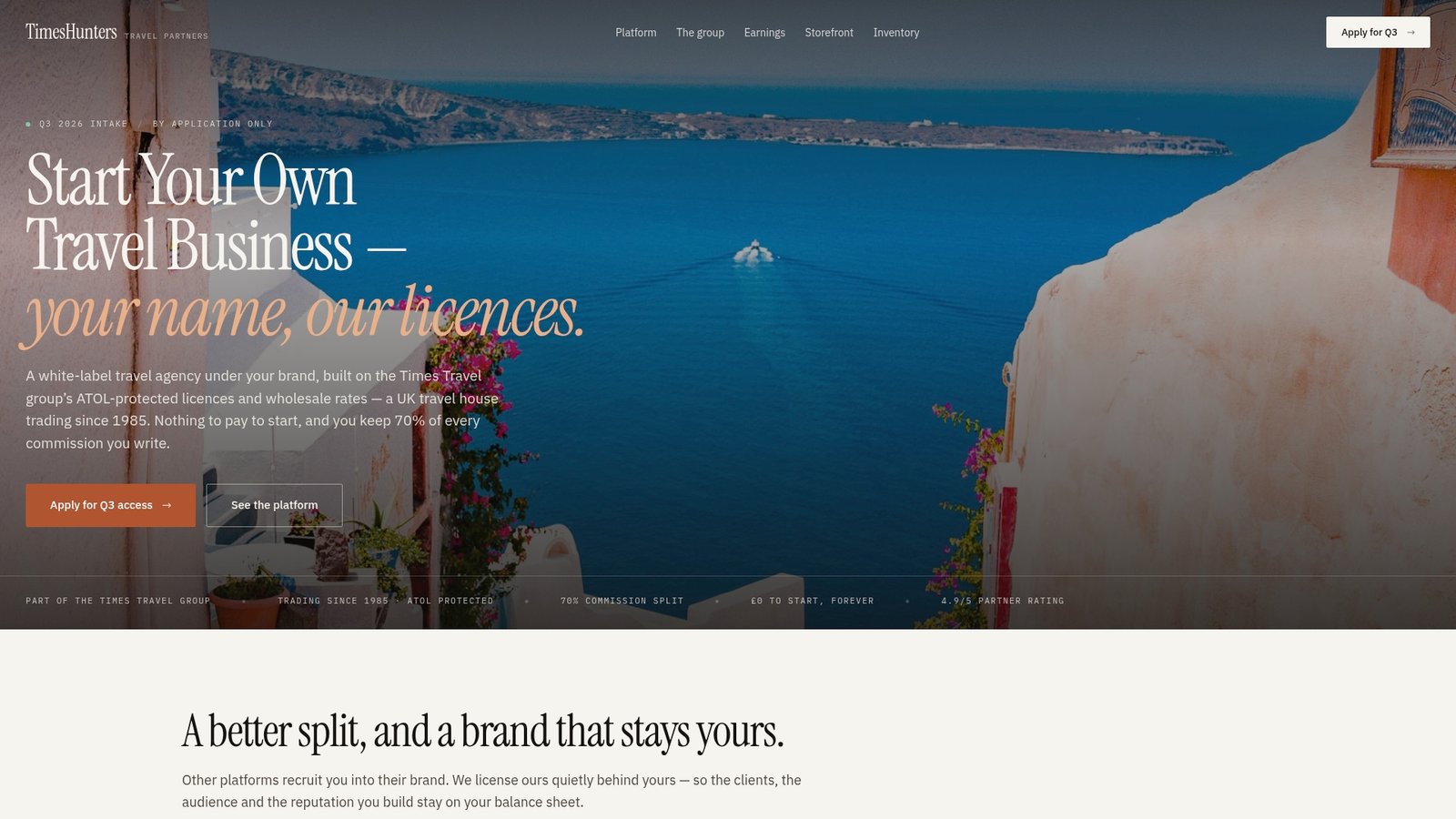
If low commission is capping what you earn per booking, a white-label partner model is worth a look. We let you keep your own brand and client relationships while booking through an ATOL-protected licence, with access to wholesale rates and automated booking workflows that cut down manual admin. Partners keep a commission split on bookings made through the platform, a structure built specifically to reward agents who are building their own client base rather than reselling under someone else’s name.
Before choosing any partner model, check a few things:
- Confirm the ATOL protection and client-money handling cover your bookings directly.
- Ask how quickly you can launch and start quoting live inventory.
- Compare the commission split against what you currently keep per booking.
| What to check | Why it matters |
|---|---|
| ATOL and client-money protection | Confirms bookings and client funds are covered |
| Time to launch | Affects how soon you can start taking bookings |
| Commission split | Determines take-home pay per booking |
Visit the white-label travel agency page to see how the model works, or explore the referral programme if you’d rather start by referring bookings before launching your own brand.
FAQ
How much does a travel agent get paid in the UK?
UK travel agent pay typically combines supplier commissions with any service fees charged directly to clients, and the mix varies by product type. Commission structures vary widely, with packaged holidays and cruises generally paying more than simple flight-only bookings.
How do I promote myself as a travel agent?
Promote yourself by narrowing your focus to a specific niche and building content, a newsletter and referral partnerships around that audience rather than trying to appeal to everyone. Consistent, destination-specific content paired with a clear follow-up process tends to outperform broad, unfocused marketing.
What is the best corporate travel booking platform?
There’s no single platform that suits every corporate travel need, since the right choice depends on company size, travel volume and existing expense systems. Evaluate any platform against your specific booking approval process, payment terms and reporting needs before committing.
What are the top 10 travel agencies?
Rankings of top travel agencies vary by source and criteria, such as revenue, booking volume or customer satisfaction, so there’s no single definitive list. Focus instead on what a comparable agency does well in your niche, such as response time, pricing transparency or specialist knowledge, rather than chasing a general ranking.
What should I check before choosing a white-label travel partner?
Check that the partner’s ATOL protection and client-money handling genuinely cover your bookings, and ask directly how commission splits and launch timelines work. A clear, published commission structure and a fast route to live bookings are good signs of a well-run partner programme.