
Personal Travel Brand: How to Build One That Earns
How to build a personal travel brand in the UK: pick a niche, earn trust, stay legal with ATOL cover, and turn your audience into paid bookings.
A personal travel brand is the reputation that makes people think of you first when they plan a trip. To build one that earns, you need three things: a specific niche, a clear voice, and a legal way to sell. The first two make people trust you. The third lets you take their money without breaking UK law. Most guides stop at logos and photoshoots. This one goes on to the bookings.
TL;DR
- A travel brand is a promise about who you help and how, not a logo. Choose a narrow corner of travel and own it.
- Trust comes from showing real expertise and giving people tools they can use, not from copying the usual wanderlust style.
- If you sell packages in the UK you need financial protection. Either hold your own ATOL or sell under a licence holder’s ATOL.
- Typical UK agent commission is 10% to 15%, so the structure behind your brand decides how much of each sale you keep.
- You can start small: a simple site, an email list and a handful of useful posts will teach you more than months of planning.
Table of Contents
- What a personal travel brand actually is
- Start with a niche, not a name
- Build trust before you ask for the sale
- Ship a simple version first
- Choosing a name
- The part most brand guides skip: selling legally
- What your brand can earn
- Our perspective: own the brand, rent the infrastructure
- Working with the audience you already have
- Mistakes that slow a travel brand down
- Where TimesHunters fits
- A 90-day plan
- FAQ
- Sources
What a personal travel brand actually is
Your brand is not your logo or your website. One UK brand strategist puts it as the feeling someone gets when they land on your page. That feeling is built from small, repeated signals: what you write about, which trips you recommend, how quickly you reply, and what you refuse to sell.
For a travel seller, a personal brand does one job above all. It lets a stranger decide you are the right person to trust with a holiday that may cost several thousand pounds. A big booking site has scale and price comparison. You have a face, a point of view and a relationship. That is a different product, and the market still has room for it.
The UK travel market reached a record £56.6 billion in gross bookings in 2025. Online travel agencies’ share of that total has fallen for three years running, from 22% in 2023 to 20% in 2025, according to Phocuswright figures reported by Breaking Travel News. The big platforms are not going away. But a personal, human-led service is not a niche hobby either.
Start with a niche, not a name
The hardest part is rarely the technical setup. It is giving yourself permission to be specific. “I plan holidays” describes ten thousand people. “I plan multi-generational family trips to the Algarve” describes you.
A workable niche usually combines three things:
- A traveller you understand. Honeymooners, solo women over 50, families with a child who has additional needs, wheelchair users, dive couples.
- A type of trip or place. Safari camps, Caribbean villas, Alpine rail journeys, expedition cruises.
- A reason you are credible. A job you did, a place you lived, a hundred nights in the same kind of hotel, a community you already belong to.
Test the niche with one question: could a stranger repeat what you do after ten seconds on your homepage? If not, narrow it. You can widen later, once people are asking you for more.
Pick a niche that matches your life
Forbes contributors have argued that you should design a brand around the lifestyle you want, such as flexibility or remote work, rather than bending your life to fit the brand. In practice that means asking what a good working week looks like. If you want school-hours flexibility, a niche that needs late-night calls to other time zones may not suit you. If you love planning, choose trips with complex itineraries. If you hate admin, choose a model that automates it.
Build trust before you ask for the sale
A strong travel brand rests on emotional connection, not aesthetics alone. Design practitioners advise against the “wanderlust copy-paste” look: sunsets, passport flat-lays and the same captions as everyone else. Memorable brands show real expertise and give their audience something they can use.
What that looks like in practice:
- A checklist people save. “What to ask before booking a Nile cruise” will outperform a mood board.
- Honest advice, including “don’t go”. Telling a client that August in a particular resort is miserable builds more trust than any five-star review.
- Your own story, told once and well. An About page that explains why you chose this niche and what you have learned.
- Proof. Real client messages (with permission), trip reports, photos you took yourself.
- Speed and consistency. Reply within a day, use the same tone everywhere, and keep your promises small enough to keep.
We go deeper on the emotional side in our piece on why a memorable travel agency brand sells feelings, not flights.
Ship a simple version first
You do not need a finished brand to start. One practitioner’s free guide to building a lifestyle travel brand recommends shipping a minimum viable site early: a hero image, an email sign-up and a first cluster of content, then measuring what your audience actually engages with. Small, consistent actions beat a long upfront plan.
A realistic first month looks like this:
| Week | Focus | Output |
|---|---|---|
| 1 | Niche and promise | One sentence stating who you help and with what |
| 2 | Basic home | One-page site, email sign-up, a name and handle that match everywhere |
| 3 | First content | Three genuinely useful pieces in your niche |
| 4 | First conversations | Ten people you know who fit your niche, asked what they struggle with when planning |
That last step matters most. Your first clients almost always come from people who already know you, so tell them what you are doing and ask what they need.
Choosing a name
People often ask what makes a good travel brand name. A few rules help:
- Use your own name if you want the brand to be you. It is memorable, hard to copy and travels with you if you change direction.
- Choose something you can say on the phone without spelling it out.
- Avoid “world”, “global” and “holidays” unless you really are all three.
- Check the domain, social handles and Companies House before you fall in love with it.
The part most brand guides skip: selling legally
A brand that attracts enquiries but cannot legally take bookings is a hobby. In the UK, the Package Travel and Linked Travel Arrangements Regulations 2018 apply when you sell a combination of at least two travel services for one trip, and they require information duties and insolvency protection for the refund of money and repatriation of travellers. Flight-inclusive packages typically bring ATOL into play.
That leaves a new seller with two broad routes:
- Hold your own protection. This means your own licence or bonding, trust arrangements and the compliance work that goes with them. It suits businesses with capital and appetite for regulation.
- Sell under an existing licence holder. You build the brand and the relationships; a licensed business provides the protected infrastructure behind the scenes.
Which route fits depends on your plans, so check the current rules with the Civil Aviation Authority and, for anything complex, a solicitor or accountant who knows travel. Our guides to trust accounts versus insurance and the five checks for client money protection walk through what to look for. If your plans involve selling packages after April 2027, read our note on the changes to the Package Travel Regulations.
What your brand can earn
The business model behind your brand decides how much of each booking you keep. According to the Condor Ferries roundup of travel agency statistics, commission on hotel bookings is around 8% to 15%, and 10% to 15% on tours. The same source says about 78% of agent revenue comes from commission and 22% from service charges.
Those figures are industry averages, not a promise for any one seller. Two practical points follow:
- Your split matters as much as your rate. If you sell through an intermediary, the share you keep after the licence holder’s cut is your real commission. Always ask for it in writing.
- Service fees are a legitimate second income. A personal brand built on expertise can justify a planning fee, particularly for complex or luxury trips.
Our guide to typical travel agent commission rates and the home agent cost playbook show the arithmetic in more detail.
Our perspective: own the brand, rent the infrastructure
We see the same pattern with people who come to us. They have the audience, the niche knowledge or the client list. What they lack is a licence, supplier access and a booking system. Building those yourself takes capital, paperwork and time, and none of it makes a client choose you.
So we built TimesHunters around a simple split. You own the brand, the client relationships and the decisions. We provide the ATOL-protected licences of the Times Travel group, wholesale inventory, a branded booking site, automated booking management and training. The licence’s branding is invisible to your clients, so what they see is you.
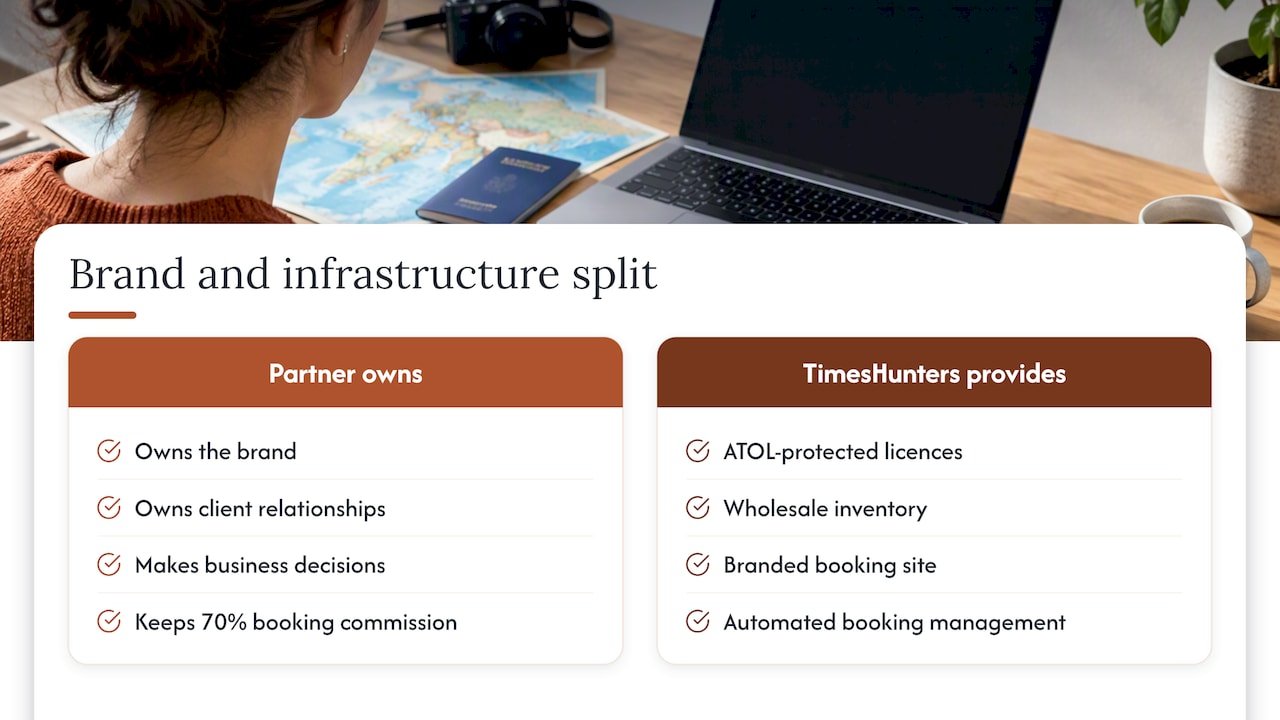
The commission is where we think the model differs most. Partners keep 70% commission on bookings, and we keep a 30% split. One partner has told us their income per booking rose from £400 to £1,200. That is one person’s experience, not a guarantee, and results depend on your niche, your audience and how hard you work at it.
Our advice is to put the brand first and the product second. Choose a niche you can talk about for years. Get to ten real conversations before you build anything elaborate. Then pick the compliance route that lets you spend your time with clients rather than on paperwork.
— Sam
Working with the audience you already have
Different starting points call for different first moves.
If you are an influencer or creator
Your audience already trusts your taste. The risk is drifting into generic content. Turn a recurring theme, such as family city breaks or slow travel by rail, into a bookable service, and make it plain what a follower gets from you that they cannot get from a comparison site. We cover the creator route in more detail on our page about selling travel as an influencer.
If you work in hospitality
You already know what guests ask for, and that knowledge is the brand. A hotel manager who moves into planning trips for guests who loved a certain kind of stay has a ready-made story. Think about how to refer guests to wider trips without conflicting with your employer’s policies.
If you are leaving a corporate job
Your contacts, your reputation and your professional network are assets. Start by serving people who already know you, and treat your first year as a test of one niche rather than a launch of a full agency. Our guide to becoming a travel agent in the UK covers the self-employment side.
If you want something steady
Pick a niche with repeat demand, such as cruises or annual family villas, where one happy client can book year after year. Repeat clients cost far less to win than new ones.
Mistakes that slow a travel brand down
- Starting broad. “All holidays for everyone” is the same as no brand.
- Spending on design before testing demand. A logo suite will not tell you if anyone wants your service.
- Copying the wanderlust look. It signals that you are a tourist, not an expert.
- Ignoring the legal route. Taking money without proper protection puts clients and your business at risk.
- Underpricing your time. If you plan complex trips, charge for the planning or choose suppliers that pay you properly.
- Hiding your personality. People buy from people, so show who you are.
Where TimesHunters fits
If you want to build your own brand and sell under protected licences without carrying the regulatory set-up yourself, our white-label travel agency gives you a branded booking site, wholesale access to hotels, cruises, tours, villas, safari camps and rail, automated booking management and a 70% commission. There is no cost to start. You can see how the model works on the TimesHunters homepage, or read how our 4-week training route gets a new partner ready to sell.
A 90-day plan
- Days 1 to 14: Write your niche sentence. Talk to ten people who fit it. Note the questions they ask.
- Days 15 to 30: Publish a simple site and email sign-up. Write three practical guides.
- Days 31 to 60: Choose your selling route and complete onboarding. Prepare your email templates so every enquiry gets a prompt, consistent reply.
- Days 61 to 90: Make your first offers to your warm contacts. Ask for reviews. Refine your niche based on what they actually book.
By day 90 you should know whether your niche has demand, what your clients value and which part of the brand to invest in next.
FAQ
Do I need a travel qualification to build a personal travel brand?
Not necessarily. What clients judge is your expertise and the way you treat them. You do need a legal way to sell, which means protection under the Package Travel Regulations, so check the current rules before taking bookings.
How much does it cost to start?
A basic site, an email tool and your time can cost very little. The larger cost is the regulated infrastructure behind selling, which varies by route. With our model there is no cost to start, and we keep a 30% split of each completed booking.
Should I use my own name or a business name?
If the brand is about you, your own name is usually the strongest choice because it is memorable and portable. A business name works better if you plan to bring in other advisers later. Check that the domain and social handles are free either way.
How long does it take to get the first booking?
It varies widely. People with an existing audience or network often get enquiries within weeks, because the trust already exists. Starting from zero takes longer, so aim for ten real conversations in your niche before judging the idea.
Sources
- Building Your Travel Brand Identity | Where to Start
- The PONTUS Blueprint: Your First 31 Days
- Designing a travel brand, Supercharged Studio
- Personal branding and travel, Forbes
- U.K. travel distribution settles into a stable pattern, Breaking Travel News
- The Package Travel and Linked Travel Arrangements Regulations 2018
- Latest Travel Agency Statistics 2025, Condor Ferries