
White Label vs Host Agency: Which Model Suits You?
White label or host agency? Compare brand ownership, ATOL cover, commission, client data and control, so you can pick the right route into UK travel.

A host agency and a white-label agency both let you sell travel in the UK without holding your own ATOL, but they differ in whose name the customer sees, who owns the client relationship and how much of the commission you keep. A host agency generally puts you inside someone else’s agency as a member. A white-label agency puts your brand in front of the customer and runs the licensed machinery behind it. Below we set out how each works, what to check in the paperwork, and who each model suits.
TL;DR
- Host agency: you join an existing agency and usually trade under its umbrella, with its support, supplier deals and rules.
- White label: you trade under your own name, with the licensed principal invisible to customers, and you own your client list.
- Legal core is the same: in the UK an agent selling flights or packages for an ATOL holder needs a written agency agreement, and an ATOL Certificate must be issued immediately on payment.
- Commission: at TimesHunters partners keep 70% and we keep 30%. Whatever model you consider, compare what you take home per booking, not the headline percentage.
- Decide on control: if you want your own brand and client data, white label fits. If you want to learn inside an established team first, a host may fit better.
Table of Contents
- What each model actually is
- What UK law says, whichever you choose
- White label vs host agency: the comparison
- Five differences that change your income
- Questions to ask before you sign anything
- Perspective: how we see it
- Which model suits which person
- Launching under your own brand: what trust signals to show
- Starting with TimesHunters
- FAQ
- Sources
What each model actually is
The two terms are often used loosely, so here are working definitions.
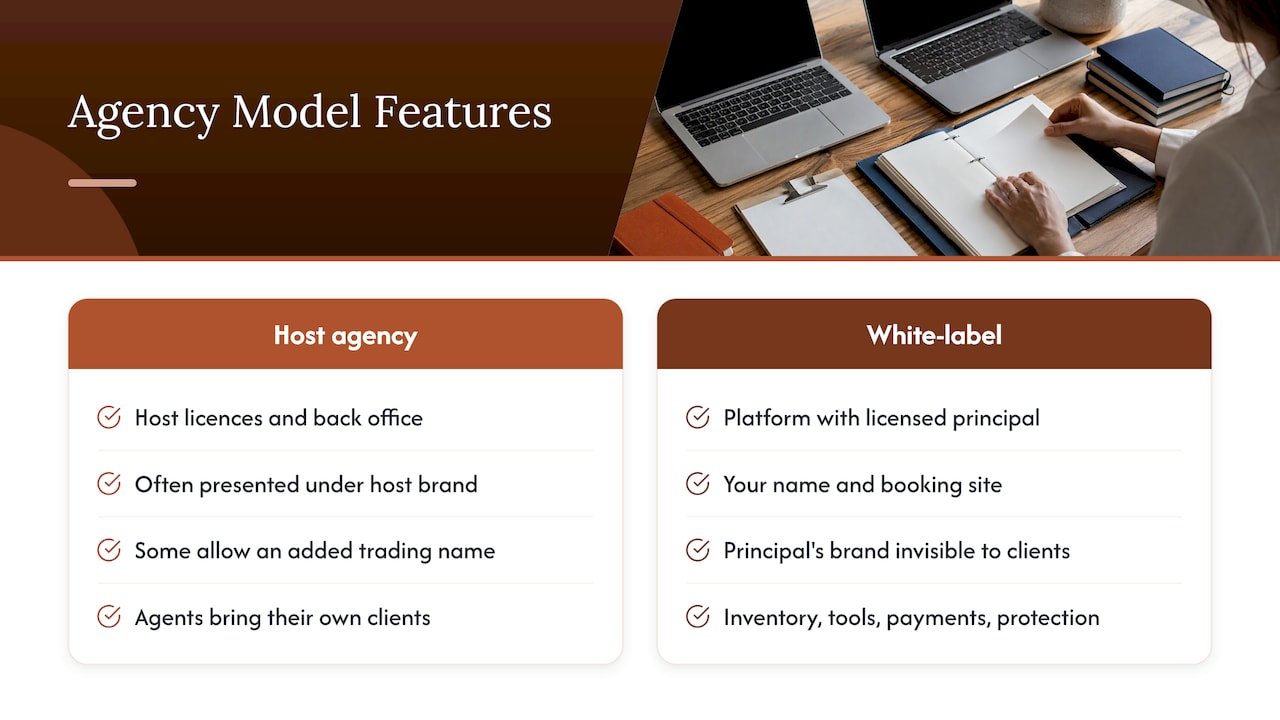
Host agency. An established travel business that has the licences, supplier contracts and back office, and lets independent agents work under it. Agents are usually self-employed, bring their own clients and are paid a share of commission. Many hosts present agents as part of the host’s own brand, and some let you add a trading name on top. Terms vary a lot from host to host, which is why the contract matters more than the label.
White-label agency. A platform and licensed principal that lets you run a branded travel business: your name, your booking site, your client relationships, with the licence holder’s branding invisible to end customers. The “white” means the supplier’s name is removed. You get the product (inventory, booking tools, payments, protection) without the supplier’s logo on it.
In practice the line blurs. Some hosts offer a lot of brand freedom, and some white-label providers are rigid. So do not buy on the label. Buy on the answers to the questions in the checklist further down.
What UK law says, whichever you choose
The model changes your branding and economics. It does not change the regulation, and it is the first thing to understand before you sell anything with a flight in it.
The Civil Aviation Authority sets out that an ATOL holder selling flight-only or packages through agents must have a written agency agreement with each agent. Without the right agreement in place, both the ATOL holder and the agent are in breach of the ATOL Regulations. The same CAA page says agents must issue an ATOL Certificate to the consumer immediately on payment, whether the booking is made in a shop, by phone or online, and that receipts must identify protected and non-protected money.
The underlying law is the Civil Aviation (Air Travel Organisers’ Licensing) Regulations 2012, which also covers acting as agent and facilitating flight accommodation. Exactly what applies to you depends on the transaction and the capacity in which you act, so read your own agreement rather than relying on a summary, including ours.
The practical lesson: compliance is operational, not a logo. Certificates, receipts, agency wording and payment flows have to work correctly on every booking. Before you market anything, ask to see the real customer documents and the agreement you would sign.
If you want the legal routes in more depth, our guide to trust accounts versus insurance for UK agents walks through how agents reach legal sales, and our piece on client money protection checks for white-label partners covers what to verify on the money side.
White label vs host agency: the comparison
| Question | Typical host agency | White-label agency |
|---|---|---|
| Whose brand does the customer see? | Often the host’s, sometimes with your trading name added | Yours; the licence holder is invisible to customers |
| Who owns the client relationship? | Varies by contract; check data and non-solicitation clauses | You build and keep your own client list |
| Booking site | Frequently the host’s platform or portal | A branded booking site under your name |
| Licensing and protection | Under the host’s licences | Under the principal’s ATOL-protected licences |
| Commission | A split set by the host, often tiered | At TimesHunters: you keep 70%, we keep 30% |
| Autonomy | Follow the host’s processes and preferred suppliers | More freedom over how you present and sell |
| Community and mentoring | Often a major draw | Depends on the provider; ask what training and support is included |
| Best for | People who want to learn inside an established team | People who want a standalone brand and audience |
The table describes types, not specific companies. Hosts differ from one another as much as they differ from white-label providers, so treat the left column as a list of things to verify, not as a fixed description.
Five differences that change your income
1. Brand and trust
Customers book with people and names they trust. ABTA’s Holiday Habits research says travel agents continue to be seen as trusted advisers, with more people saying they have a better holiday when they book through one. If your name is the one on the website, the emails and the proposals, that trust accrues to you, and it travels with you as the business grows.
In a host arrangement, the trust can accrue partly to the host. That is not bad, particularly early on when a recognised umbrella reassures nervous customers. It matters if you plan to build something you can eventually sell or move.
2. Who owns the customer list
This is the clause that decides whether you are building an asset or renting a desk. Ask in plain terms: if I leave, whose are the customers? Are there restrictions on contacting them? Where is their data held? A white-label model built around your own brand and client relationships answers this by design. With any host, get the answer in writing.
3. Commission and what is left of it
Headline splits can mislead. A 70% share of a small margin can be worth less than a 60% share of a large one, and fees change the sum. Work out net per booking: commission paid, minus platform or joining fees, minus card or payment costs, minus anything charged for marketing materials or training.
Our own model is simple to state. Partners keep 70% of commission on their bookings, and we keep 30%. That compares with the 4% the typical online travel agency offers, as we describe it. There is no cost to start. For worked arithmetic, our cost playbook for UK home agents shows how to reach break-even, and the tour operator commissions calculator page helps you model net earnings per booking.
4. Suppliers and inventory
A host usually brings its preferred-supplier relationships, which can come with overrides and support. A white-label platform brings access to wholesale hotel, cruise and tour inventory, plus villas, safari camps and rail, resold through your branded site. Neither is automatically better. Preferred-supplier programmes can reward volume with one supplier, while a wider wholesale range suits you if clients ask for varied itineraries. Our article on preferred supplier programmes and white label explains how control over supplier choice shifts between the two.
5. Admin and tools
You will spend more time on paperwork than you expect. Look for automated booking management, instant pricing proposals, managed payments with financial protection and automated client follow-up. These are things we build into the platform, so partners spend their time selling rather than chasing confirmations. If a host cannot show you equivalents, factor in the hours you will lose.
Questions to ask before you sign anything
The CAA’s guidance and the way the rules work in practice suggest a checklist. Put these to any host or white-label provider, in writing:
- Who is the ATOL holder, and what is the ATOL number? You should be able to see it on the agreement and on sample certificates.
- Who issues the ATOL Certificate, and when? The CAA says agents must issue it immediately after payment.
- Whose name appears on receipts and confirmations? Receipts must identify protected and non-protected money.
- Who handles refunds, amendments and complaints? And how are customers told who to contact?
- Can I see the written agency agreement now? Not after you have paid or onboarded.
- What exactly are the fees? Joining, monthly, per booking, payment processing, training.
- What happens to my client list and my domain if I leave?
- What support do I get in the first 90 days? Our 30/60/90 onboarding plan is an example of what a clear answer looks like.
A provider who answers these crisply is easier to trust than one who talks mostly about commission.
Perspective: how we see it
We built TimesHunters because we think the usual deal in travel is lopsided. Agents do the finding, the advising and the hand-holding, and then the booking platform keeps most of the margin. A host agency improves that deal by giving you licences and support. It does not always give you the one thing that compounds over time: a brand and a client list that are yours.
So our view is straightforward. If you have an audience or a book of contacts, or you are already trusted in a niche, put your own name on the business from the start. Use a licensed principal for the parts that are hard to do alone (ATOL-protected licences, wholesale access, payments and booking automation) and keep the customer relationship. Partners keep 70% of commission, and the principal’s branding stays invisible to the client.
We also say plainly that this is not for everyone. If you are brand new to travel and would rather learn beside colleagues in a large team, a host agency with a strong mentoring culture may be a gentler start. What we would urge on anyone, whichever route, is to read the agency agreement first and make sure you understand who stands behind every booking you take.
— Sam
Which model suits which person
A host agency may suit you if:
- you are new to travel and want day-to-day mentoring from an established team;
- you do not mind trading under the host’s identity for now;
- you value an in-house community over independence.
White label may suit you if:
- you already have an audience, such as followers, a community or a loyal customer base;
- you run a hospitality business and want a new revenue stream under a name your guests know;
- you are a professional with existing client relationships you want to monetise;
- you intend to own the brand and the data for the long term.
For creators in particular, the question is how to sell travel without becoming an unlicensed seller. We cover that in how creators can monetise a travel audience through a compliant agent and in our guide to selling travel as an influencer while keeping your commission.
Launching under your own brand: what trust signals to show
A new brand has to prove itself fast. ABTA reported that during its February 2025 campaign, visits to its website rose 72% year on year in January, with member searches up 74%, which suggests people actively check protection credentials. For a white-label business, that means being clear and visible about who the licence holder is, how ATOL protection applies and where to complain. Implying your new brand holds every licence itself is the wrong move; explaining the structure plainly is more credible.
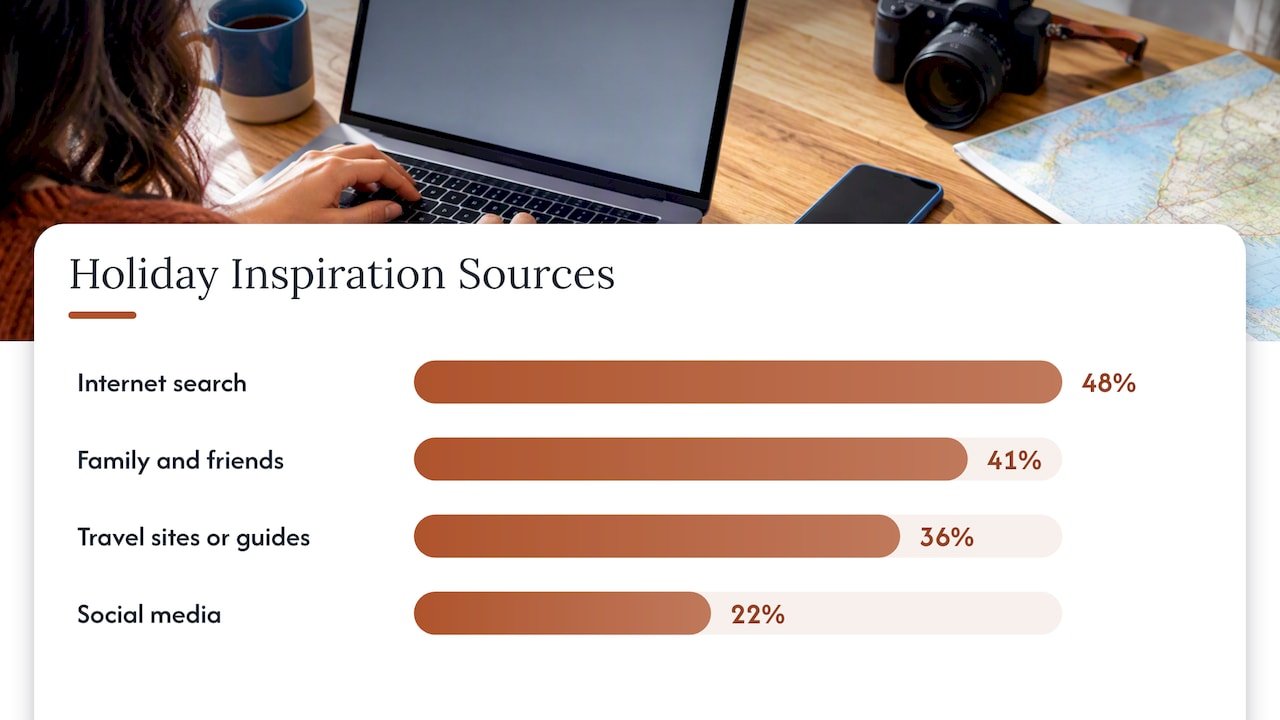
Where will customers find you? ABTA’s research says general internet search is used by 48% of UK travellers for holiday inspiration, recommendations from family and friends by 41%, travel websites or guidebooks by 36% and social media by 22%. So a sensible launch plan combines helpful, searchable guides, personal recommendations and the social channels your audience already uses. Our guide to travel agency SEO fixes covers the search side.
Starting with TimesHunters
TimesHunters is a white-label travel agency platform. You trade under your own name using Times Travel group’s ATOL-protected licences, with a branded booking site, instant pricing proposals, managed payments and financial protection, automated client follow-up and training. You keep 70% commission and there is no cost to start. If you want to see how the launch works week by week, read about launching a white-label ATOL agency in four weeks, or go straight to the white-label travel agency page to see what you can sell.
FAQ
Is a white-label agency the same as a host agency?
No. A host agency usually lets you work under its umbrella and often its brand, while a white-label agency lets you trade under your own brand with the licence holder hidden from customers. Some providers mix features of both, so compare the actual agreement, brand rules and client-data terms.
Do I need my own ATOL to sell holidays with flights?
Not necessarily. The CAA says an ATOL holder can sell through agents, provided there is a written agency agreement with each one. The agent must issue an ATOL Certificate immediately after payment. Check your own position with the CAA’s guidance and the provider’s paperwork.
Which model pays more commission?
It depends on the net amount you take home, not the headline percentage. Add up fees, payment costs and any required spend. With TimesHunters, partners keep 70% of commission and we keep 30%, and there is no cost to start.
Can I keep my clients if I leave?
Only if the contract says so. Ask any host or white-label provider who owns the client data, whether there are non-solicitation limits and what happens to your domain and branding on exit. Get the answers in writing before you sign.
Is white label legal in the UK?
Yes, when the licensed principal and the agent have the right written agreement and every booking is documented properly, including ATOL Certificates where they apply. The detail depends on what you sell and the capacity in which you act, so read your agreement and, if unsure, seek professional advice.
Sources
- Travel trade selling through agents, UK Civil Aviation Authority
- The Civil Aviation (Air Travel Organisers’ Licensing) Regulations 2012, legislation.gov.uk
- Holiday Habits 2025/26, ABTA
- ‘Travel with confidence’ boosts member searches, ABTA