
Client Retention for Travel Agents: A UK Playbook
How UK travel agents keep clients booking again: calculate your retention rate, follow up before and after trips, run loyalty schemes and own the relationship.

Client retention for a travel agent comes down to one thing: the client remembers you, not the supplier, and hears from you at the right moments. Do that with a simple follow-up routine, a way to measure repeat bookings and a brand the client recognises. When the client list belongs to you, every repeat booking pays you again without the cost of finding a new customer. That is the case for building your own brand rather than selling under someone else’s name, and it is the thinking behind the way we set up our partners.
This guide is for people starting out or going independent: freelancers, influencers, hospitality owners and professionals with a network. It covers what retention means, how to calculate it, what to do before, during and after a trip, and how to keep the effort manageable.
TL;DR
- Retention is the share of clients who book with you again. Work it out each year from your own booking records.
- Travel Trade Consultancy’s 2026 repeat-rates report says loyal clients tend to bring higher lifetime value and lower marketing and acquisition costs.
- Great service is the biggest driver of repeat custom. Loyalty schemes and a short, scheduled follow-up routine add to it.
- Trust matters: AITO’s 2025 survey found over 84% of respondents saw trade-association membership and financial protection as crucial when choosing where to book.
- You can only retain clients you own. A branded agency with your name on it keeps the relationship with you.
Table of Contents
- What client retention means for a travel agent
- How to calculate your client retention rate
- Why trust and protection keep clients with you
- A follow-up routine for before, during and after the trip
- Measure satisfaction with a Net Promoter Score
- Loyalty schemes: simple ones work
- Use CRM tools without drowning in them
- Personalise by what you sell
- Own the relationship: the structural advantage
- Start your own branded agency
- FAQ
- Sources
What client retention means for a travel agent
Retention means a client who has travelled with you comes back, and recommends you to people they know. Travel is a purchase made once or twice a year, so the gap between bookings is long. In that gap, a client either forgets you or keeps you in mind. Retention work fills the gap.
The reason it matters to a new agent is arithmetic. Every client you win costs time, advertising or both. According to the Travel Trade Consultancy’s 2026 report announcement, loyal clients tend to have higher lifetime customer value and lower marketing and acquisition costs. A client who books three holidays over five years is worth far more than one who books once, and the second and third bookings cost you almost nothing to win.
If you earn a high share of each commission, this effect is even stronger. With our model, partners receive 70% commission on bookings, so each repeat booking from a client you already know carries a larger share of income to you.
How to calculate your client retention rate
You do not need software to start. You need a list of clients who booked in a given period and a list of who booked in the next one.
The standard formula:
Retention rate = (clients at end of period − new clients won in the period) ÷ clients at start of period × 100
A worked example for a year:
- You began the year with 40 clients who had booked with you before.
- During the year you won 25 new clients.
- At the end of the year you have 55 active clients.
- (55 − 25) ÷ 40 × 100 = 75%.
So 30 of your original 40 clients stayed with you, a 75% retention rate.
Two practical points. First, choose a period that fits how your clients travel. A family that books one summer holiday a year should be measured over 12 to 24 months, not three. Someone who takes frequent city breaks can be measured over six months. Second, count a client as retained when they book again, not when they open an email. Opens are a signal, bookings are the result.
Track the rate once a year and keep a note of which clients lapsed. Patterns show up quickly: for example, clients who only ever booked a one-off honeymoon or a milestone birthday trip need a different approach from regular cruisers.
Why trust and protection keep clients with you
Before anyone books again they must feel safe handing over money. AITO’s 2025 Travel Insights survey found more than 84% of respondents considered trade-association membership and financial protection crucial when deciding where to book. The same survey reported that 68% of customers had travelled more than once with their specialist tour operator, and that over 61% had spent more than £2,500 per person on experiential holidays through specialist operators. Clients who spend that kind of money want to know where their deposit goes.
That makes financial protection part of your retention strategy, not only a legal matter. Showing clients clearly what protects their booking, and doing it the same way every time, is a repeat-business habit. Booking processes that spell out each check up front, like the coach booking process checks organisers are walked through, show how clear steps build confidence before money changes hands.
Our partners sell under ATOL-protected licences, with managed payments and financial protection handled through the platform, and the licence’s branding is invisible to the end client. The client sees you, trusts you, and has one name to remember. If you want the detail on how client money is kept safe in the UK, our guides on how to protect client money when you sell travel and client money protection checks for white label partners go through it.
A follow-up routine for before, during and after the trip
Most retention advice boils down to one habit: contact clients at planned moments, not when you happen to remember. Here is a routine that suits a one-person agency.
Before the trip
- At booking: send a confirmation straight away that sets out what they have bought, the payment schedule and what happens next. A fast, accurate confirmation shows you are organised.
- A few weeks before departure: send a short message with practical details: documents, transfers, anything the client should do. Add one personal line that shows you remember why they are going, such as the anniversary or the first trip with the grandchildren.
- A day or two before: a brief good-luck message.
Automated booking management and confirmations take much of this off your hands. Our booking confirmation automation page explains how it works for travel teams.
During the trip
Keep this light. A single check-in message mid-trip, or simply making sure the client knows how to reach you, is enough. The aim is that if something goes wrong, you are the first call, not a stranger on a helpline. A client who sees you fix a problem is more loyal than one who never had a problem.
After the trip
This is where most agents lose the client. Aim for:
- Within a few days of return: a thank-you and a simple question: how was it? Ask for a score out of 10 on how likely they are to recommend you (more on that below).
- A few weeks later: ask for a review or an introduction, while the trip is still fresh. Photos from the trip are a natural reason to get in touch.
- Around the time they would start planning next year’s holiday: a relevant idea based on what they liked, not a generic newsletter.
Two or three well-timed messages beat a weekly mailing. We have set out a simple pattern in automated client follow-up with two or three messages, and our platform includes automated client follow-up for partners.
Measure satisfaction with a Net Promoter Score
A simple way to know whether clients will come back is to ask how likely they are to recommend you. Travel Weekly’s 2025 report on the method describes it: respondents score from 0 to 10, with scores of 0 to 6 counted as detractors, 7 to 8 as passives and 9 to 10 as promoters. The score is the percentage of promoters minus the percentage of detractors.
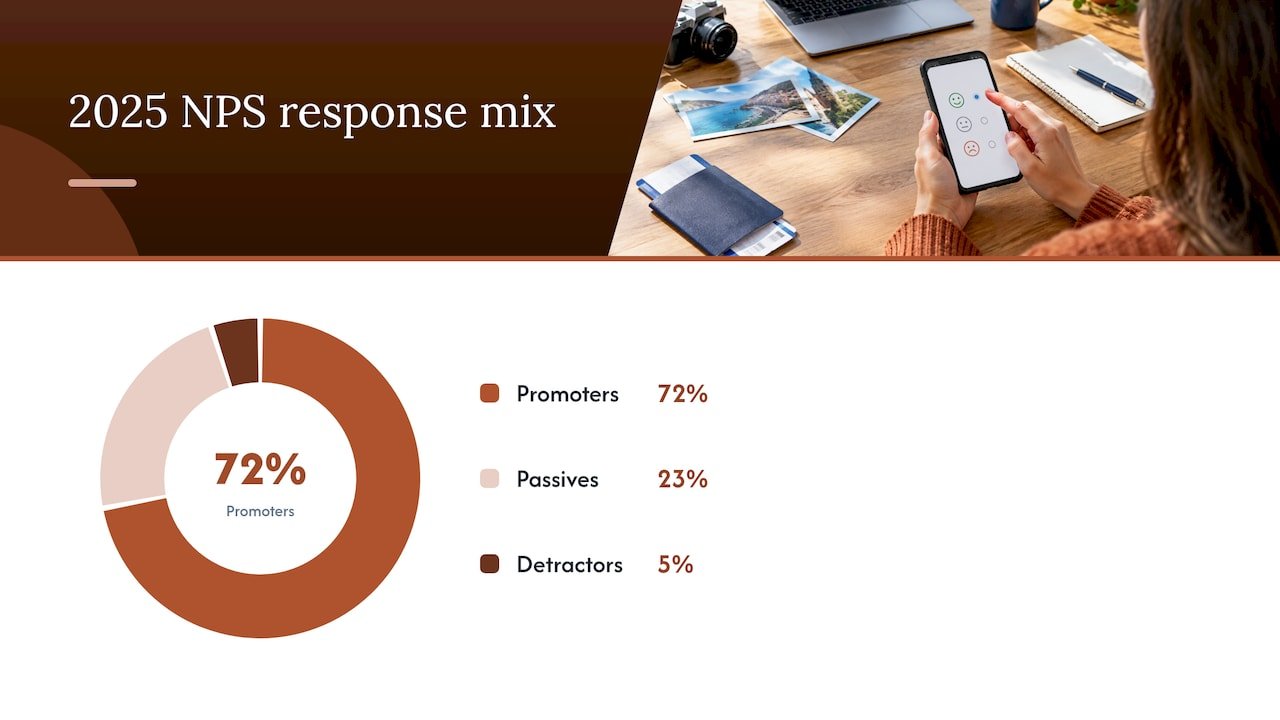
For scale, AITO’s 2025 survey recorded an average NPS of 67.1 across its members, up from 64.8 in 2024, with a response mix of 72% promoters, 23% passives and 5% detractors, drawn from nearly 14,000 responses from customers of 37 companies, as Travel Weekly reported. Those are specialist operators, so treat the figure as a reference point rather than a target on day one.
With a small client list, a score is less useful than the comments that come with it. Read every reply. If a detractor mentions a slow response, fix the response time. If promoters mention the same thing repeatedly, say it in your marketing.
Loyalty schemes: simple ones work
TTG’s advice for agents is that great service is likely to be the biggest factor in repeat custom, with loyalty schemes as an extra, such as points redeemable against a future holiday or a discount on a later booking. It stresses monitoring costs so a scheme remains cost effective.
Its 8 November 2024 report described one scheme that gave clients 25 points on opening an account and one point per £1 spent, each point worth 1p. Run the sums on that model: a £3,000 holiday earns 3,000 points, plus the 25 sign-up points, worth £30.25 against a future booking. That is about 1% back, which is easy to afford from a commission and still feels like a reward.
Tips for a scheme that suits a new agency:
- Keep it to one rule that you can explain in a sentence.
- Make the reward a discount or credit on the next booking so that it brings the client back.
- Work out the cost against your commission before you launch. A reward that eats a third of your margin is not a loyalty scheme, it is a discount.
- Use occasions as well as points: a small gift on a milestone trip or a priority call-back for returning clients costs little.
Use CRM tools without drowning in them
A customer relationship management (CRM) tool is simply a record of who your clients are, what they booked and when to talk to them next. Start with the fields that drive repeat business:
| What to record | Why it helps retention |
|---|---|
| Travel dates and trip type | Tells you when to follow up and what to suggest next |
| Who travelled and the occasion | Lets you personalise the message |
| Spend and supplier category (hotel, cruise, tour, villa) | Shows what to offer next |
| Feedback score and comments | Flags unhappy clients early |
| Date of last contact | Stops anyone going silent for a year |
The tool matters less than the discipline: update it after every conversation and review it weekly. If you also handle bookings through a platform that records them automatically, you avoid double entry. Our partners get automated booking management and instant pricing proposals, so the history of what each client was quoted and booked sits in one place.
Personalise by what you sell
Retention improves when you use what you know. A few examples for different clients:
- Cruise clients often rebook with the same line or look for the next itinerary. Our guide to selling cruises from home covers the basics.
- Hotel and villa clients may return to the same destination or ask for something similar elsewhere. Access to wholesale hotel inventory means you can price a comparable stay quickly. See how static and dynamic hotel rates work.
- Tour and safari clients tend to plan the next trip long in advance, so an early conversation wins the booking.
- Rail and short-break clients book more often, and respond to quick, timely ideas.
Extras are a retention tool too. A client who gets a transfer, an excursion or a restaurant booked by you has one more reason to call you next time. Our upselling travel extras playbook shows how to add them while keeping more commission.
Own the relationship: the structural advantage
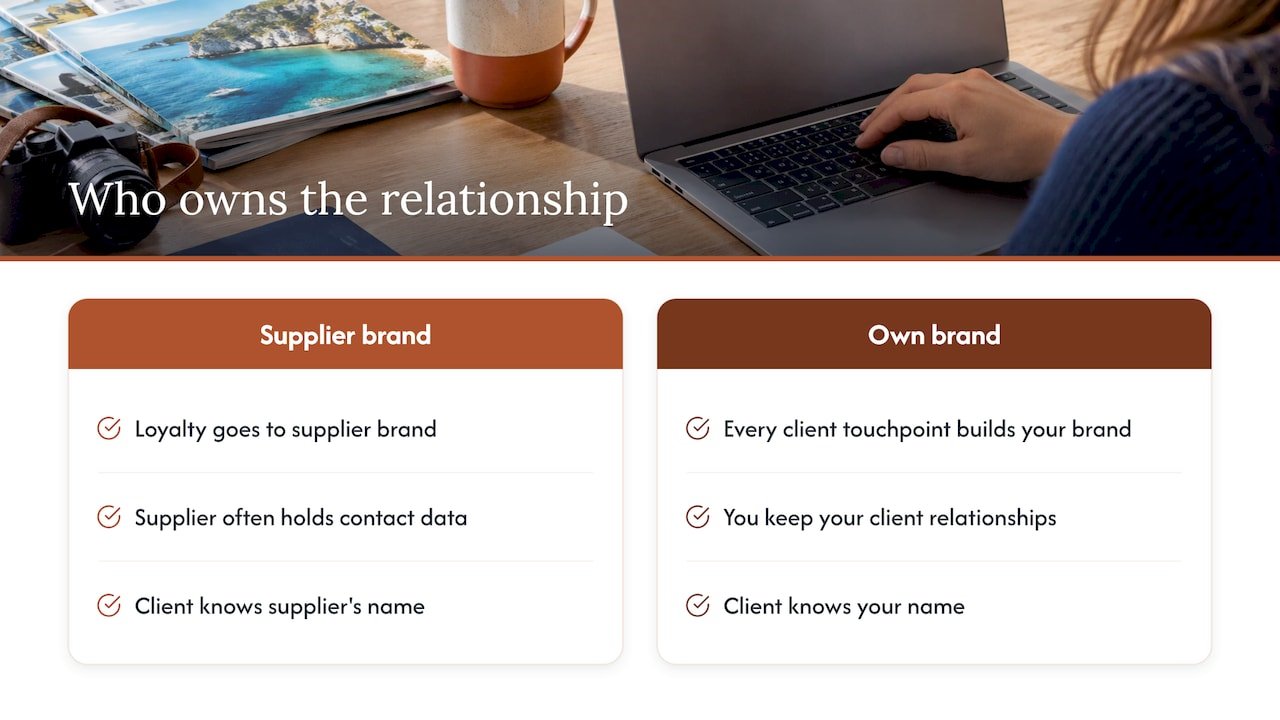
Everything above assumes the client knows who you are. If you book under a supplier’s or a network’s brand, the client’s loyalty goes to that brand, and so does their contact data in many cases. If you book under your own name, every thank-you, anniversary note and next-trip idea builds your brand.
That is the idea behind a white-label agency: you trade under your own name, with the licensing, protection and booking systems running behind it. Recurring revenue in travel sets out how independent agents build income that repeats rather than restarts each month. For influencers and creators with an audience, selling travel as a creator shows how an audience becomes a client list.
Our view: retention starts with whose name is on the booking
We built TimesHunters because we saw a gap between what an independent agent can do for clients and what the old structures let them keep. Most advice on retention talks about emails and discounts. We think the first question is simpler: when your client thinks of a holiday, whose name do they think of?
That is why partners trade under their own brand, with a branded booking site and their own client relationships, while we supply ATOL-protected licences, wholesale rates, managed payments and financial protection. The licence’s branding is invisible to end clients, so the person they trust is you.
It is also why we pay partners 70% commission. A repeat client is the most valuable booking in your business, and we want you to keep most of it. Build the routine in this article, keep the list, and every year the business gets easier rather than starting again from zero.
Sam
Start your own branded agency
If you already have clients, an audience or a network, you have the raw material for retention. Our white-label travel agency lets you launch under your own name using Times Travel group’s ATOL-protected licences, with a branded booking site, access to wholesale hotel, cruise and tour inventory, automated booking management and follow-up, and training and support. There is no cost to start, and partners receive 70% commission on bookings.
See how it works on the white-label travel agency page, or read the details of the 70% commission referral programme. If you want a structured start, our UK travel agent training is built around launching in four weeks.
FAQ
What is a good client retention rate for a travel agent?
There is no single benchmark that fits every agency, because it depends on how often your clients travel. Specialist operators see strong loyalty: AITO’s 2025 survey found 68% of customers had travelled more than once with their specialist operator. Set your own baseline from your first full year of bookings, then aim to improve it a little each year.
How often should I contact past clients?
Two or three planned messages per trip are enough: before travel, shortly after return, and when they are likely to start planning again. Add a personal note for birthdays or anniversaries you know about. Contact that is timely and relevant is welcomed, while frequent generic mailings are not.
Do loyalty schemes really work for a small agency?
They can, when they are simple and affordable. TTG’s reporting stresses that great service comes first and that agents should monitor costs so a scheme stays cost effective. A small credit against the next booking is a good starting point.
Can I keep my clients if I book through a white-label platform?
Yes. With our model, partners keep their own brand, client relationships and autonomy, and the licence’s branding is invisible to end clients. The client list is yours.
Sources
- A deep dive into travel repeat rates, Travel Trade Consultancy
- Tried and tested: Agents’ schemes to help keep customers loyal, TTG
- AITO Travel Insights 2025 survey results
- Travel firms urged to focus on improving Net Promoter Scores, Travel Weekly
- Coach booking process checks for organisers