
6.5%–8.5% Take-Home: Cruise Agent Commissions for Aspiring Agents
Forecast what you really keep from cruise agent commissions. Worked examples reveal typical 6.5%–8.5% take home, cashflow timing risks, and a 70% split case.

Headline cruise commission rates, commonly cited as between 10% and 16%, appear generous until you see what they actually apply to. Once you strip out taxes, port fees and non-commissionable fees, then split what remains with a host agency, most agents end up with a single-digit to low-teens percentage of the total booking value. Luxury cruises and group bookings pay considerably more. The worked examples below show exactly how the maths plays out.
TL;DR:
- Most agents effectively earn between 6.5% and 8.5% of the total booking value after non-commissionable fees are deducted, especially on mainstream cruises.
- Higher commissions are available on luxury and group bookings, with luxury lines paying 15% to 16% and overrides rewarding high-volume sales.
- Commission payout timing varies, often delayed until final payment or after the cruise, increasing cashflow risk and necessitating cash reserves or upfront fees.
- Selling ancillary products like excursions, transfers, or travel insurance can significantly boost total income per booking.
- Cancellations and downgrades typically trigger partial or full clawbacks, meaning agents should only count on earned commission after the cruise’s completion.
Table of Contents
- What is cruise agent commissions and how is the fare calculated?
- How do you calculate your take-home commission?
- How can you increase your effective cruise commission?
- When do cruise lines actually pay agents, and what’s the cashflow risk?
- Legal and ethical considerations in accepting commissions
- How do cancellations and refunds affect commission?
- How do commission structures compare across cruise lines?
- What actually determines whether this business works?
- Ready to earn more per cruise booking?
- Sources
- FAQ
What is cruise agent commissions and how is the fare calculated?
Every calculation starts with the “commissionable fare.” That’s the base cruise price the supplier actually pays commission on, and it’s almost always smaller than the number the client sees on their invoice. Taxes, port fees, gratuities and most government-mandated charges get stripped out before commission is calculated, and some promotional fares reduce the commissionable base further still.
Headline supplier rates typically sit in the 10% to 16% range, but that range shifts by segment:
- Mass-market lines (Caribbean, Mediterranean sailings) tend to sit at the lower end, often around 10%.
- Premium lines usually offer a modest step-up in commission rates compared to mass-market lines.
- Luxury and river cruise lines frequently pay 15% to 16% or negotiate individual override deals for high-volume agents.
- Tiered and override structures reward agents who hit annual sales thresholds with an extra 1 to 3 percentage points on top of the base rate.
Payment timing adds another layer of complexity. Some suppliers pay commission once the client makes final payment, others release it a set number of days before departure, and some hold it until after the cruise has sailed. Crystal Cruises, for example, spells out exactly when commission becomes payable and under what conditions it can be clawed back, and most major lines run similarly detailed policies. Read your supplier agreements carefully. The percentage on the page is only half the story.
How do you calculate your take-home commission?
The formula is simple even if the inputs vary wildly:
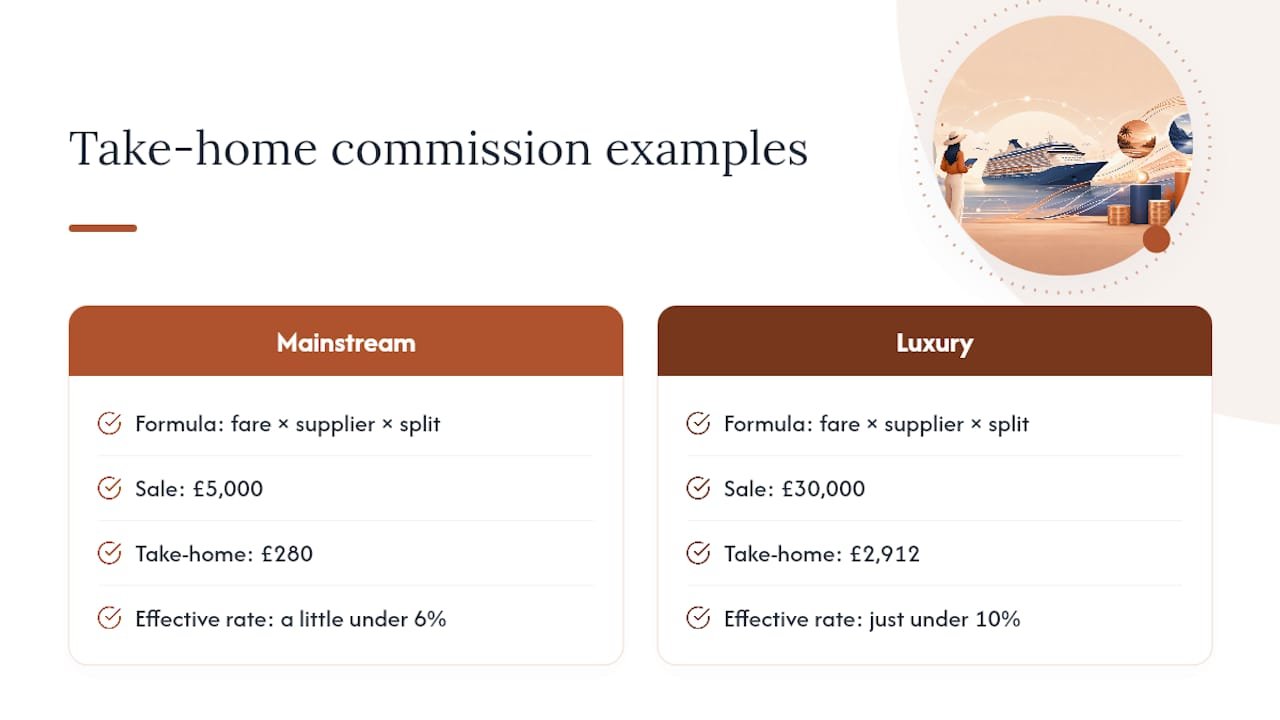
Take-home = commissionable fare × supplier rate × agent/host split (+ ancillaries or overrides)
The commissionable fare is the stripped-down base price. The supplier rate is what the cruise line pays out, typically 10% to 16%. The agent/host split is the percentage of that commission you actually keep after your host agency or platform takes its cut, which is where a headline rate can either survive intact or shrink dramatically depending on how the split is structured.
Here’s how that plays out on two real bookings.
The mainstream booking nets £280 on a £5,000 sale, a little under 6% of the total invoice. The luxury booking nets £2,912 on £30,000, just under 10% of the total. Volume and segment both matter enormously here.
Trade reporting from ASTA suggests effective take-home commission on many mainstream bookings often falls into a single-digit percentage range of total booking value once non-commissionable fees are accounted for. That’s the number to plan a business around, not the 10% to 16% headline rate suppliers advertise.
How can you increase your effective cruise commission?
Raising your income per booking is largely about which products you sell and how you structure the sale. Some tactics take five minutes; others take months to build.
- Sell commissionable ancillaries. Pre-booked excursions, private transfers and travel insurance (where you’re authorised to sell it) often carry their own commission on top of the cruise fare, sometimes at rates comparable to or higher than the cruise itself. A private transfer specialist is a useful example of the kind of ancillary supplier worth building a relationship with.
- Target group bookings and premium cabins. Groups routinely unlock override bonuses on top of standard rates, and luxury cabin categories carry higher base commission than an inside cabin on the same sailing.
- Negotiate your host split. Joining a consortium or a platform with stronger wholesale access can matter more than chasing a marginally higher supplier rate. A lower split on genuinely better rates can beat a higher split on mediocre ones.
- Charge service fees for complex planning. Multi-generational group trips or bespoke itineraries justify a flat planning fee that isn’t tied to commission timing at all.
Pro Tip: Rank your effort against your return before chasing every booking type. A single group booking can pay what ten single-cabin mainstream sales earn combined, so build your marketing around groups and premium cabins first, then treat ancillaries as the top-up, not the main event.
When do cruise lines actually pay agents, and what’s the cashflow risk?
Payment timing is inconsistent across the industry, and that inconsistency is exactly what catches new agents out. Some cruise lines release commission on final payment, months before the ship sails. Others hold it until a set number of days before departure. A few don’t pay until after the client has actually travelled, according to trade reporting on cruise line payment schedules.
That gap between booking and payday creates a real working capital problem if your income depends on a steady run of commission cheques.
- Cancellations before sailing generally void commission payments, and some suppliers may recall commission already paid if a client cancels after payment is made.
- Rebookings, date changes and downgrades can also trigger partial recall depending on the supplier’s specific policy.
- Build a cash reserve equivalent to a few months of expected commission before relying on cruise sales as your sole income.
- Where your agreement allows it, charge a non-refundable booking or planning fee upfront to cover your time regardless of what happens to the commission later.
- Track each major supplier’s payment calendar so you know roughly when money is due, not just how much.
Short-term booking fees and a deliberate cash buffer are the two most common fixes agents use to smooth out this variability, and both are worth setting up before you need them, not after.
Legal and ethical considerations in accepting commissions
Commission itself isn’t controversial. It’s the standard way travel suppliers pay agents, and it’s built into the fare structure long before a client sees a quote. The ethical questions arise around disclosure and steering.
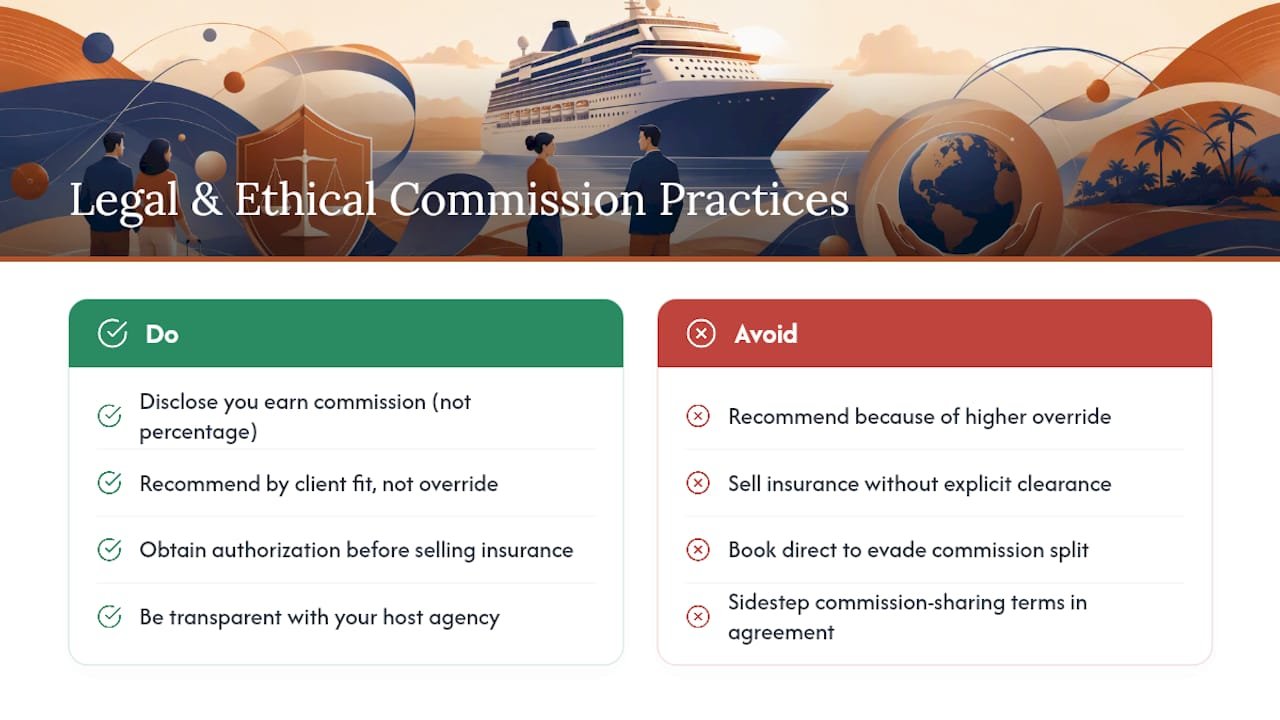
Recommending a cruise line because it pays a better override, rather than because it genuinely suits the client, is where agents get into trouble. If a client later feels sold to rather than advised, that damages the one asset your business actually depends on: repeat referrals. Being upfront that you earn commission on bookings, without needing to disclose the exact percentage, is standard practice and keeps the relationship honest.
Selling regulated ancillaries is a separate issue entirely. Travel insurance in particular often requires specific authorisation or accreditation to sell legally, and the rules differ depending on which insurer or underwriter you’re working with. Never sell insurance products you haven’t been explicitly cleared to offer.
Transparency with your host agency or platform matters too. Booking directly with a supplier to avoid a split, while still using your host’s ATOL protection or branding, breaches most partner agreements and can end the relationship outright. If you’re operating under someone else’s licence, the commission-sharing terms aren’t optional extras. They’re the basis of the whole arrangement, and most agreements spell out exactly what happens if you sidestep them.
How do cancellations and refunds affect commission?
A cancelled booking is, in most cases, a cancelled commission. Cruise lines generally only pay out on completed, non-cancelled sailings, which means a client who cancels before final payment typically leaves the agent with nothing for the hours already spent on the booking.
It gets more complicated once commission has already been paid. Many suppliers, Crystal Cruises among them, reserve contractual rights to claw back commission already disbursed if a booking is later cancelled, downgraded, or found not to meet the original terms. That clawback risk is precisely why agents shouldn’t treat commission as fully “earned” until the client has actually sailed.
Partial refunds and cabin changes sit in a greyer zone. Downgrading from a suite to a balcony cabin after final payment might trigger a partial commission adjustment rather than a full clawback, and the exact treatment depends entirely on the individual supplier’s policy. There’s no single industry standard here, which is exactly why reading each cruise line’s commission terms matters more than assuming they all work the same way.
The practical takeaway: build a small buffer into your income forecasting for cancellations and downgrades, and never spend commission on a high-value booking until final payment has cleared and the cancellation window has passed.
How do commission structures compare across cruise lines?
Commission structures vary meaningfully by cruise line, and the differences go well beyond the headline percentage. Premium lines often sit a couple of points higher and are more willing to offer tiered overrides tied to annual sales targets.
Luxury and river cruise lines are where the real variation shows up. That’s part of why agents who specialise in luxury or river cruising often report meaningfully higher average commission per booking than generalists selling mainstream sailings.
Payment terms differ just as much as the percentages. Some lines pay promptly on final payment; others hold funds until close to or even after departure, which matters as much to your cashflow as the rate itself. There’s also a genuine industry shift underway: some lines and consortia are actively reducing non-commissionable fees or moving toward fully commissionable pricing, which directly improves effective take-home for agents who prioritise those suppliers. Watching which lines are moving in that direction is worth more than memorising today’s rate card.
What actually determines whether this business works?
The agents who make cruise selling a genuine income stream, rather than a side hustle that fizzles out, tend to focus on the unglamorous fundamentals first: repeat clients, a narrow enough specialism to build real expertise, and a host relationship that pays out on rates that hold up once you do the maths properly. Chasing the highest advertised split without checking the underlying supplier rates and cashflow terms is a common early mistake, and it’s an easy one to avoid once you’ve run the numbers yourself.
A platform like Timeshunters is worth understanding in this context. It provides a white-label travel agency setup with ATOL-protected access to suppliers, meaning partners operate under established financial protection rather than building that infrastructure from scratch. One partner has reported income rising from £400 to £1,200 per booking after moving onto the platform, which illustrates just how much the host split and rate access genuinely affect the final number.
None of that replaces doing your own homework on commissionable fares and supplier terms. But it does show that the platform you build your business on matters as much as which cruise lines you sell.
— Sam
Ready to earn more per cruise booking?
Most new agents lose income twice: once to a low host split, and again to the admin of running quotes, payments and follow ups manually. Timeshunters tackles both at once.
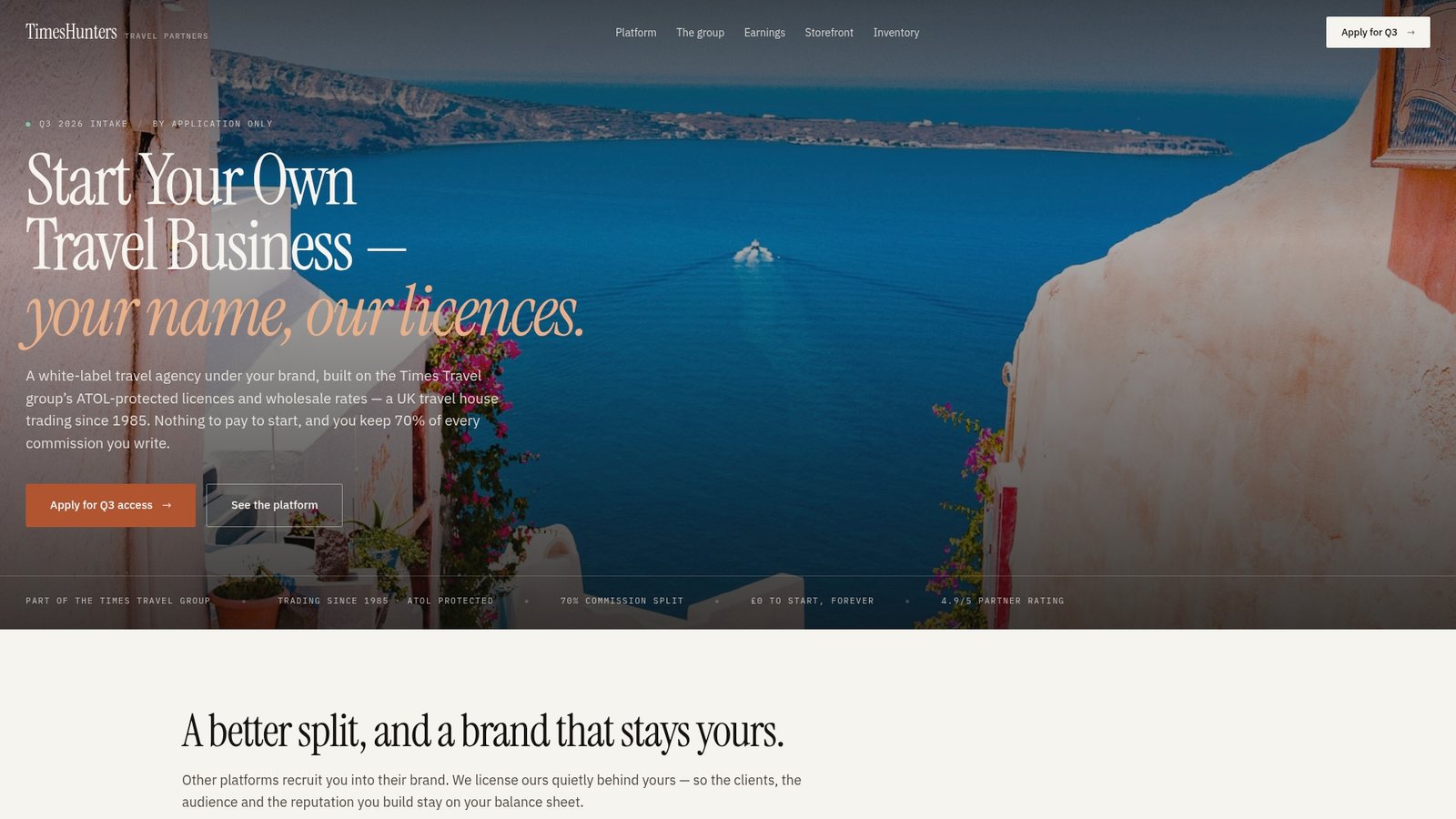
The setup includes ATOL-protected licences through Times Travel group, a branded booking site under your own name, automated booking management, instant pricing proposals and managed payments, so you’re not building compliance and back-office systems from zero. It suits aspiring agents starting from nothing, entrepreneurs with an existing audience looking to monetise travel recommendations, and small hospitality businesses wanting a branded booking arm without the licensing overhead.
If the worked examples above made you want to see what your own numbers could look like on a proper 70% split, visit the Timeshunters partner programme to check eligibility and see the platform in detail.
Sources
- Complete Cruise Commissions Guide For Travel Agents
- ASTA brief puts hard numbers on what advisors already knew: NCFs are gutting commissions | Travel Agent Central
FAQ
How much do cruise agents actually make per booking?
Effective take-home commonly falls between 6.5% and 8.5% of total booking value on mainstream cruises once non-commissionable fees are stripped out, though luxury and group bookings run considerably higher.
What is a good commission split with a host agency?
A 70% split, like the one Timeshunters offers partners, is well above the roughly 4% typical of online travel agency models and gives agents a far larger share of each supplier payout.
Do agents lose commission if a client cancels?
Usually, yes. Most suppliers only pay commission on completed sailings and reserve the right to claw back commission already paid if a booking is later cancelled or downgraded.
When do cruise lines pay agent commission?
Timing varies by supplier: some pay on final payment, some a set number of days before sailing, and others only after the client has actually travelled.
Is selling travel insurance a good way to boost commission?
It can add meaningful income, but insurance is regulated and typically requires specific authorisation before an agent can sell it legally.