
Preferred Supplier Programs: White Label Gives Travel Advisors Control
Learn how travel advisors assess preferred supplier programs, track partner value, and weigh white label platforms for client control and higher commissions.

A preferred supplier programme is a curated arrangement where an advisor’s chosen suppliers give priority service, negotiated rates and extra incentives in return for focused volume. In practice, it decides who you reach for first when booking a client. Treat those suppliers as partners rather than vendors, and your loyalty follows the service you get. Platforms such as TimesHunters offer a different route to similar control.
TL;DR:
- Build a focused portfolio of about three to six partners, then test service with a small booking before agreeing on volume, commissions, and escalation routes.
- Priority status does not transfer automatically when you change host agencies, so confirm your standing and escalation contact with each supplier’s BDM in writing.
- Review performance quarterly or at least twice a year, comparing bookings with targets alongside complaint resolution times and useful response times from your BDM.
- Ask suppliers to confirm commission protection in writing, especially how commissions hold up when clients amend dates, upgrade, or rebook.
- If client and brand ownership matter more than supplier perks, TimesHunters offers a white label route and says it takes 30% of commission.
Table of Contents
- What does a preferred supplier programme look like in practice?
- Why do preferred programmes shape advisor loyalty and client outcomes?
- How do preferred programmes affect host-agency relationships and BDMs?
- How do you choose, build and maintain a curated portfolio of preferred partners?
- How can you tell whether a preferred partnership is delivering value?
- What features and incentives should you expect from a preferred programme?
- When does a white-label platform beat chasing supplier perks?
- Consider TimesHunters as an alternative: white-label agency platform at a glance
- FAQ
- Sources
What does a preferred supplier programme look like in practice?
The clearest test is the relationship, not the label. A standard supplier fills an order. A preferred partner commits to how it treats your bookings, and you commit to how you place them. Advisors who treat preferred suppliers as strategic partners describe the difference as deeper product knowledge, reliability and prioritised service rather than a simple price list.
Typical components you can look for:
- Service commitments, such as agreed response times and a named escalation route
- Production targets that set the volume you are expected to place
- A dedicated business development manager (BDM) as your day-to-day contact
- A set communication cadence, from newsletters to scheduled catch-ups
- A written memorandum of understanding or set of expectations, where one exists
Be realistic about formality. Commercial terms often sit in a written host-agency agreement, but the prioritisation you feel on a difficult booking usually rests on the relationship with one person. If you cannot name your contact and describe what they have agreed to do, you probably have a supplier, not a partner.
Why do preferred programmes shape advisor loyalty and client outcomes?
Advisors lean on preferred partners because the benefits show up exactly when a booking gets difficult. Faster answers, quicker fixes and sometimes better rooms all reach the client through you.
Where the advantages tend to land:
- Service: prioritised responses, faster issue resolution and occasional upgrades or enhanced amenities
- Commercial: negotiated rates, overrides and commission protection that can safeguard your earnings
- Operational: predictable fulfilment and fewer surprises, which means less friction for the client
Preferred arrangements can also turn into concrete extras on the booking itself. Egencia’s preferred-rate programmes list a minimum discount of 10%, free breakfast and loyalty points as examples of what negotiated arrangements deliver for travellers.
Egencia’s supplier network cites a minimum discount of 10%, free breakfast and loyalty points as typical preferred-rate benefits. For advisors, the lesson is that a preferred arrangement should be visible in what the client receives, not just in what you are told.
There is also an emotional return. Clients remember who sorted out a cancelled flight transfer when plans change, and they credit the advisor. Suppliers who prioritise you protect that reputation, which is why loyalty tends to follow service quality more than headline rates.
How do preferred programmes affect host-agency relationships and BDMs?
A host agency negotiates the commercial framework: commission levels, override tiers and the terms printed in the supplier agreement. The BDM relationship decides how that framework behaves in daily life. Practitioner advice is that host-agency agreements set the terms, but you still need to cultivate individual relationships with supplier BDMs.
That has practical consequences:
- Escalations move faster when a BDM knows you and your booking pattern
- Service continuity depends on a person who can act, not only a contract that permits it
- Client protection improves when you know who to call if something breaks
The same source notes that those relationships must be re-established if you move between hosts. A new host may carry equal or better rates, but your priority status with each supplier does not transfer automatically. Plan a handover period: introduce yourself to each BDM, restate your volume history and confirm your escalation route before you rely on it.
Pro Tip: Before switching host agency, ask each key supplier’s BDM in writing what status you would hold under the new host, so you are not guessing about priority after the move.
How do you choose, build and maintain a curated portfolio of preferred partners?
Concentration beats breadth. Practitioner guidance recommends building trust with about three to six preferred partners, because focused volume buys product knowledge, reliability and prioritised service that protects clients when plans change. Spread across too many suppliers, you are a small account everywhere.
A workable sequence:
- Map your demand. List the destinations, cruise lines or product types you actually sell, and rank them by revenue.
- Check product fit. Shortlist suppliers whose inventory matches your clients’ real requests, not the brochure range. Our guide to GDS versus bedbanks helps when you are deciding where inventory should come from.
- Test service levels. Place a small booking, ask a hard question and note how long the answer takes.
- Compare commercial terms. Look at commission, overrides, payment terms and how commission is protected if a booking changes.
- Ask about enablement. Confirm training, familiarisation trip access and a named BDM.
- Agree escalation and reporting. Know who you call, and what production reports you will receive.
- Document it. Write down what was promised, by whom and when, and share the summary with your host agency if you use one.
Specialist partners can fill gaps a large supplier cannot. Keys of Italy, for example, offers tailor-made experiences in Venice built on local guides, which suits advisors selling immersive Italian itineraries.
Pro Tip: Start each relationship with one clear commitment, such as a quarterly volume figure you are comfortable with, so the supplier knows what priority it is earning.
If you are still building the operational side, our host agency training playbook covers onboarding in more detail.
How can you tell whether a preferred partnership is delivering value?
Judge it on numbers you can pull from your own records, not on how warm the last lunch was. Pick a short set of indicators and compare them against what was agreed.
Useful KPIs:
- Production against target: actual bookings placed divided by the volume you committed to
- Average booking value: total booking value divided by number of bookings, tracked by supplier
- Complaint and resolution rate: issues raised per hundred bookings and how many closed within the promised time
- Advisor satisfaction: a simple score you record after each quarter, or an NPS-style question for your team
- BDM response time: hours between your query and a useful answer
Data usually comes from host-agency reports and exports from your booking platform. A simple example: compare the bookings you placed with a supplier against your target. That comparison shows quickly whether to deepen or loosen the relationship.
Review quarterly or at least twice a year, and bring in anyone who shares the account: your host contact, your BDM and, where relevant, a colleague who books on the same supplier. If incremental earnings matter to you, our playbook on keeping more commission when upselling extras is a useful companion to the numbers above.
What features and incentives should you expect from a preferred programme?
Match each feature to value you can actually use, then negotiate for the ones that matter most to your client mix.
Common financial incentives:
- Preferred rates and net pricing that undercut what the public can find
- Room or cabin upgrades and added amenities
- Commission overrides that reward volume
- Marketing co-op funds for campaigns you run
- Exclusive inventory or allotments that open space others cannot reach
Non-financial perks often matter just as much:
- Product training and familiarisation trips that sharpen what you sell
- A dedicated account team rather than a general call centre
- Priority handling when a booking is disrupted
Commission protection deserves special attention. In practice it shows up as a supplier honouring your commission when a client amends dates, upgrades or rebooks, rather than quietly reducing it. Ask how this works in writing, because it is the feature most likely to be tested the first time a booking goes wrong. A dependable partner for group stays, such as Dragonfly Retreat’s private group accommodation and hosted retreat experiences in Andalusia, is a good example of exclusive-use inventory that regular channels rarely offer.
When does a white-label platform beat chasing supplier perks?
Preferred programmes reward loyalty, but they leave one thing untouched: the client relationship still sits partly with the supplier or host. My view is that advisors underrate how much that matters. If you spend years earning priority status and then move host, you restart. A white-label platform answers a different question, namely who owns the brand, the client list and the pricing.
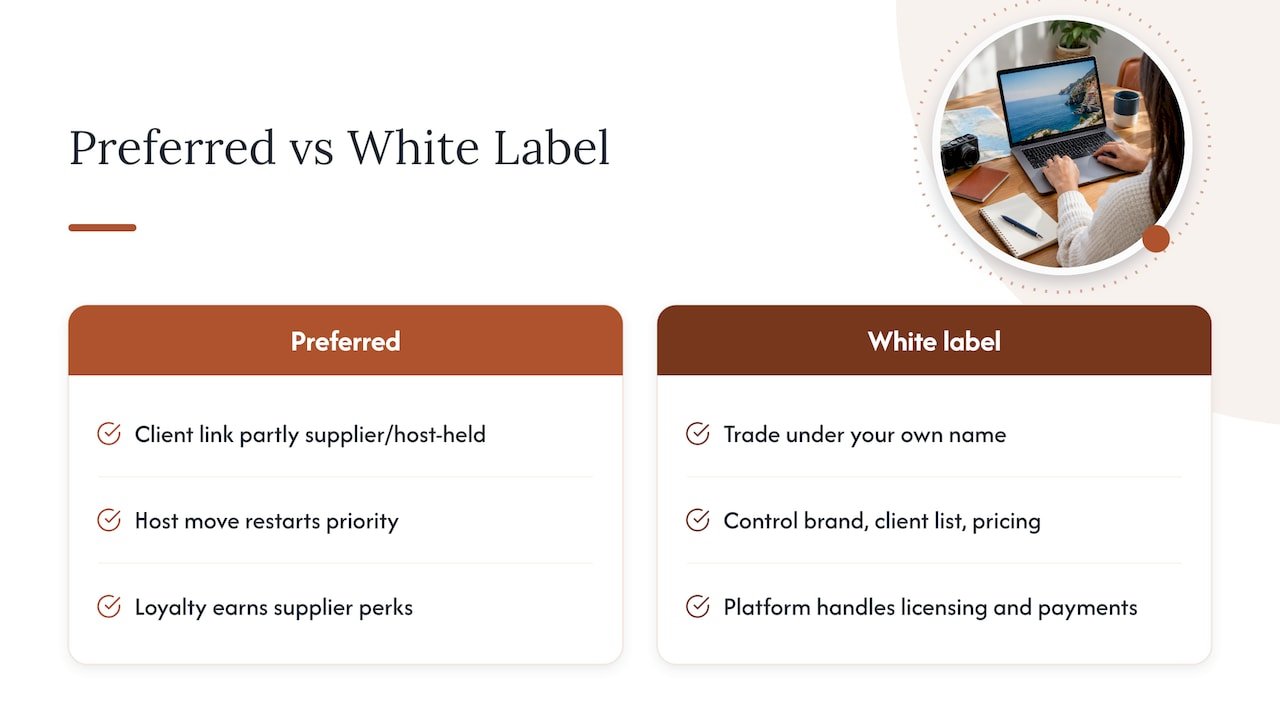
A white-label travel agency lets you trade under your own name while the platform handles licensing, managed payments and access to wholesale inventory. Our own claims for it include licensing, a larger commission split and a partner’s account of increased income per booking. Those are our claims and a partner’s own account, not independent benchmarks. Those are our figures and a partner’s own account, not independent benchmarks.
So the choice is practical. If your business depends on a few strong supplier relationships, deepen them. If your frustration is low commission and no ownership of your clients, a white-label route deserves a look.
— Sam
Consider TimesHunters as an alternative: white-label agency platform at a glance
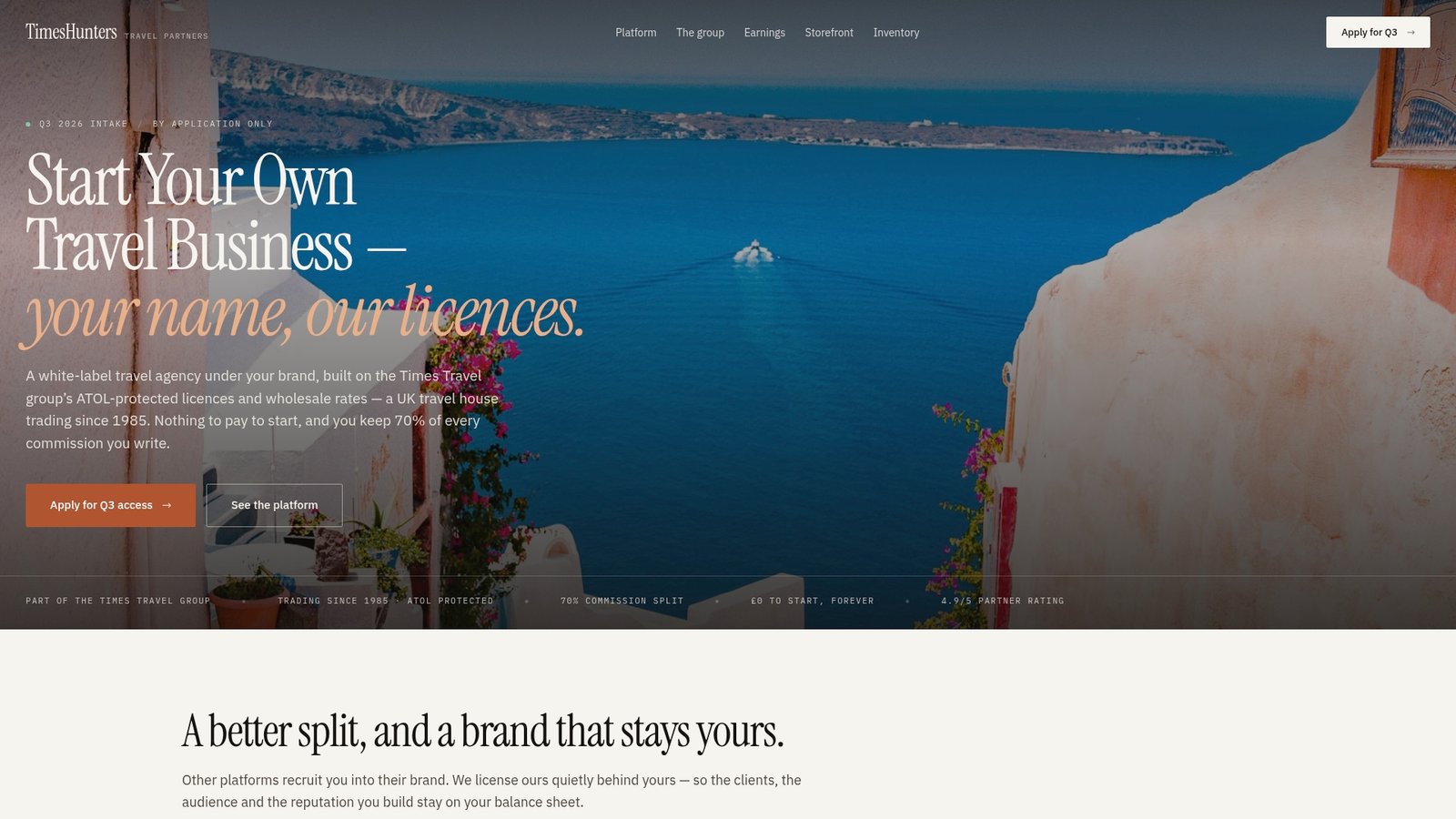
If you want your own brand, your own clients and a bigger share of each booking, our white-label travel agency platform is built for exactly that. You trade under your name on Times Travel group’s licences, and we handle the infrastructure behind the booking.
What you get:
- A branded booking site and instant pricing proposals
- Access to wholesale hotel, cruise and tour inventory
- Managed payments and financial protection
- Automated booking management and client follow-up
- Training and support to get started
You keep a larger commission split, with 30% going to us. It suits advisors who already have an audience and want more control over their earnings, and there is no cost to start. The easiest next step is to read how our referral programme and commission model works, then visit Timeshunters to get started.
FAQ
What is a travel supplier?
A travel supplier is a business that provides the actual travel product, such as a hotel, airline, cruise line, tour operator or transfer company. Advisors sell those products to clients and earn commission when a booking is made.
What does preferred supplier mean for a travel advisor?
A preferred supplier is one you deliberately concentrate volume with, in return for priority service, better terms or extra incentives. It is a partnership built on commitments from both sides rather than a one-off purchase. Practitioners suggest building trust with about three to six of them.
How many preferred suppliers should an advisor have?
A small, curated group usually works better than a long list. Advice from practising advisors points to roughly three to six partners, so your volume is large enough to earn real attention from each supplier.
Do preferred supplier benefits really reach the client?
They can, when the programme is well designed. Egencia’s supplier network lists a minimum discount of 10%, free breakfast and loyalty points as examples of perks that reach travellers directly.
Sources
- The Power of Preferred Partnerships: Strategies for Building Successful Relationships: Travel Weekly
- Business Travel Savings: Egencia Supplier Network