
Sell Cruises from Home: A UK Guide to Starting Properly
How to sell cruises from home in the UK: the legal basics, ATOL and package rules, how commission works, finding clients and the route we recommend.

You can sell cruises from home in the UK without a shop, a licence of your own or a big budget. The usual route is to trade as an agent under someone else’s protection. What matters is choosing a set-up that keeps you legal, keeps your clients’ money protected and lets you keep a fair share of each booking. This guide covers the rules, the money, the skills and the first 90 days.
TL;DR
- Most home-based cruise sellers work as an agent for a licensed principal. That keeps the legal and financial-protection burden off you.
- Cruises sold with flights, or with other travel services such as accommodation, usually count as packages. Insolvency protection must be in place before you take a penny.
- Commission is only half the story: look at the split you keep, when it is paid and whether it can be clawed back.
- Your first clients will come from people who already trust you, so build a personal brand early.
- Our white-label platform lets you sell under your own name with ATOL-protected licences and a 70% commission split.
Table of Contents
- Why selling cruises from home works in the UK
- The three ways to start
- What the law expects of a home-based cruise seller
- How cruise commission really works
- The knowledge and skills you need
- How to match a cruise to a customer
- Finding your first customers
- Our perspective: keep your brand and your clients
- Start under your own brand
- Your first 90 days, step by step
- FAQ
- Sources
Why selling cruises from home works in the UK
The market is big and still growing. Trade body CLIA reported that 2.4 million UK and Ireland passengers sailed with its ocean member lines in 2024, a record and up 5.2% on the year before. The same report put the average sailing at 9.7 days, which means a typical booking is a substantial, considered purchase. That is the kind of sale where a trusted adviser beats a comparison website.
Cruises also suit working from a kitchen table. A booking is built from a handful of decisions: itinerary, ship, cabin type and extras such as dining or excursions. Clients like talking those through with a person. Your time goes on conversations, not on stock or premises.
There is also a wide range to sell. Short weekend breaks from Southampton, Mediterranean fly-cruises, Danube river sailings and long expedition voyages all attract different customers. A seller who knows which customer fits which product has an edge no algorithm gives.
The three ways to start
Before anything else, decide how you will trade. There are broadly three routes.
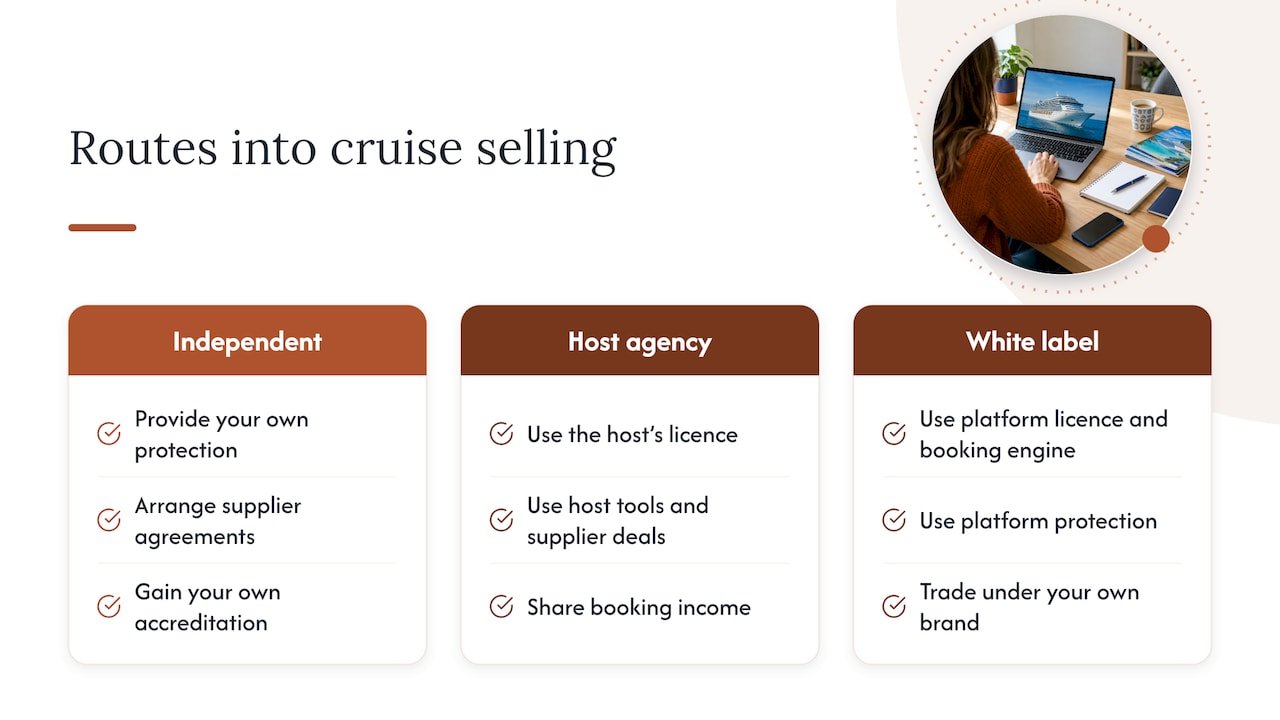
Going fully independent
You hold your own financial protection, your own supplier agreements and your own accreditation. You keep everything you earn, but the setup is slow and expensive. A flight-inclusive business needs an ATOL, and the waiting time alone can eat months. Our own guide to avoiding the 12 week wait for an ATOL licence explains why many newcomers skip this route.
Joining a host or homeworking agency
You sell under the host’s licence, tools and supplier deals, and they take a share of each booking. Support can be good. The trade-offs are the split, the fees and the fact that the host’s name, not yours, often appears on the paperwork. Before you sign, read how host agency commissions pay out after fees and clawbacks.
Using a white-label platform
You trade under your own brand while the platform supplies the licence, booking engine and protection behind it. This is the model we run, and we say more about it below. For a wider look at all the options for becoming self-employed, see our guide on how to become an independent travel agent in the UK.
What the law expects of a home-based cruise seller
This is the part newcomers skip and later regret. Three ideas matter: whether you are an agent or a principal, whether the sale is a package, and whether flights are involved.
Agent or principal
ABTA explains that an agent acts for a principal, brings about the customer’s contract with that principal and earns agreed commission. A principal is the party contractually bound to deliver the travel services. The distinction decides who carries liability and who must provide financial protection. If you simply put clients in touch with a cruise line or a licensed operator and earn commission, you are on the agent side. If you assemble and sell a package in your own right, you take on the obligations of an organiser.
When a cruise is a package
The government’s guidance on the Package Travel and Linked Travel Arrangements Regulations says cruise holidays are generally packages when they combine at least two travel services, such as transport and accommodation, unless they are shorter than 24 hours with no overnight stay. The same guidance says the rules apply throughout the UK and that agents should be clear about which bookings are packages and what insolvency protection applies. Amendments to the regulations commence on 6 April 2027, so read our summary of the UK Package Travel Regulations changes if you are planning to sell beyond then.
Organisers must also provide security for refunds and repatriation if they fail. That is the regulation behind the protection a client expects when they hand over a deposit, as set out in the 2018 Regulations themselves.
Fly-cruises and ATOL
Many UK cruises include flights to the port. The Civil Aviation Authority says a business selling flight-inclusive packages to UK consumers must hold an ATOL, be an airline selling its own services or be an exempt person, for example an agent of an existing ATOL holder. This is why the fly-cruise is the booking where home sellers most often get into trouble. If you want to understand how flight-inclusive holiday packages are put together and supported by a specialist, it shows how much paperwork sits behind a single itinerary with flights.
Two routes keep you on the right side of this: sell as an agent of an ATOL holder, or hold your own licence. Our comparison of trust accounts versus insurance for UK agents sets out what the second route involves.
Describing your protection honestly
If you are an ABTA member, its November 2025 guidance says members must give clear and prominent information about financial protection and use claims such as “fully bonded” only when every product they sell is protected. The principle is good practice for anyone: say exactly what protects the client, and only claim it for the bookings it covers. Our checklist on client money protection for white-label partners turns this into five practical checks.
How cruise commission really works
Headline rates are easy to quote and hard to compare. Four questions give you the real picture.
- What is the commission on the product? Rates vary by cruise line, cabin grade and sometimes volume.
- What share do you keep? If you sell through a host or platform, your cut is a percentage of that commission, not of the fare.
- When is it paid? Cruise commission is often paid after the client has sailed, so a booking made in January for a September sailing may not pay you until well after.
- Can it be taken back? If a client cancels or amends, commission already paid can be reclaimed.
A worked example makes it plain. Say a couple book a £2,000 cruise and the supplier pays a commission of 10%. That is £200 of commission on the booking. A split that leaves you 70% of that commission means £140 to you. A 30% share would leave £60. The commission rate is set by the supplier and varies, but the split is the part you can choose, and over a year of bookings it decides whether this is a hobby or an income. See how this plays out on a real number in our piece on wholesale cruise rates through a white label and in the breakdown of cruise agent commissions for aspiring agents.
Keep a simple spreadsheet from day one: booking date, sailing date, expected commission, date paid, and any amendments. Cash flow, not sales, is what catches new sellers out.
The knowledge and skills you need
You do not need ten years in travel, but you do need to be useful in the first conversation. Focus on four things.
- Know the cruise lines by personality. A lively family ship with water slides and a quiet, adult-leaning line suit entirely different people. Learn two or three lines well before you try to cover all of them.
- Know the cabin types. Inside, ocean view, balcony and suite differ in more than price. Motion, noise and deck position matter to some clients far more than the view.
- Handle objections. Seasickness, “I’ll feel trapped” and “it’s all too crowded” are the common ones. A calm, informed answer wins the booking.
- Know what is and is not included. Drinks packages, gratuities, excursions and flights are where a headline fare grows. Clients value the adviser who tells them early.
Training is widely available. Cruise lines run programmes for homeworking agents, and the Celebrity Cruises Xcelerator programme is one example that mixes sales, marketing and client-nurturing skills with product knowledge. That mix is telling: for a home seller, business coaching matters as much as knowing the ships. If you want structured learning on the platform side too, see our notes on what to look for in an agent training portal.
If you will sell cruises seriously, consider industry membership once you have some bookings behind you. We cover how to make CLIA membership pay over 90 days.
How to match a cruise to a customer
The best home sellers sell fit, not ships. Five questions in a first call usually get you there.
- Who is travelling? Couple, multigenerational family, solo traveller or friends. Each group wants different things from the same ship.
- What does an ideal day look like? Lounging, sightseeing, nightlife or activities for children.
- How far will they travel to join? Some will happily drive to Southampton; others want a fly-cruise.
- What is the budget, all in? Including flights, drinks, excursions and tips, not only the fare.
- Have they cruised before? First-timers need reassurance; repeat cruisers want something new.
Write the answers down and send a short proposal with two or three options, not ten. Then follow up. Repeat business comes from remembering the anniversary, the dietary need and the cabin they loved, and offering the next sailing before they ask. Our guide to selling travel in seven stages takes the same fit-first approach, and our notes on upselling travel extras show how to add value without pushing.
Finding your first customers
Your first clients are almost always people who already know you. Trade media suggests a mix of tactics for home-based agents: an offline network, a Google Business Profile, social media, segmented email newsletters and local events, as set out in TTG’s tips for growing a client base. Here is how to turn that into a plan.
- Week 1 to 2: tell friends, family, colleagues and former customers what you now do. Ask each for one introduction.
- Week 3 to 6: set up a simple page for your brand with a way to enquire, and claim your Google Business Profile.
- Week 7 to 12: share one useful post a week, such as a ship comparison or a first-timer’s checklist, and start an email list segmented by interest: families, couples, river cruisers.
If you already have an audience, you start ahead. Our guides for turning a following into bookings and for selling travel as a creator cover the compliance side that audience-led sellers need to get right.
Our perspective: keep your brand and your clients
We built TimesHunters because we think the usual deal for home sellers is lopsided. Online agencies typically pay around 4% on a booking, and many host set-ups leave the seller’s name invisible and the client relationship in someone else’s hands. Cruises are relationship sales: the same client may book five or six sailings over the years. If the relationship belongs to somebody else, so does that future income.
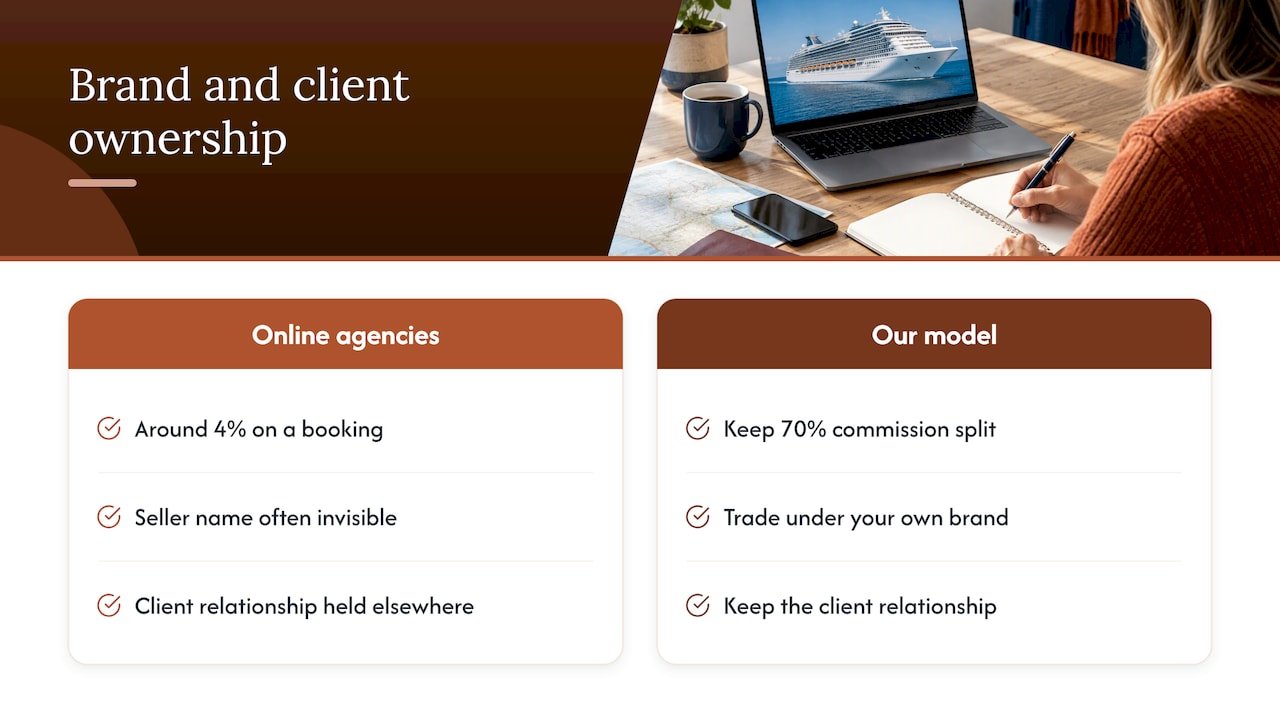
Our model is designed to reverse that. You trade under your own name, on a booking site that carries your brand, while the licence behind it stays invisible to your clients. You keep a 70% commission split, and we keep 30%. There is no cost to start. Our group’s ATOL-protected licences sit behind your sales, so the hardest regulatory step is already handled, and automated booking management and client follow-up take over the admin that eats a beginner’s evenings.
We do not claim it replaces the need to learn the product. You still need to know your ships, your clients and your numbers. What we offer is the structure so that skill turns into income you own.
— Sam
Start under your own brand
If you want to sell cruises, hotels, tours and more under your own name, our white-label travel agency gives you ATOL-protected licences, wholesale inventory, a branded booking site, instant pricing proposals and managed payments, with training and support as you launch.
You can see how the split works on our referral programme page, or explore the four-week launch and training route.
Your first 90 days, step by step
- Choose your trading model. Agent under a licensed principal, host, white label or your own licence. Check each against the rules above.
- Confirm your protection. Know which of your bookings are packages and what protects the client’s money. For a wider view of the accreditation steps, read our guide to starting to sell this quarter.
- Pick a niche. Families on British-port sailings, river cruises for over-55s, or milestone celebrations. A narrow focus makes you easier to refer.
- Learn two or three cruise lines properly. Take their trade training and ask for a ship inspection when invitations come.
- Set up your brand and your tracking. A simple site, a branded email address and the commission spreadsheet from earlier.
- Make ten warm conversations a week. Ask questions before you recommend anything.
- Review at day 90. Which enquiries became bookings, which enquiries stalled, and what is your net per booking after the split?
If this is your first step into the industry, our overview of how to become a travel agent in the UK places cruise selling in the wider picture.
FAQ
Can I sell cruises from home with no experience?
Yes. Many home sellers start with no travel background and learn through supplier training and by specialising in a few cruise lines. The real requirement is that you trade in a legally protected way. Experience in talking to clients and following up matters more than a travel CV.
Do I need an ATOL to sell cruises?
Only if the booking includes flights and you are selling it as a package to UK consumers. The CAA says that business must be an ATOL holder, an airline or an exempt person such as an agent of an ATOL holder. Selling as an agent under an existing holder’s licence is the common route for home sellers.
How much can I earn selling cruises from home?
It depends on the commission the supplier pays, your split and how many clients you serve. As a worked example, 10% commission on a £2,000 cruise is £200 before your split. We do not promise a level of income, and results differ between sellers.
Is a cruise always a package under UK rules?
Not always, but usually. Government guidance says cruises are generally packages when they include at least two travel services such as transport and accommodation, with an exception for trips under 24 hours without overnight stays. If you are unsure about a particular booking, check the guidance or ask the licensed principal you sell for.
Sources
- Clia UK and Ireland hails record passenger numbers for 2024, Travel Weekly
- Guidance on the Package Travel and Linked Travel Arrangements Regulations 2018 (amended 2026), GOV.UK
- The Package Travel and Linked Travel Arrangements Regulations 2018, legislation.gov.uk
- Do I need an ATOL, UK Civil Aviation Authority
- How your business trades, ABTA
- Guidance on the application of the Code of Conduct, ABTA, November 2025
- Celebrity Cruises partners with TTG to launch interactive virtual training, TTG Media
- 10 top tips on how home-based agents can grow their client base, TTG Media