
Package Holiday Definition: What Counts Under UK Law
A package holiday is two or more travel services sold together. See what the UK rules count as a package, what they exclude, and how ATOL fits in.

A package holiday is a trip that combines at least two different types of travel service, such as flights and a hotel, for the same holiday, and is sold in one of the ways UK law lists. ABTA adds that it must cover at least 24 hours or include overnight accommodation. The legal detail sits in the Package Travel and Linked Travel Arrangements Regulations 2018 (the PTRs), and it matters to two groups: travellers who want to know what protection they have, and anyone who sells or plans to sell holidays.
TL;DR
- A package is at least two different types of travel service (transport, accommodation, vehicle hire or a significant other tourist service) combined for one trip.
- How it is sold matters as much as what is in it: one trader combining services under a single contract, a single payment, an inclusive price or being advertised as a “package” can all create one.
- The business that organises a package is responsible for how all of it is performed, and a package that includes a flight must be ATOL protected.
- Linked travel arrangements, trips under 24 hours without a night’s stay, and some business and not-for-profit bookings fall outside the package rules.
- If you want to sell holidays under your own name, we explain at the end how a white-label route works.
Table of Contents
- The short definition in plain English
- What the law says counts as a package
- Examples of packages and non-packages
- Package, linked travel arrangement or separate booking?
- What is included in a package holiday?
- What the organiser must do
- Where ATOL fits in
- What does not count as a package
- Our perspective on selling packages
- Start selling holidays under your own name
- Practical checks before you book or sell
- FAQ
- Sources
The short definition in plain English
Think of a package holiday as a ready-made trip that one business takes responsibility for. You might buy a week in Majorca with return flights, a hotel and airport transfers from a tour operator. You might pick a flight and a hotel on one website and pay a single total. Both can be packages.
The everyday dictionary meaning is a holiday at a fixed price where a travel company arranges your travel and accommodation. The legal meaning is wider. It reaches combinations that never carry a “package” label, and it narrows to exclude some things that feel like packages but are not.
What the law says counts as a package
The PTRs define a package as a combination of at least two different types of travel service for the same trip or holiday. There are two broad routes into that definition.
- One trader combines the services before a single contract is concluded for all of them. This is the classic tour operator holiday.
- The services are bought under separate contracts but meet specified conditions. These are covered below.
The four types of travel service
The government guidance on the regulations lists the building blocks:
| Type of service | Examples |
|---|---|
| Carriage of passengers | Flights, trains, coaches, ferries and cruise transport |
| Accommodation | Hotels, villas and apartments (with exclusions, such as accommodation that is intrinsically part of the passenger carriage) |
| Motor vehicle hire | A hire car for the length of the trip |
| A significant other tourist service | Event tickets, excursions, guided tours, ski passes, equipment rental or spa treatments |
Two different types from that list make a package. Two nights in two different hotels do not, because that is the same type twice.
When an “other tourist service” counts
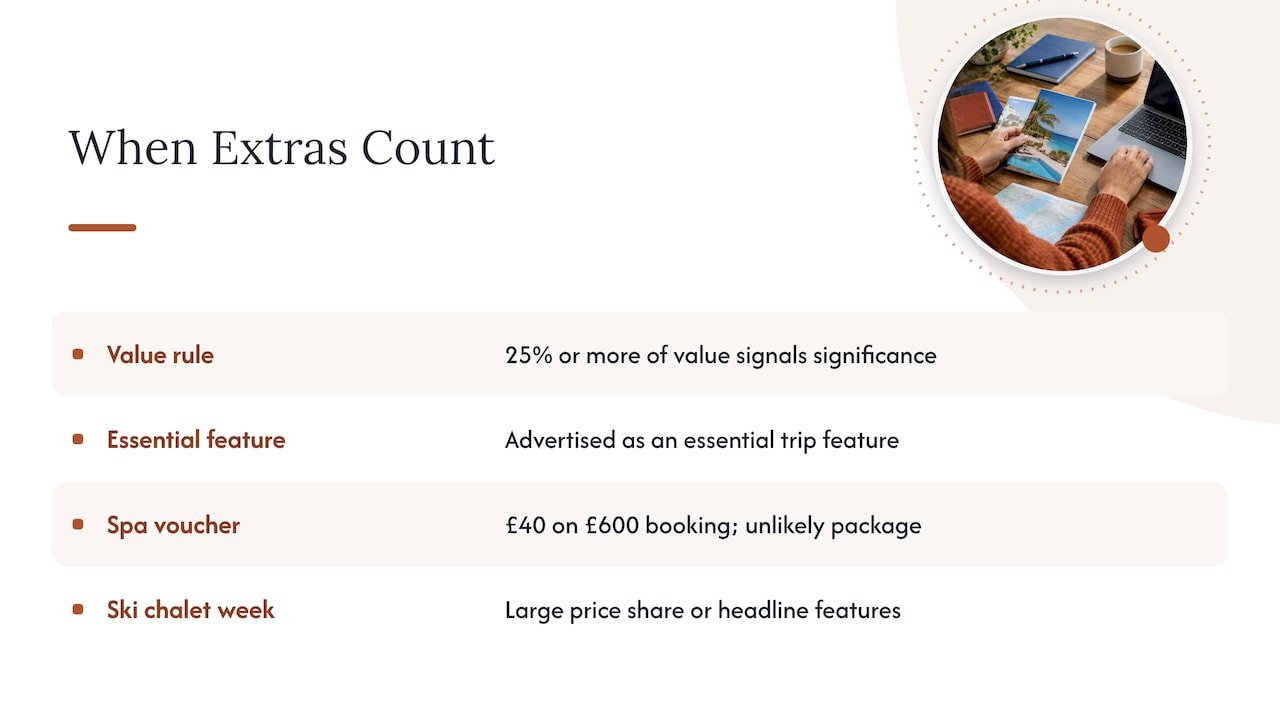
An extra such as an excursion only helps create a package when it is significant. The guidance says that where just one of transport, accommodation or car hire is combined with an other tourist service, a package arises only if that service is advertised as an essential feature of the trip or makes up a significant proportion of the value. The guidance offers a rule of thumb that 25% or more of the value points to significance, while noting that the PTRs do not define “value”.
A worked example: a hotel stay with a £40 spa voucher on a £600 booking is unlikely to be a package. A ski chalet week where the lift pass and equipment hire are a large share of the price, or are headline features, is much more likely to be.
Separate contracts that still add up to a package
This is where most confusion arises. Even when you sign several contracts, the arrangement can still be a package. According to the regulations, that happens when the services:
- are purchased from a single point of sale and chosen before you agree to pay;
- are sold at an inclusive or total price;
- are advertised or sold as a “package” or a similar term;
- are combined after a contract that lets you choose among types of service; or
- are bought through linked online booking processes where your details pass from one trader to another and a second contract is concluded within 24 hours.
ABTA’s own explanation frames the same test in consumer terms: one price paid in one payment, a combination you select before agreeing to pay, an inclusive price, a package-style description, or your details being handed on so another service is booked within 24 hours.
Examples of packages and non-packages
| Booking | Package? | Why |
|---|---|---|
| Tour operator week in Crete with flights, hotel and transfers, one price | Yes | One trader combines services under one contract |
| Flight and hotel picked on one site, one total paid | Yes | Combined at a single point of sale at a total price |
| Hotel bought from a hotel’s own site, flights bought separately elsewhere | No | Separate bookings with no combining trader |
| Rail-and-hotel city break advertised as a “city break package” | Yes | Advertised as a package, transport plus accommodation |
| Flight only | No | One type of service |
| Hotel with a small add-on treatment | Usually no | The extra is unlikely to be significant |
There are also curated, guided trips that bundle transfers, stays and local experiences, such as curated Italian itineraries. Whether a particular one is legally a package depends on the services combined and the way it is sold, using the tests above.
Package, linked travel arrangement or separate booking?
A linked travel arrangement (LTA) is the middle ground. The PTRs describe it as involving at least two different types of travel service for the same trip, not constituting a package, and resulting in separate contracts with each provider. The trader must facilitate either separate selection and payment during a single visit or contact, or a targeted procurement of an additional service, where the second contract is made within 24 hours of confirmation of the first booking.
ABTA’s guidance shows that the line between the two depends on how the trader facilitates the booking, not only on what you buy. A single combined sale or contract points to a package. Separate contracts with a facilitated link point to an LTA. For the traveller the difference is protection: packages carry the organiser’s full responsibility, while LTAs carry a narrower insolvency protection duty.
If you book each element yourself from different providers with nothing linking them, it is simply separate bookings, and the package rules do not apply.
What is included in a package holiday?
The contents are whatever the organiser has combined, but the legal minimum is two of the four service types above. In practice you will meet these common combinations:
- flights plus hotel, often with transfers;
- accommodation plus hire car for a fly-drive or road trip;
- a cruise combined with flights and pre-cruise hotel nights;
- rail plus hotel for a city break;
- accommodation plus lift passes and equipment for a ski week.
Meals, drinks and baggage allowances are matters of the specific offer. They are not what makes something a package, so read the pre-contract information to see what your price actually covers.
What the organiser must do
Whoever organises a package takes on legal duties. The official guidance says the PTRs place liability for performance of the travel services in the package on the organiser, whoever actually delivers them. It also says organisers and, where relevant, retailers must:
- give the required pre-contract information using the binding standard information forms, including the main characteristics of the package, total price, organiser details and cancellation policy;
- confirm the contract; and
- supply key post-sale information, including insolvency protection contact details.
The guidance is amended for application from 6 April 2027. If you sell holidays, our page on the UK Package Travel Regulations changes explains what to act on. For clear customer terms, see what to put in a travel agency cancellation policy.
Where a package is created through linked online booking processes, the guidance says both the trader creating the package and the trader whose data is transmitted must provide the relevant Schedule 1 information, and the creating trader must also use the standard information form in Schedule 4.
Where ATOL fits in
ATOL is the financial protection that sits behind packages with flights. The CAA states that UK companies selling package holidays that include a flight are legally required to register with ATOL. If the travel company ceases trading, you either get your money back or, if you have already started your holiday, can complete the trip at no extra cost.
The Department for Transport’s impact assessment describes ATOL as a statutory scheme managed by the CAA for licensable air travel, covering package holidays that include a flight and some flight-only sales, with refunds or repatriation arranged by the CAA if a licensed firm fails.
For travellers, the practical tip is to check for an ATOL number on your confirmation when your package includes a flight. For sellers, it means the business that organises a flight package needs the right licence or must sell under someone else’s. ABTA notes that a travel agent who becomes the organiser of a package would need insolvency protection and become liable for proper performance of all the services in it. Our guide to trust accounts versus insurance routes sets out the options.
What does not count as a package
The regulations do not apply to:
- packages and linked travel arrangements covering less than 24 hours, unless overnight accommodation is included;
- arrangements offered or facilitated occasionally, on a not-for-profit basis, for a limited group of travellers; or
- arrangements bought under a general agreement for booking travel connected with a trade, business, craft or profession.
The second exemption is why a friend organising a one-off trip for a small group is not running a package business, though they may still want a tidy way of splitting group trip costs. It is narrow, though: regular selling for profit does not qualify.
Business travel is not automatically outside the rules either. ABTA explains that where a business customer uses a travel management company acting as agent, liability may be limited because the customer may not have the same rights as a consumer. The contract structure and the role of the company, agent or organiser, decide the outcome.
Our perspective on selling packages
We see the package definition from the seller’s side every day, and our view is simple: the rules are not a barrier, they are the reason a package is worth selling. A customer who books through you gets one accountable business, financial protection and clear information. That is a strong thing to put your own name on.
The trouble for most would-be travel entrepreneurs is not understanding the definition. It is that building a compliant business from scratch means licences, protection and systems before the first booking. Online agencies often pay around 4% commission, which leaves little reward for the advice you give.
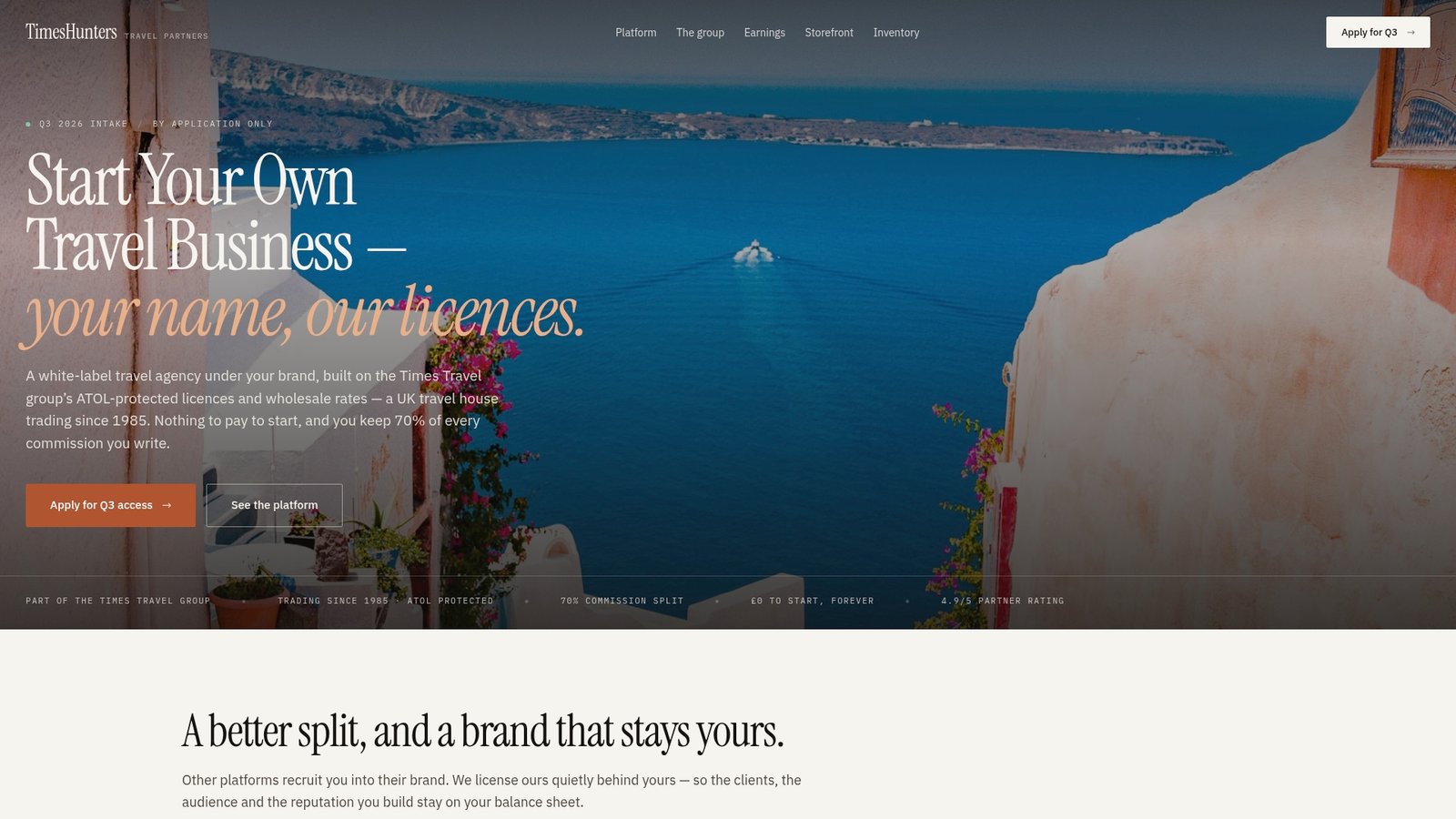
That is why we built our model around ATOL-protected licences, with the licence branding invisible to your clients, so the brand and client relationships stay yours. Our partners keep 70% commission, and we keep a 30% split. Hotels, cruises, tours, villas, safari camps and rail sit on one platform with automated booking management.
If you understand what makes a holiday a package, you already understand what a good adviser sells: one trip, one trusted point of contact, and protection behind it.
Sam
Start selling holidays under your own name
If you have an audience, a client list or hospitality experience, you can sell holidays without building the licensing structure yourself. Our white-label travel agency platform lets you launch a branded booking site on ATOL-protected licences, with access to wholesale hotel, cruise and tour inventory, instant pricing proposals, managed payments and automated client follow-up. There is no cost to start, and partners receive 70% commission on bookings.
See how it works on our white-label travel agency page, read about the route to becoming a UK travel agent, or go straight to agent sign-up.
Practical checks before you book or sell
If you are booking a holiday:
- Look for a single price and a single contract for flights plus accommodation. These are the usual signs of a package.
- Find the ATOL number on your confirmation if flights are included.
- Keep the pre-contract information you were given, including the cancellation terms.
- If you book through an adviser, ask who the organiser is. That is the business responsible for the whole trip.
If you are selling holidays:
- Work out whether what you sell is a package, a linked travel arrangement or a single service, using the tests above.
- Decide who the organiser is. If it is you, you carry the liability and protection duties.
- Make sure customer money is protected. Our checklist on client money protection is a good place to start.
- Hold the right cover. See the core insurance covers for UK travel agents.
- Understand how you earn. Our breakdown of host agency commissions shows pay after fees and clawbacks.
FAQ
What is a package holiday?
It is a trip combining at least two different types of travel service, such as flights and accommodation, for the same holiday. It must be sold in a way the PTRs recognise, for example under one contract, at an inclusive price or advertised as a package. It must also last at least 24 hours or include overnight accommodation.
What is included in a package holiday?
At minimum, two of transport, accommodation, motor vehicle hire and a significant other tourist service such as excursions, ski passes or spa treatments. Everything else, such as meals or transfers, depends on the specific offer. The pre-contract information shows your exact inclusions and price.
What is the difference between a package and a linked travel arrangement?
A package is combined by one trader or meets the listed conditions, and the organiser is liable for the services. A linked travel arrangement involves separate contracts with individual providers, where the trader facilitates separate selection and payment in one visit or a targeted second booking within 24 hours.
Does every package holiday have ATOL protection?
Packages that include a flight sold by UK companies must be ATOL registered, according to the CAA. Packages without flights, such as rail and hotel, do not use ATOL, so the insolvency protection arrangements will differ. Check the confirmation documents for the protection that applies.
Is a one-night trip with a hotel and train a package?
It can be. Anything under 24 hours is outside the regulations unless it includes overnight accommodation, so a train and a hotel night sold together can qualify if it meets the combination and sale conditions.
Sources
- The Package Travel and Linked Travel Arrangements Regulations 2018, Part 1
- Regulation 3 of the 2018 Regulations (as made)
- Package Travel Regulations 2018 guidance (BEIS, July 2022)
- Guidance on the Package Travel and Linked Travel Arrangements Regulations 2018 (amended)
- ABTA: what is a package holiday and what is a linked travel arrangement
- ABTA: adding travel services to a package
- ABTA: business travel and responsibility
- CAA: what are package holidays and what makes them so safe
- DfT impact assessment on ATOL licensing