
How to Sell Tailor-Made Holidays Legally in the UK
What UK law says about selling tailor-made holidays: when they count as packages, when you need ATOL, what to tell customers and how to start compliantly.

You can sell tailor-made holidays in the UK legally, provided you know which legal category each booking falls into and have the right protection behind it. A bespoke trip with a flight and a hotel is usually a package, and that means an ATOL, either your own or one you sell under as a disclosed agent. Trips without a flight still need insolvency protection and the full package information. The route most new sellers take is to sell as an agent under an existing licence rather than apply for their own.
TL;DR
- A tailor-made holiday is a package when it combines two or more qualifying travel services for one trip and meets one of the legal package tests. “Bespoke” is not a legal exemption.
- A flight-inclusive package sold to UK consumers needs an ATOL holder behind it. You can be that holder, or an agent of one named on the paperwork under a written agreement.
- Before the contract you must give prescribed information and the standard information form. After booking you must give confirmation on a durable medium and, for ATOL sales, an ATOL Certificate immediately on payment.
- Packages without flights need insolvency protection through a bond, insurance or a trust account.
- Changes to the package rules take effect on 6 April 2027, so build your process on the amended rules now.
Table of Contents
- What counts as a tailor-made holiday in law
- When you need an ATOL
- What you must tell customers and when
- Responsibilities once the customer has booked
- Trips without a flight: insolvency protection
- Our perspective
- Starting without waiting for your own licence
- Build your travel brand on a compliant base
- FAQ
- Sources
What counts as a tailor-made holiday in law
In everyday language, a tailor-made holiday is one built around the customer: a fortnight in Louisiana then Mexico, a safari with a beach finish, a rail trip with a villa stay. The law does not use that phrase. It asks what you have combined and how you sold it.
ABTA, the travel association, states that tailor-made holidays are packages where two or more qualifying travel services are combined for one trip lasting at least 24 hours or including overnight accommodation. Qualifying services include transport, accommodation, car hire and certain other tourist services.
The Package Travel and Linked Travel Arrangements Regulations 2018 set out when a combination becomes a package. Under Part 1 of the Regulations, package status can arise where:
- one trader combines the services;
- the traveller selects them before agreeing to pay;
- they are sold at an inclusive or total price;
- they are advertised as a package or something similar; or
- the traveller is later given a right to choose between different travel services.
So the fact that a customer chose each element does not take the trip out of the rules. If you assemble a flight, a hotel and transfers and quote one price, you are almost certainly selling a package. For a wider view of how bespoke arrangements are assessed, it helps to read about what customised tour packages are from the supplier side.
Package, linked travel arrangement or separate bookings
Three outcomes are possible, and each carries different duties.
| Outcome | What it looks like | Main consequence |
|---|---|---|
| Package | You combine qualifying services under one of the package tests | Full information, organiser liability and insolvency protection |
| Linked travel arrangement | Separate contracts for a trip, linked by you at a customer’s request or through targeted online booking | Lighter duties, including protection for money you take |
| Separate services | Genuinely independent bookings | Each supplier’s own terms apply |
The government’s guidance says the amendments commence on 6 April 2027. After that date, former Type A linked arrangements become packages and Type B arrangements are removed. If your tailor-made model relies on linked arrangements today, plan for more of your trips to be packages. We explain the practical side in our guide to linked travel arrangements and what changes in 2027.
When you need an ATOL
The ATOL (Air Travel Organisers’ Licensing) scheme is the part of the rules that catches most new sellers, because most tailor-made holidays include a flight.
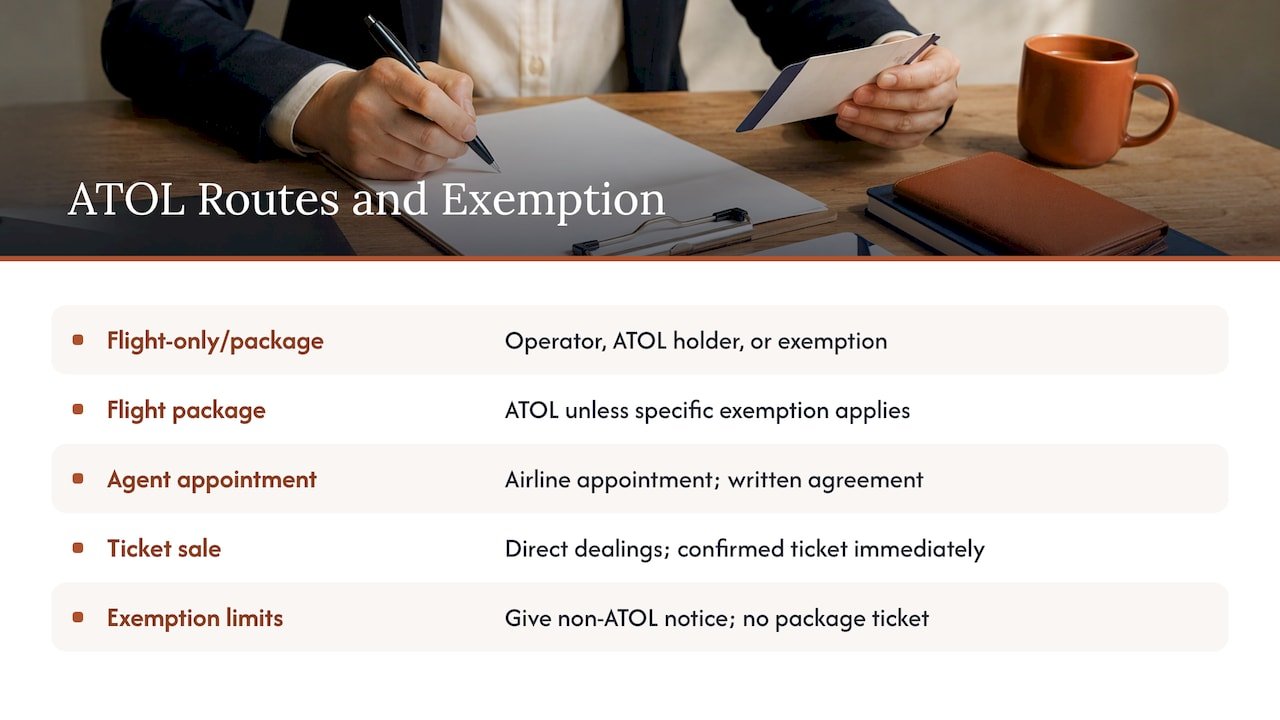
The Civil Aviation Authority says a business selling a flight-inclusive package or a flight-only sale to UK consumers must be the aircraft operator, an ATOL holder, or fall within an exemption. The rules apply to overseas businesses selling to UK consumers, and to packages regardless of where the flight departs from.
If you combine a flight with accommodation or another service, the CAA says you need an ATOL unless a specific exemption applies. The airline ticket-agent exemption for flight-only sales is narrow. It needs appointment by the airline, a written agreement, direct dealings with the consumer, immediate issue of a confirmed ticket, a notice that the flight is not ATOL-protected, and no sale of the ticket as part of a package. A bespoke itinerary that includes a hotel falls outside it.
Your own licence or someone else’s
You have two lawful routes.
- Hold your own ATOL. This brings direct responsibility, an application process, financial requirements and a long lead time. Our page on ATOL licence requirements before launch sets out what that involves.
- Sell as an agent of an ATOL holder. The ATOL Regulations allow this only where you act as an agent for a disclosed, identified ATOL-holder principal, with authority, a compliant written agency agreement, the ability to bind the principal and the ability to issue the ATOL Certificate immediately on payment.
The CAA adds that an ATOL holder selling through agents must have a written agency agreement with each one, and that without the correct agreement both the holder and the agent are in breach. The agreement must include the CAA’s Schedule of Terms, name both parties and be dated.
In practice, “selling under someone’s licence” without that paperwork and without the customer’s documents naming the holder is not legal selling. Check these points before you take a penny:
- The agency agreement is written, dated and names you.
- The ATOL holder is named on what the customer receives.
- You can issue the ATOL Certificate at the moment of payment.
- Any booking fee you charge yourself is shown separately as not protected.
What you must tell customers and when
A tailor-made sale is a conversation, but the legal information is fixed. The government’s guidance says that before the contract you must provide the main characteristics of the package, total price, organiser’s identity and contact details, and cancellation information. That information is binding unless you clearly and prominently communicate changes and the customer expressly agrees before the contract is concluded.
The prescribed standard information form comes in two versions. Under Part 2 of the Regulations, Schedule 2 applies where hyperlinks are possible and Schedule 3 where they are not or where the contract is concluded by telephone. Many tailor-made bookings begin on the phone or on WhatsApp, so know which one fits your channel.
After the booking
The guidance requires you to provide the contract or confirmation on a durable medium, in plain language, with assistance and complaints details. For ATOL sales, the ATOL Certificate must be issued immediately when payment is taken, whether in person, by phone or online. Receipts and invoices must show the ATOL holder’s name and number and the prescribed financial-protection statement, and an agent must separately identify any booking fee or other money not protected by the principal’s ATOL.
A simple checklist per booking:
- Classify the trip: package, linked arrangement or separate services.
- Give the pre-contract information and correct standard information form.
- Take payment only once the protection route is in place.
- Issue the ATOL Certificate immediately where the trip includes a flight.
- Send confirmation on a durable medium with assistance and complaints details.
Responsibilities once the customer has booked
If you are the organiser, you are liable for performance of all package services, even when other providers deliver them. If something is not performed as agreed, you must remedy the problem within a reasonable period unless that is impossible or disproportionately costly. Where a significant proportion of services cannot be provided, you must offer suitable alternative arrangements at no extra cost.
Cancellations follow a set pattern under the same Part. Customers can usually cancel before departure subject to a reasonable termination fee, but may cancel without a fee in qualifying unavoidable and extraordinary circumstances. They may transfer the booking on reasonable notice. Full refunds due after a cancellation must be paid within 14 days. ABTA’s guidance makes the same point: a refund is due where unavoidable and extraordinary circumstances significantly affect the package or passenger carriage at the destination or its immediate vicinity, and otherwise reasonable termination fees may apply.
For a tailor-made seller this shapes your supplier choices. Rigid, non-refundable components make it harder to honour refund and alternative-arrangement duties, so ask suppliers about change and cancellation terms before you build the itinerary, not after.
Trips without a flight: insolvency protection
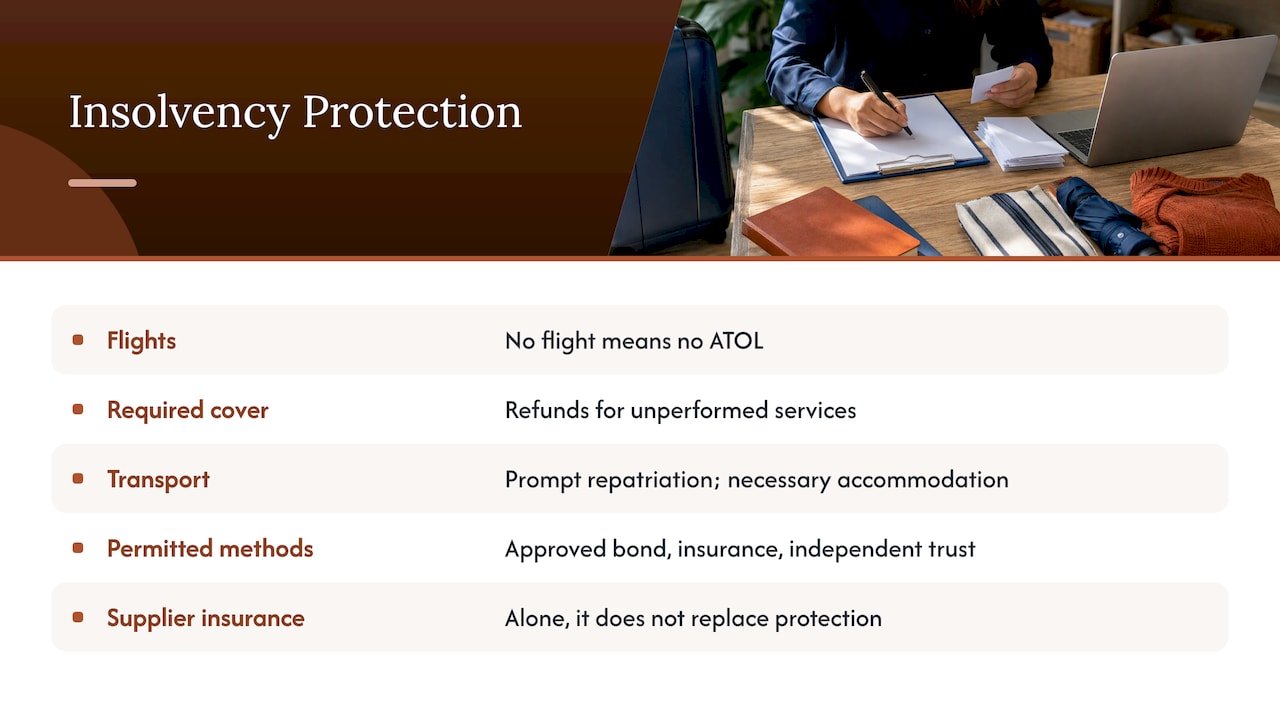
A rail-and-hotel trip or a villa-plus-car-hire break involves no flight, so no ATOL. It can still be a package. For these, the government’s guidance says protection must cover refunds for services not performed and, where transport is included, prompt repatriation and necessary accommodation. Permitted methods are an approved bond, insurance or an independent trust account. Supplier-failure insurance alone does not replace protection against the organiser’s own insolvency.
VisitBritain gives the same summary: protection should cover return of payments for services not performed and repatriation, and can be provided by insurance, a customer-payment trust account or bonding. It also notes that classification as a package or linked arrangement decides which information, contract and financial-protection rules apply.
If you are weighing the methods, read our comparison of trust accounts versus insurance and our guide to tour operator bonding in the UK.
Our perspective
Most people who ask us about selling tailor-made holidays are not trying to dodge the rules. They are stuck between two bad-looking options: wait months for their own licence, or sell as a loose referrer for a few per cent.
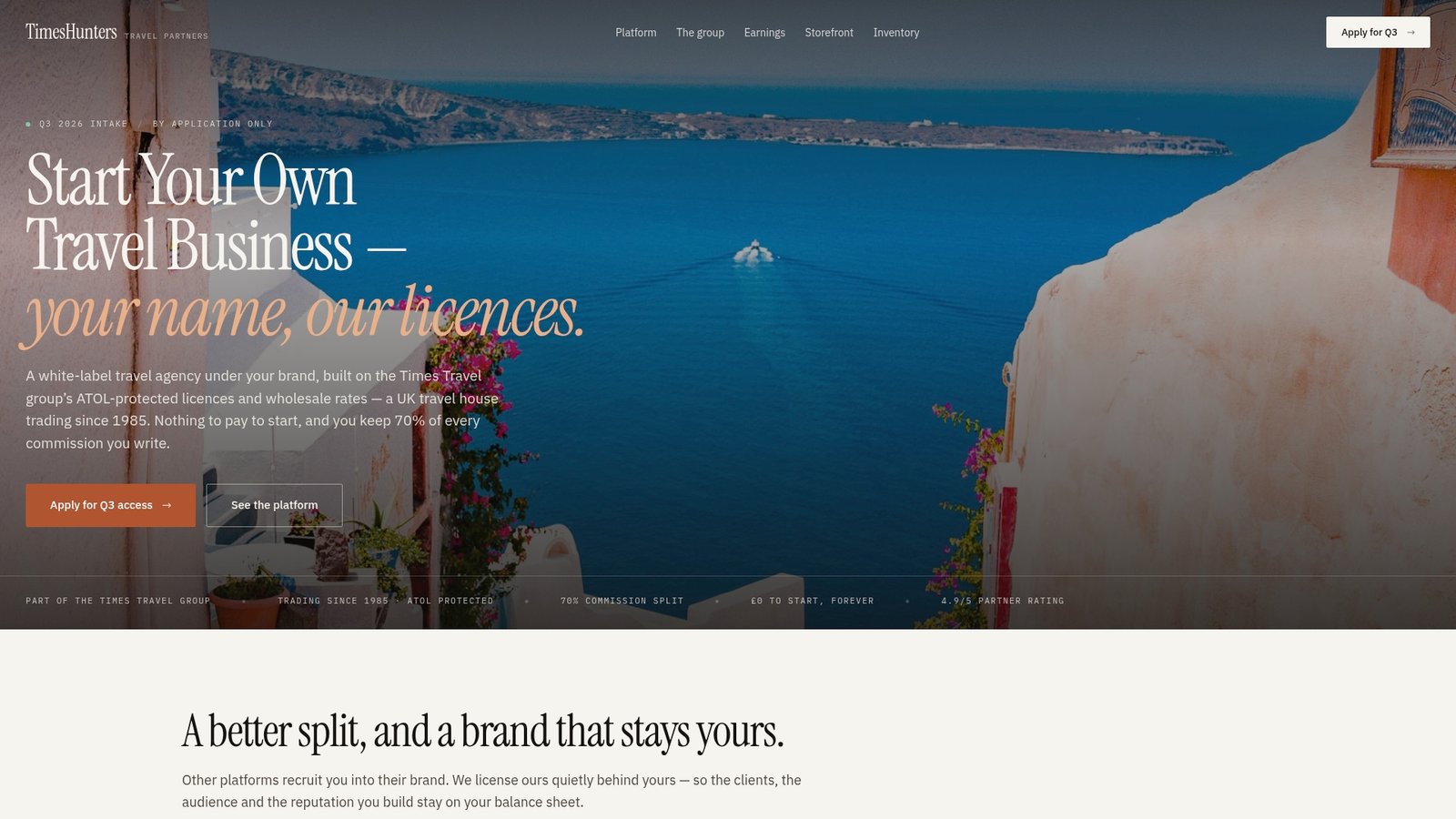
We built TimesHunters for a third path. You sell under your own name, with your own brand and your own clients, while the booking runs through Times Travel group’s ATOL-protected licences. The licence’s branding is invisible to your end clients, and there is no cost to start.
We think the legal question and the money question are linked. If compliance is built into the platform, you spend your time on what a tailor-made seller is actually paid for: knowing destinations, building itineraries and keeping clients. Partners receive 70% commission on bookings, against the 4% typically offered by online travel agencies, and one partner reports moving from £400 to £1,200 per booking.
Compliance is not a reason to stay small. It is the reason a personal travel brand can become a proper business.
Sam
Starting without waiting for your own licence
Our page on the ATOL licence and the 12 week wait explains why many new sellers choose to start under an existing licence. For the wider steps, including accreditation, see how to become an independent travel agent in the UK and our supplier accreditation guide.
A sensible order of work:
- Decide what you will sell. Flight-inclusive trips, land-only trips, or both. This sets your protection route.
- Choose the protection route. Agent under an ATOL holder, your own ATOL, or bond, insurance or trust account for non-flight packages.
- Get the paperwork in place. Written agency agreement, terms and conditions, pre-contract information and the standard information form.
- Set up your documents. Confirmation, receipts and the ATOL Certificate flow, with any booking fee shown separately.
- Train. Know the rules well enough to explain them to a client in plain words. Our UK travel agent training covers launching a white-label agency.
- Prepare for 6 April 2027. Review your linked-arrangement trips and your terms against the amended rules.
Build your travel brand on a compliant base
TimesHunters gives UK travellers-turned-entrepreneurs a white-label travel agency platform: a branded booking site, access to wholesale hotel, cruise and tour inventory, instant pricing proposals, automated booking management, managed payments and financial protection, and automated client follow-up. Villas, safari camps and rail are part of what partners can resell. You keep 70% of the commission and we keep a 30% split.
If you want to see how it would work for your audience, start with our white-label travel agency page.
Creators with an audience can also see how it works for selling travel as an influencer.
FAQ
Is a tailor-made holiday the same as a package holiday?
Often, yes. If you combine two or more qualifying services for one trip and meet one of the package tests, such as a total price or the traveller choosing before agreeing to pay, it is a package. ABTA says tailor-made holidays are packages in these cases. The trip must last at least 24 hours or include overnight accommodation.
Can I sell holidays without my own ATOL?
Yes, as an agent of an ATOL holder. You need a written agency agreement, authority to bind the holder, and the ability to issue the ATOL Certificate immediately on payment. The holder must be disclosed and named to the customer.
Do I need ATOL for a holiday without flights?
No, ATOL covers flight-inclusive packages and flight-only sales. A package without a flight still needs insolvency protection, through an approved bond, insurance or an independent trust account.
What happens if a customer cancels?
They can usually cancel before departure, subject to a reasonable termination fee. There is no fee where unavoidable and extraordinary circumstances apply. Where a refund is due after cancellation, you must pay it in full within 14 days.
Do the rules change in 2027?
Yes. The amendments commence on 6 April 2027. Former Type A linked arrangements become packages, and Type B arrangements are removed. Check the government’s guidance for the current wording before you design your booking process.
Sources
- Guidance on the Package Travel and Linked Travel Arrangements Regulations 2018 (amended 2026)
- The Package Travel and Linked Travel Arrangements Regulations 2018, Part 1
- The Package Travel and Linked Travel Arrangements Regulations 2018, Part 2
- The Package Travel and Linked Travel Arrangements Regulations 2018, Part 4
- ABTA: what is a package holiday and what is a linked travel arrangement
- ABTA: refunds and compensation
- CAA: Do I need an ATOL
- CAA: Selling flight-only
- CAA: Travel trade selling through agents
- Civil Aviation (Air Travel Organisers’ Licensing) Regulations 2012, regulation 12
- VisitBritain: UK Package Travel Regulations guidance
- What Is Customized Tour Packages?