
How to Scale a One-Person Travel Agency in the UK
Scale a one-person travel agency in the UK without more headcount: pick a niche, automate admin, stay protected and keep more of every booking commission.

A one-person travel agency scales by removing the work that only exists because you are alone: licensing, financial protection, supplier contracts, payment handling and admin. The cleanest way to do that in the UK is to trade under an established, ATOL-protected set of licences, keep your own brand and clients, and spend your hours on selling. That is what our white-label platform is built for: you keep 70% of the commission on every booking, and there is no cost to start.
TL;DR
- Your ceiling is time, not demand. Scale by cutting hours per booking and raising the value of each booking, not by working longer.
- Trading under protected licences removes the slowest, riskiest part of growth: the ATOL, the bond and the supplier contracts.
- A narrow niche, a branded site and automated follow-up let one person handle far more enquiries.
- Compare commission as pounds per real booking, not as a headline percentage.
- With us you keep 70% of commission under your own brand, and the licence branding is invisible to your clients.
Table of Contents
- Why one-person agencies stall
- Step 1: Sort out protection before you add volume
- Step 2: Choose a niche you can say in one sentence
- Step 3: Compare commission as pounds per booking
- Step 4: Automate everything that does not need you
- Step 5: Raise the value of each client
- Step 6: Know when to hire or outsource
- How we help you scale
- Our perspective
- FAQ
- Sources
Why one-person agencies stall
Most solo agents do not run out of customers first. They run out of hours. Every booking carries a fixed load of work that does not grow with the sale: finding rates, building a quote, chasing payments, issuing confirmations, sending pre-departure information and following up afterwards. A £400 booking and a £4,000 booking can take nearly the same admin time, so a solo agent who sells small trips hits a wall early.
There is a second wall, and it is legal. In the UK, an agent who sells packages that include flights needs ATOL protection, and one selling non-flight packages needs a bond, insurance policy or trust account. The CTSI’s holiday law guidance for travel agents sets this out, and also notes that the Package Travel Regulations include criminal offences where the required pre- and post-contract information is not given. Growth that outruns your compliance is a liability, not progress.
So scaling a solo agency means solving three things in order: protection, process and positioning. The rest of this guide takes them one at a time.
Step 1: Sort out protection before you add volume
The more you sell, the more customer money sits in your chain, and the more a gap in protection matters. You have three broad routes in the UK: trade under a host’s licences, join a franchise, or hold your own licences. Holding your own means meeting the criteria the CAA sets out for ATOL licensing, including financial requirements, bonding and security, and fitness and competence tests for the people running the business. That takes time and working capital before the first sale. Our page on the ATOL wait and how white label avoids it covers the timeline in more detail.
When you sell as an agent, the arrangement matters as much as the licence. ABTA explains that an agent must have agreements with the principals who appoint them, must tell customers they are acting as an agent and who the customer’s contract is with, and is paid by agreed commission from the principal. ABTA’s Code of Conduct guidance adds that members selling through agents need a written agency agreement covering whether they act as principal, agent or sub-agent, and the arrangements for protecting money paid and for repatriation if there is an insolvency.
That is the point of a white-label model: the protected licences, the principal relationships and the paperwork sit with the group, and you build the brand and the client list on top. Times Travel group’s ATOL-protected licences sit behind every partner on our platform, and payments and financial protection are managed for you. If you want the detail on how the alternatives differ, see our guides to trust accounts versus insurance and to tour operator bonding in the UK.
Keep an eye on the April 2027 changes
The government’s amended guidance on the Package Travel and Linked Travel Arrangements Regulations applies from 6 April 2027. It restates that organisers are liable for the performance of package travel services, even when third parties deliver them, and that insolvency protection must cover refunds and, where applicable, repatriation. Anyone planning to scale should understand what counts as a package in their own sales. Our summary of the package travel changes is a practical place to begin, and our guide to selling tailor-made holidays legally shows how this applies to bespoke itineraries.
One more point on honesty: ABTA’s guidance says advertising, including websites, must contain nothing misleading about financial protection, and that customers often do not understand when they are protected. Say plainly on your site and in your quotes what protection applies to each sale.
Step 2: Choose a niche you can say in one sentence
A generalist who “arranges travel” competes with the whole internet. Creo Proposals makes the contrast clearly: an agent who specialises in African safaris or family trips to Costa Rica becomes memorable and easy to refer. Its advice is to be specific: not “Europe” but something like Italian countryside walking tours or multi-generational family trips.
A useful test comes from marketing consultant Christoph Olivier, who says a niche for a one-person agency should pass three checks:
- A stranger can repeat it back after one sentence.
- The people in it gather somewhere you can reach them.
- The trips are big enough to hit your maths.
The third check is the one solo agents skip. If you have a fixed number of working hours, the average value of a booking sets your income. A niche built around higher-value trips, such as cruises, villas, safaris, rail journeys or multi-stop tours, lets you earn more from the same hours. These are the categories we resell, alongside hotels and tours, so a niche in any of them can run on the same platform. If cruises are your focus, our guide to selling cruises from home walks through the start, and the page on cruise agent commissions shows what to expect per sale.
A narrow niche is what you market, not the only thing you sell. Past clients will still ask you for the odd trip outside it, and you can take those too.
Step 3: Compare commission as pounds per booking
Headline percentages mislead. A higher rate with weaker supplier rates, thinner training or poorer systems can leave you with less money in the end. Kurt Graver of StartGrowImprove makes this point in his UK guide: compare the actual commission you would receive on a real booking, not the number on a recruitment page.
Do the sum yourself with a worked example. Take a trip with a £3,000 booking value and a supplier commission pool. Your pay is your share of that pool, after any fees and any clawbacks if a client cancels. Ask of any arrangement:
- What share of the commission do I keep, and on what base?
- Are there monthly fees or deductions, and what do they cover?
- What happens to my commission if the booking is cancelled or amended?
- Which supplier rates can I actually access?
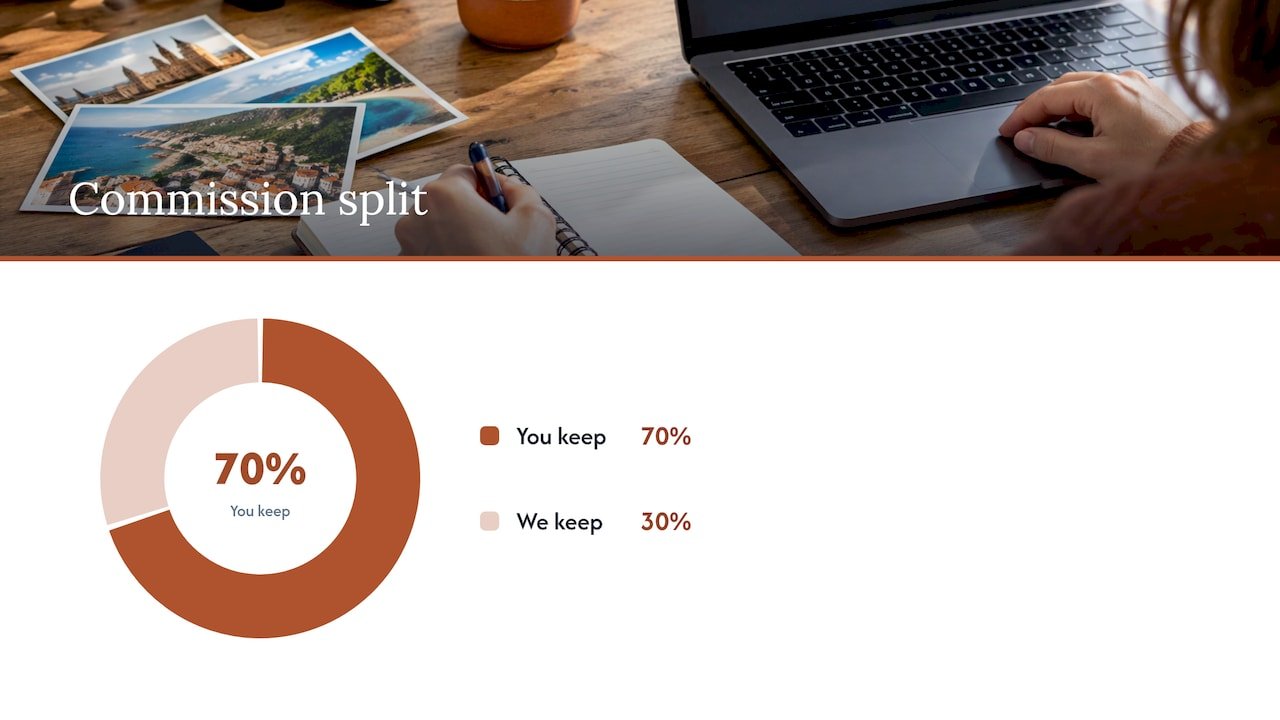
Our model is a straightforward split: you keep 70% and we keep 30%, with access to wholesale hotel, cruise and tour inventory. One of our partners reports moving from £400 to £1,200 per booking. For a deeper walk through the arithmetic, see our guides on host agency commissions after fees and clawbacks and tour operator commissions per booking.
If you sell groups, the same discipline applies to supplier pricing. Going in with numbers prepared is how you win better terms, as this piece on preparing before asking for group discounts explains.
Step 4: Automate everything that does not need you
Technology is where one person starts to look like a team. Alex Locke, UK general manager at 1,000 Mile Travel Group, told Travel Weekly that technology is a necessity for scaling a travel business, pointing to recommendation tools and itinerary apps that raise productivity and strengthen client relationships.
Travel business coach Korrine Johnson offers a practical method in her article on letting go:
- Write down every task in your business.
- Sort them into four piles: only I can do this, I can outsource this now, I could outsource this later, and this can be automated.
- Record yourself doing routine tasks to build a library of standard procedures.
- Automate recurring jobs such as reminder emails, standard follow-ups and post-booking tasks.
For a travel agent, the “only I can do this” pile is short: advising clients, building relationships and shaping the trip. Almost everything else belongs in another pile. On our platform the following is handled for you:
| Task | Handled by |
|---|---|
| Quote building | Instant pricing proposals |
| Client website | Branded booking site under your name |
| Booking admin | Automated booking management |
| Payments and protection | Managed payments and financial protection |
| Staying in touch | Automated client follow-up |
| Skills | Training and support |
That leaves your day for conversations with clients. Our page on booking confirmation automation shows how confirmations can be taken off your plate, and static versus dynamic hotel rates explains what you are quoting from.
Step 5: Raise the value of each client
There are only so many new clients one person can serve well, so scaling often comes from earning more per client, not finding more clients. Three habits do most of the work:
- Add the extras. Transfers, excursions, insurance referrals where permitted and upgrades add value to a booking you have already won. Our upselling guide for UK agents covers how to do this without losing commission.
- Rebook at the point of return. A client who has just travelled is the easiest booking you will get. Ask for the next trip before the first has ended.
- Ask for referrals by name. In a niche, your clients know other people like them. A specific request, such as “who else in your running club would love this trip?”, works better than a general plea.
Your own brand is what makes this repeatable. When clients book with you, not with a faceless site, the relationship and the client list belong to you. On our platform the licence branding is invisible to your end clients, so the name they see and remember is yours.
Step 6: Know when to hire or outsource
Hire when a task is repeatable, written down and not the reason clients choose you. A virtual assistant who sends documents and chases balances costs far less than the time you lose doing it. Before hiring, the automation step above should already have removed what software can do. What is left is usually small enough for a few paid hours a week.
Resist hiring a second salesperson before your niche and your systems are working. Adding people to a vague offer multiplies the vagueness.
How we help you scale
If you want the protection, tools and rates in place from day one, our white-label travel agency lets you launch under your own name using ATOL-protected licences, with wholesale access, automated booking management, a branded booking site and training included. You keep 70% of commission, there is no cost to start, and clients deal with your brand. You can see the programme on our white-label travel agency page or read the UK agent referral programme details.
If you are building on an audience, our page for creators selling travel shows how the model works for influencers, and the travel agent training page outlines how a launch can be done in about four weeks. To get started, go to timeshunters.com.
Our perspective
Most advice to solo agents says “work smarter”. We think the real issue is structural. If you hold your own licences, you carry the bond, the working capital and the supplier contracts before you have sold a thing, and all of that is weight on a business of one.
We built TimesHunters so that weight sits with the group. You keep your brand, your clients and your autonomy, and you earn 70% commission, against the 4% typically offered by online travel agencies. That difference is what pays for the time you would otherwise spend on admin, and it is why partners can afford to spend their hours on the clients who book the bigger trips.
Our advice: pick a niche, choose big-ticket categories, let the systems do the repeatable work, and measure everything in pounds per booking.
Sam
FAQ
Can one person really run a travel agency alone?
Yes, if the repeatable work is automated and the licensing is handled. Trading under established ATOL-protected licences with a booking platform, quotes and follow-up built in leaves you to advise and sell.
What is the quickest way to grow income without more clients?
Raise the average booking value. Focus on higher-value categories such as cruises, villas, tours and safaris, add extras to each booking, and rebook past clients. Calculate your income per hour of work, not per booking.
Do I need my own ATOL to sell holidays in the UK?
If you sell flight-inclusive packages as the organiser, you need ATOL protection, as the CTSI guidance explains. Our partners trade under Times Travel group’s ATOL-protected licences, so they do not apply for their own to start.
How should I tell customers about financial protection?
Be clear and specific. ABTA’s guidance says advertising must not mislead on protection, and customers must be told who they are contracting with and what protection applies. Put this in your quotes and on your site.
Sources
- Holiday law for travel agents (CTSI Business Companion, September 2025)
- ATOL Guidance and Policy notes (UK Civil Aviation Authority)
- How your business trades (ABTA)
- Guidance on the application of the Code of Conduct (ABTA, November 2025)
- Guidance on the Package Travel and Linked Travel Arrangements Regulations (GOV.UK)
- How to Win More Travel Clients (Creo Proposals)
- Travel Agency Marketing Plan for Solo Advisors
- How to Start a UK Travel Agency (StartGrowImprove)
- The rising role of technology in the homeworking sector (Travel Weekly)
- You Can’t Scale What You Can’t Let Go Of (Travel Biz Boss)