
Instant Travel Quotes: How UK Agents Can Offer Them
How to offer instant travel quotes under your own brand in the UK: what clients expect, what ATOL requires, and how to keep the human touch that wins bookings.

If you are searching for instant travel quotes as someone who wants to sell holidays, not just buy one, the short answer is this: you can give clients a priced proposal within minutes, under your own name, without holding your own ATOL. You do it by acting as an agent on a licence holder’s ATOL, with a written agreement in place and the certificate issued the moment a client pays. The quote is the start of the conversation, not a replacement for it.
This guide is for would-be and early-stage agents: freelancers, creators, hoteliers and professionals with an audience who want to turn trust into bookings. It covers what an instant quote actually is, what the rules say, how to build the workflow, and where speed helps or hurts.
TL;DR
- An instant quote is a priced, branded proposal produced in minutes from live supplier inventory. It works best as the opening of a conversation, not a fully automated sale.
- In the UK, flight-inclusive packages must be ATOL protected. As an agent you need a written agency agreement with the licence holder, and the ATOL certificate must be issued on first payment.
- UK clients like speed, but many still book through an agent for human advice and expertise. Combine both.
- With our white-label platform you keep 70% of the commission, trade under your own brand and start at no cost.
Table of Contents
- What an instant travel quote really is
- Why clients now expect speed
- What the rules say before you quote
- Building an instant quote workflow
- Where speed helps, and where it hurts
- Our perspective
- Put it into practice with TimesHunters
- Mistakes to avoid
- FAQ
- Sources
What an instant travel quote really is
For a consumer, an instant quote is a price on screen after typing dates and a destination. For an agent, it is something more useful: a proposal you can send while the client is still excited. It usually has the hotel or cruise cabin, the dates, the total price, what is included and a clear next step.
The difference matters. A price comparison page competes on the lowest number. A proposal from you competes on fit: the right room, the right sailing, the right resort for a family with a toddler. Industry analysis of the UK holiday market points to the same conclusion: travel expertise is the second most cited reason for booking through an agent, and Mintel also reports that many offline bookers choose that route because they prefer human interaction.
So the goal is not to make a robot that sells. It is to remove the dull minutes between a client’s enquiry and your recommendation, so you spend your time on the advice.
Why clients now expect speed
Travellers are used to getting answers quickly. A September 2025 survey reported by eDreams ODIGEO found that the number of UK holidaymakers using AI to streamline travel rose 61% on the previous year. The same release says the biggest frustrations with traditional booking were a lack of personalisation (44% overall) and time wasted filtering irrelevant options (37%).
PwC found something similar earlier: 40% of UK consumers were using AI to research prospective holiday destinations. Your clients arrive having already skimmed options. If your reply takes three days, they will have booked elsewhere or lost the thread.
The opportunity for an independent agent sits in those two frustrations. Speed answers the time problem. Your knowledge of the client answers the personalisation problem. Neither works alone.
What the rules say before you quote
This is the part people skip, and it is the part that protects you. We are not lawyers, and you should read the primary sources and take advice on your own set-up. Here is what the official pages say.
Packages, flights and ATOL
The Package Travel and Linked Travel Arrangements Regulations 2018 require the organiser or retailer to give the traveller specified pre-contract information before a package contract is concluded. If your quote bundles flights with accommodation, you are likely in package territory, and flight-inclusive packages need ATOL protection.
You have two routes: hold your own ATOL, or sell as an agent of someone who does. We explain the first route and its delays in our guide to the ATOL licence for UK sellers, and the requirements in ATOL licence requirements before launch.
The written agency agreement
The CAA states that an ATOL holder selling through agents must have a written agency agreement with each of its agents, and that without the correct agreement both the holder and the agent are in breach of the ATOL. Using someone’s technology or branding is not enough. The paperwork has to exist.
The certificate on first payment
An ATOL Certificate must be issued immediately when the consumer makes the first payment on a covered trip. That is why a quote tool and a payment flow cannot be separate afterthoughts. A quote that converts into a payment must trigger the certificate automatically, whether the client books online, by phone or in person.
Say who you are
ABTA’s guidance on how your business trades describes the difference between a principal, who typically issues its own documentation, sets terms and the price, and an agent. Being clear about your role, and about who the client is contracting with, builds confidence rather than weakening your brand. Keep this in your quote template from day one.
If you are planning a launch, our eight step launch for live travel quotes walks through the compliance order of work, and our note on the package travel regulations changes covers what sellers need to prepare for.
Building an instant quote workflow
Here is a practical sequence that works for a solo agent or a small team.
- Capture the brief in one form. Dates, budget, party size, ages of children, must-haves and deal-breakers. Five minutes of questions saves five rounds of email.
- Pull live availability from wholesale inventory. Hotels, cruises, tours, villas, safari camps and rail should sit in one place, so you are not juggling supplier logins.
- Build the proposal under your brand. Your name, your logo, your tone. The client should see a proposal from you, not a screenshot of a supplier page.
- Show what is protected and who you are. State your agent status and the ATOL position where it applies, as the sources above require.
- Add your recommendation. Two or three options with one line on why each suits this client. This is where you earn your commission.
- Send it fast, then follow up. A proposal is only as good as the nudge two days later.
- Take payment through a managed flow. The certificate and confirmation should issue automatically, so nothing depends on you remembering.
To see what the confirmation side should look like, read our piece on booking confirmation automation.
A worked example
A client messages you on a Sunday evening: a week in the Algarve in May, two adults and two children, mid-range budget. Within minutes you send a proposal with three villas or hotels, each with the total price and board basis, plus a note on which has the shallow pool end. On Monday morning the client replies with a question about transfers. You answer, they pay a deposit, and the certificate and confirmation are issued automatically.
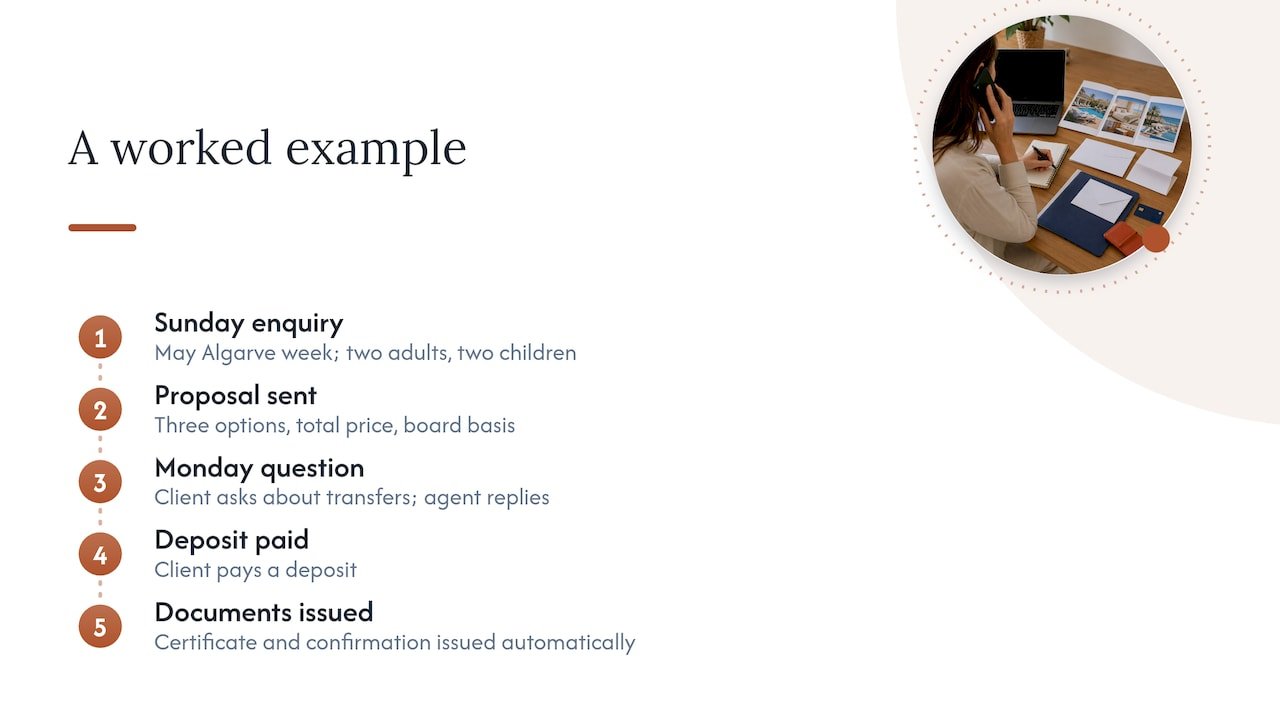
No part of that needed a three-day wait. No part of it removed you from the decision.
Where speed helps, and where it hurts
It helps on straightforward trips: city breaks, beach weeks, standard cruises. Clients want a number, a few options and a quick yes or no.
It hurts on complex or high-value trips: multi-stop tours, safaris, honeymoons, family groups with mixed needs. Here, a fast but generic quote signals that you did not listen. Use the quote to open the conversation, then slow down and curate.
| Trip type | Quote speed | Your role |
|---|---|---|
| Weekend city break | Minutes | Confirm preferences, send two options |
| Family beach week | Same day | Match resort to children’s ages and budget |
| Cruise | Same day | Compare cabins, itineraries and what is included |
| Multi-stop tour or safari | 24 to 48 hours | Build the route, check logistics, explain trade-offs |
| Luxury or special occasion | Starts with a call | Curate, then price |
AI tools can help with the first draft. This overview of AI travel apps for hotel search shows how they cut the time clients spend searching, which is the same time you can save when preparing options. For trips where expert guidance matters most, the example of an independent agency pairing deals with bespoke itineraries shows why a human layer still sells.
Our perspective
We built TimesHunters because we kept seeing the same pattern: talented people with loyal followers or client lists who earned very little from the bookings they generated, because the platforms they sold through paid commission in the low single digits. Those people did the advising, the trust-building and the follow-up, and someone else kept most of the money.
Instant quotes make that worse if you handle them badly. If your quote tool is a generic booking engine with someone else’s name on it, you are training clients to compare you on price and leave. If your quote tool carries your brand, your relationship and your recommendation, the speed becomes an advantage.
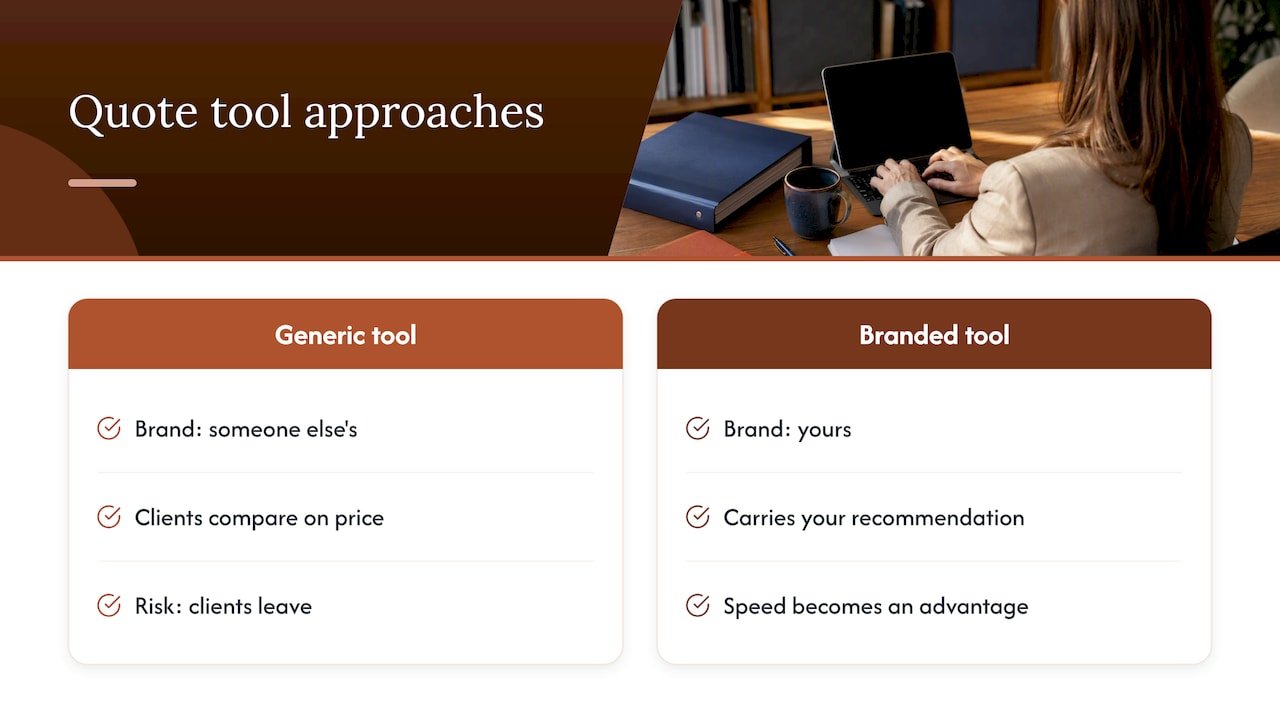
That is why our model gives partners their own branded booking site, instant pricing proposals, managed payments, automated client follow-up and access to wholesale hotel, cruise and tour inventory, all running on ATOL-protected licences. The licence’s branding is invisible to your end clients, and you keep the client relationship. Partners receive 70% commission, and it costs nothing to start.
Our advice is plain. Automate the minutes, never the judgement. Use the platform to quote fast and follow up reliably, and spend the time you save on calls, questions and the small details clients remember.
— Sam
Put it into practice with TimesHunters
If you want to send branded instant quotes without applying for your own licence, our white-label travel agency gives you the platform, the wholesale inventory and the ATOL-protected structure in one place. You keep 70% of the commission and the client relationship stays yours. Creators can see how it works for audiences in our guide on how to monetise a travel audience through a compliant agent, and anyone starting from scratch will find the steps in how to become an independent travel agent in the UK.
There is no published price to start, and the commission split is 70% to you and 30% to us. You can see the full offer on our home page.
Mistakes to avoid
- Treating the quote as the sale. A price without advice is a commodity. Add your recommendation every time.
- Hiding your status. Be clear that you are an agent and who holds the licence, as ABTA guidance encourages.
- Relying on branding for protection. Using a platform’s look does not remove obligations. The written agency agreement does the work.
- Forgetting cover. Check what insurance you need before you trade, starting with our list of core covers for UK travel agents.
- Ignoring client money. Know how deposits are handled and protected, using these five checks for client money protection.
- Quoting too slowly. If the platform can produce a proposal in minutes, a reply that takes days says you are not ready.
FAQ
Can I give instant travel quotes without my own ATOL?
Yes, if you sell as an agent under an ATOL holder’s licence and have the written agency agreement the CAA requires. Quoting itself is not the regulated step. Selling flight-inclusive packages is, so the protection and certificate need to be in place before a client pays.
Does an instant quote have to include an ATOL certificate?
No, the certificate comes with payment, not with the quote. The CAA says it must be issued immediately when the consumer makes the first payment on a covered trip. Your quote can mention the protection so the client knows what to expect.
Will automation replace the travel agent?
Not for the clients worth keeping. UK research shows people still choose agents for human interaction and expertise. Automation handles price retrieval and follow-up, while you handle advice and curation.
Do I need to tell clients I am an agent?
Yes, be clear about who they are contracting with. ABTA’s guidance on how businesses trade stresses clarity about your role. It protects the client and also helps you if a supplier fails.
How much can I earn on bookings I quote?
With our platform, partners receive 70% of the commission on a booking, and we keep 30%. The actual amount depends on the supplier’s commission and the booking value, so we do not promise a figure per booking.
Sources
- Travel trade selling through agents, UK Civil Aviation Authority
- ATOL Certificates, UK Civil Aviation Authority
- How your business trades, ABTA
- The Package Travel and Linked Travel Arrangements Regulations 2018, legislation.gov.uk
- eDreams ODIGEO: Boom in UK Holidaymakers Using AI for Travel, Business Wire
- UK Holiday Planning and Booking Market Report 2024-2029, Mintel
- UK consumers opting for AI to map out their summer breaks, PwC